Engineering the Next Generation of Reliable Electric Work Class ROVs
Key Highlights
- Transition from hydraulic to electric systems reduces environmental risks, leak points, and maintenance needs, especially during long-duration campaigns.
- Momentum ROV features an 800V DC backbone, redundancy, and pressure-tolerant electronics, ensuring high reliability and operational flexibility.
- Advanced visualization and pilot assistance tools enhance situational awareness, improving safety and operational precision underwater.
- Electric propulsion significantly increases efficiency, cutting surface power requirements by over 65%, and reducing carbon footprint.
- Extensive testing and data collection underpin the design, enabling real-time remote monitoring and predictive analytics for improved performance.
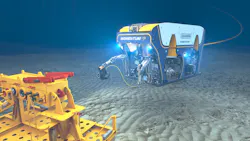

Oceaneering’s electric work class ROV architecture reflects decades of operational experience and reliability driven design.
By Nick Rouge, Subsea Robotics Product Manager, Oceaneering
Work class remotely operated vehicles (ROVs) are foundational to offshore operations across oil and gas, renewable energy, seabed infrastructure, and emerging deepsea industries. As subsea projects push into more demanding environments such as deeper water, higher currents, long duration campaigns, the expectations placed on ROV systems continue to rise. Reliability, endurance, and operational efficiency are no longer differentiators; they are requirements.
Against this backdrop, electrification is increasingly shaping the future of work class ROV design. More than a simple substitution of components, the move from hydraulic to electric architecture is redefining how ROVs are engineered, qualified, and operated offshore.
Why Electrification Is Gaining Momentum
Traditional hydraulic propulsion systems have served the offshore industry well, but they bring inherent tradeoffs. Large volumes of pressurized hydraulic fluid introduce environmental exposure and multiple leak paths, while water ingress into hydraulic systems remains a leading cause of unplanned maintenance during extended campaigns.
Removing hydraulics from propulsion systems can reduce fluid volume and associated exposure, while electric architectures introduce new options for system isolation and fault management.
Electrification also improves energy efficiency by converting power more directly at the vehicle, electric ROVs require less surface power to deliver comparable subsea thrust and tooling capability, reducing vessel fuel consumption and emissions without compromising performance. Alternatively improved efficiency can increase the thrust delivered subsea using existing umbilicals, tethers, and topsides power.
An Established Electric ROV Track Record
Electric work class ROVs are not new to Oceaneering. The company first deployed eMagnum® ROV systems in the early 2000s and later introduced eNovus™ platforms in 2018. These systems have accumulated more than 50,000 combined dive hours, including long duration resident operations exceeding 90 days, providing valuable insight into reliability, maintenance strategies, and continuous duty performance.
Reliability Driven Design as a Foundation
The next phase of development required a unified electric work class architecture built around reliability from the outset. Leveraging fleet scale feedback from offshore crews and engineers worldwide, Oceaneering adopted a reliability based design framework integrating data driven decisions, system level modeling, and qualification strategies early in development.
Achieving extended subsea endurance, up to 30 days with no touch maintenance, was a central objective. Reliability modeling and failure mode analysis guided decisions on redundancy, component isolation, and system monitoring to balance performance with practical operability.
From Lineage to Platform
Building on successive generations of electric ROV experience, Oceaneering consolidated these learnings into a dedicated electric work class architecture designed around long duration reliability, upgradeability, and operational flexibility. This architecture underpins the company’s current Momentum™ Electric Work Class ROV program, reflecting the practical application of data driven design, rigorous qualification, and operational feedback.
Momentum employs an 800 volt DC high power backbone with built in redundancy and the ability to isolate failures while continuing operations or enabling safe recovery. The design incorporates pressure tolerant electronics adapted from Oceaneering’s Freedom™ AUV program, replacing traditional one atmosphere enclosures with compact modules reducing overall system weight.
Advanced Visualization and Pilot Assistance
Electrification enables a fully digital, IP based architecture supporting advanced sensing and visualization. Momentum integrates high definition stereo cameras, a forward facing pan and tilt camera with 30x optical zoom, and 360 degree wraparound coverage to enhance situational awareness. Pilot assistance features include panoramic views, depth perception visualization, and automated object recognition.
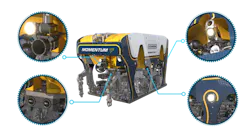
A 360‑degree camera visualization of the Momentum™ Electric ROV.
Qualification Through Testing and Data
Extensive testing underpins electric work class architectures. Since early 2025, our Test Vehicle has accumulated more than 1500 dive hours during qualification campaigns including high load stress testing, manipulator operations, and testing various tools and sensors. The Momentum will be delivered offshore with an edge device that will stream critical data to the cloud for real-time monitoring, predictive analytics, and remote troubleshooting support. These edge devices are being implemented across the existing fleet and the data collected was used to create design and testing requirements for Momentum.
Performance and Operational Efficiency
Electric propulsion improves efficiency while maintaining capability. Momentum delivers forward and lateral thrust exceeding 1,000 kgf and vertical thrust over 1,400 kgf, while nearly halving surface power required for comparable subsea performance. Overall propulsion efficiency increases from ~35% in conventional hydraulic systems to >60% in electric architectures. Between this increase in efficiency and the elimination of HPU idling power the power required to complete a given campaign reduces by more than 65% enabling battery powered resident operations and USV operations while reducing the carbon footprint of traditional ROV operations.
A Platform for Ongoing Development
Momentum is designed to integrate with Oceaneering’s existing Millennium ROV infrastructure, the platform enables transition to electric ROV sing existing tethers, tether management systems, umbilicals, launch and recovery systems, winches, and topsides control rooms. Many of the design and reliability considerations shaping next generation electric work class ROVs will be discussed further during an upcoming technical presentation at the Offshore Technology Conference (OTC) in Houston on May 6, 2026.
