MODU construction survey: Much of the newbuild rig supply may never hit the market
Key Highlights
- A significant pipeline of offshore rigs exists, but many are stranded or awaiting buyers, limiting actual market supply growth in the near term.
- Long-term strategic programs, especially in the Middle East, support the construction of certain rigs regardless of short-term market conditions, contrasting with the predominantly market-driven approach elsewhere.
- Valuation differences between near-complete and stranded rigs are substantial, influencing decisions on reactivation and investment, with upgrades becoming a safer alternative to newbuilds.
- Construction activity has declined sharply since the early 2020s, with most recent orders focused on strategic programs rather than speculative projects, reflecting cautious market sentiment.
- The offshore market's future depends more on upgrades and existing asset utilization than on new construction, with a focus on enhancing capabilities like managed pressure drilling and high-pressure systems.
Sofia Forestieri, Esgian
On paper, the offshore market still has a sizable pipeline of rigs under construction, pointing to potential new supply over the coming years. In reality, the picture is far less straightforward. Some units are effectively complete and waiting for a buyer. Others are backed by long-term strategic programs. A third group has been stranded for years, partially built and marketed as-is, with no clear route to delivery. Those differences determine how much of the pipeline is likely to become real supply — and how the market values each rig.
The headline count overstates how many rigs are likely to enter the fleet. The demand recovery has been pushed back repeatedly. Project delays tied to capital constraints and rising costs have accumulated, and owners have continued to retire less competitive units. The market is generally expected to strengthen into 2027, but the current order book gives no indication that contractors are building — or prepared to build — ahead of that recovery.
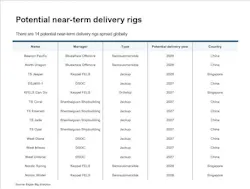
The largest of the three groups consists of 14 rigs: one drillship, nine jackups and four semisubmersibles. These units are mechanically complete or close to it and remain at the yard without a contract. Beacon Pacific and North Dragon, two harsh-environment semisubmersibles at the CIMC Raffles yard in China, fall into this category, along with Keppel’s Can-Do ultra-deepwater drillship in Singapore, whose expected delivery has passed without a buyer. Construction risk is limited compared with the rest of the pipeline, but commissioning, certification, preservation work and, in some cases, upgrades may still be required. Their timeline now depends mainly on securing a contract or finding a buyer willing to take delivery. Until then, they sit somewhere between newbuilds and cold-stacked rigs: modern assets with relatively short potential lead times to market. They represent latent capacity that could be activated comparatively quickly if commercial conditions justify it.
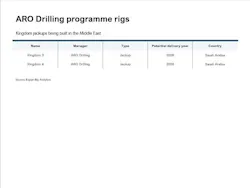
A second group sits in a very different position. Two jackups, Kingdom 3 and Kingdom 4, are being built under a defined national program that gives them greater insulation from short-term market conditions. Both are under construction at International Maritime Industries in Saudi Arabia and form part of ARO Drilling’s wider plan to acquire 20 newbuild jackups for work linked to Saudi Aramco. Kingdom 1 and Kingdom 2, the first two rigs in the series, were delivered in late 2023 and 2024. These units were not ordered as conventional speculative newbuilds. They are the only rigs in the current pipeline whose route to delivery is supported by a long-term program rather than depending primarily on broader market conditions at the time of completion.
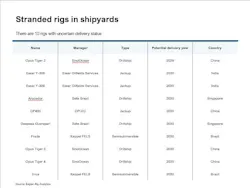
The remaining 10 rigs fall into a third category: five drillships, three jackups and two semisubmersibles. Construction on these assets was halted, often several years ago, and they remain incomplete. Frade and Urca, the Sete Brasil semisubmersibles at Keppel FELS’s BrasFELS yard, and Arpoador and Deepsea Guarapari, the Sete Brasil drillships moved from Brazil to Singapore in 2023, were ordered under firm contracts more than a decade ago. Petrobras later cancelled the contracts, and there has been no sign of a new award. The Opus Tiger 2, 3 and 4, ordered more than a decade ago by the now-defunct Opus Offshore, remain at Shanghai Shipyard. A report published on March 31, 2026, said Tiger 3 and Tiger 4 were being offered for transfer in their existing condition through the Zhejiang Property Exchange, with construction approximately 62% and 53% complete, respectively. In India, the two Essar jackups, Y-308 and Y-309, remain unfinished at the former ABG Shipyard. Essar’s 2026 filing still lists them as assets to be completed but provides no clear completion timetable. None of these 10 rigs should be treated simply as delayed newbuilds. Bringing any one of them to market would require a fresh capital decision covering missing equipment, recertification and, in some cases, structural work. They are stranded investments awaiting a reactivation decision that may never come.
The way shipyards have approached these assets reinforces the divide. In Singapore, completion has largely been concentrated on rigs close to delivery or supported by clearer commercial visibility. Keppel’s Can-Do drillship illustrates the dynamic: completed, but still without a buyer, while several jackups built on speculation or under cancelled contracts have been retained and marketed rather than forced into delivery. By contrast, more recent units, such as the KFELS Super B Class series built for Borr Drilling, have been delivered against firm counterparties, often with ownership novated prior to completion.
In China, the pattern is more closely linked to legacy inventory. Several rigs remain partially built after halted construction, with no defined path to completion. Rather than progressing these assets, yards have increasingly moved to dispose of them in their existing state. The Opus Tiger drillships are a clear example, marketed for sale at roughly the completion levels detailed above, while near-complete rigs such as Beacon Pacific and North Dragon have remained at the yard without contracts despite being close to operational readiness.
In the Middle East, newbuild activity follows a different model, with construction driven by long-term strategic programs and progressing independently of short-term market conditions. Both the yard and the operator behind Kingdom 3 and Kingdom 4 sit inside that structure. International Maritime Industries, the yard building the rigs, is a joint venture between Saudi Aramco, Lamprell, Bahri and Hyundai Heavy Industries, while ARO Drilling, which will operate them, is a 50/50 venture between Saudi Aramco and Valaris. Aramco has described the arrangement as a way to localize its supply chain and build domestic maritime expertise — a rationale that has little to do with near-term rig demand and explains why the program has kept building through a period when almost no one else has.
Behind the regional split sits a question of value. Most rigs in the pipeline lack a clear route to completion, while the two Kingdom jackups are supported by a program intended to carry them through construction. The gap between a rig’s assessed delivered value and its value today depends largely on how much capital and work still stand between the two. For near-complete rigs such as Beacon Pacific or Can-Do, that gap may be limited mainly to commissioning, certification, preservation work and sea trials. For stranded assets such as the Opus Tiger units, it also includes missing equipment — potentially at a higher cost than originally budgeted — replacement of systems that have become outdated during years of inactivity, and uncertainty over how idle equipment has been preserved. Two rigs can carry a similar headline value and still have fundamentally different economics once that gap is priced in. Those economics, together with high upfront payment requirements, help explain why speculative newbuild orders have remained rare even where yard capacity is available.
That gap becomes clear when rigs of the same generation are compared across different commercial positions. Among sixth-generation semisubs, the near-complete Beacon Pacific and North Dragon are valued at $328–$362 million, while the higher-specification Nordic Spring and Nordic Winter are valued at $395–$449 million. The stranded Frade and Urca, also sixth-generation units, are valued at just $47–$55 million. Among jackups in the 350–374 ft class, Kingdom 3 and Kingdom 4, progressing under their construction program, are valued at $93–109 million, compared with $59–69 million for the stranded Essar units. Drillships show an even wider spread, although generation accounts for more of the difference: Keppel’s near-complete, seventh-generation Can-Do is valued at $361–$399 million; the stranded, sixth-generation Arpoador and Deepsea Guarapari at $101–$112 million; and the stranded, fifth-generation Opus Tiger units at $16–$24 million. Even allowing for the generation gap, spreads of this size help determine whether a stranded asset is worth reactivating at all.
Rig orders and delivery activity have fallen sharply since the last construction wave. Deliveries were close to 10 units a year in the early part of the decade but have since tapered sharply, while only a handful of new orders have been placed since 2020.
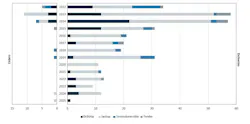
The offshore market comprises three groups of rigs at very different stages of readiness, each on a different route to market. Treating them as a single number overstates how much of the pipeline is likely to reach a rig floor. With contractors showing no sign of building ahead of the expected 2027 recovery, the more important shift is how much capital is going into the existing fleet instead: offline capabilities on jackups, managed pressure drilling and higher-pressure blowout preventer systems on floaters. These upgrades compete with newbuilds for capital but avoid much of the delivery risk. After more than a decade of watching speculative newbuilds turn into stranded assets, spending on rigs that are already working is the safer bet.
About the Author
 Sofia Forestieri
Sofia Forestieri
Sofia Forestieri is Senior Vice President Offshore (Drilling & Wind) at Esgian. In that role, she leads the firm’s offshore rigs and offshore wind departments, managing teams across analysis, sales, and product development. Forestieri has a background as both an energy market analyst and a petroleum engineer, with experience in market analysis, rig valuation, and operational experience in wireline logging in offshore environments. She has over seven years in the energy sector where she has in that time covered a diverse range of areas energy transition topics, economics modeling, rig market analysis and rig valuation, and energy sustainability issues. Forestieri previously held positions as an upstream Latin American analyst with Rystad Energy and senior field engineer-wireline with Schlumberger. She is also a member of Offshore's 2026 Editorial Advisory Board.
She can be reached at [email protected].