Dogger Bank wind farm faces more difficulties with GE Vernova turbines
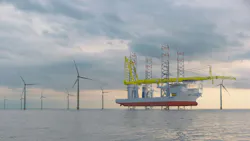
Wind developer SSE has confirmed that a “significant number” of GE Vernova Haliade-X 13 MW turbines at the Dogger Bank A phase of the UK’s flagship 3.6 GW Dogger Bank offshore wind farm require additional remediation work, contributing to delays that have already pushed back key contractual milestones.
renews.biz
In comments to analysts following the company’s half-year results this week, SSE CEO Martin Pibworth said the issues affect “a few dozen” turbines on Dogger Bank A. “Some will need repairs, some need some component exchanges,” he stated, adding that the project partners are working with GE Vernova “to make sure we do those as completely as possible.” He emphasized the expectation of receiving a reliably commissioned asset.
renews.biz
This is not the first set of problems with the turbines at the site. In May and August 2024, Dogger Bank A experienced two blade failures on installed Haliade-X machines. The May incident was attributed to an installation error, while the August failure occurred during commissioning when the turbine was left with its rotor locked and yaw system disabled during high winds. GE Vernova characterized both problems as unrelated to a separate manufacturing deviation that caused a high-profile blade failure at the Vineyard Wind project in the US the same year. Those events, and the subsequent review and remedial program, created cascading construction and commissioning delays.
renews.biz
Earlier reporting indicated that blades and some nacelle components were being replaced on just over ten turbines at the 95-turbine Dogger Bank A array, with more extensive replacements planned for the two machines that suffered blade failures. Industry observers have noted that commissioning challenges are not uncommon with first-of-a-kind installations of large new turbine platforms.
renews.biz
The Low Carbon Contracts Company has granted an eight-month extension to the Contracts for Difference start date for the first 300 MW tranche of Dogger Bank A, moving it from November 30, 2026 to July 31, 2027, after the developers indicated they could not meet the original long-stop date and associated capacity thresholds.
renews.biz
SSE’s latest update shows solid overall progress on the wider Dogger Bank project (SSE 40%, Equinor 40%, Vårgrønn 20%). Roughly 150 turbines have been installed across phases A, B and C, with around 100 commissioned. Dogger Bank A’s 1.2 GW capacity is now expected to be “substantially available” by the end of the first quarter of 2027, with remaining capacity coming online during final commissioning by the end of the third quarter of 2027. Installation at Dogger Bank B is running ahead of the pace achieved on the first phase (52 turbines installed), with most of its capacity expected in the first half of 2027. Foundations and inter-array cabling are largely complete at Dogger Bank C.
offshorewind.biz
An SSE spokesperson has described the issues on the early Dogger Bank A turbines as “teething problems,” with remediation works well underway to bring them up to required quality and reliability standards. The company has also noted that the project has already generated well over 1 TWh in the first half of the year across the phases that are producing.
telegraph.co.uk
Dogger Bank, located roughly 130 km off the north-east coast of England, is intended to be the world’s largest offshore wind farm when complete and is a significant contributor to UK renewable generation targets. The partners continue to stress that the infrastructure under construction will deliver long-term energy security benefits once fully operational.
About the Author
 Bruce Beaubouef
Senior Lead Reporter / Managing Editor
Bruce Beaubouef is Managing Editor for Offshore magazine. In that capacity, he plans and oversees content for the magazine; writes features on technologies and trends for the magazine; writes news updates for the website; creates and moderates topical webinars; and creates videos that focus on offshore oil and gas and renewable energies. Beaubouef has been in the oil and gas trade media for 25 years, starting out as Editor of Hart’s Pipeline Digest in 1998. From there, he went on to serve as Associate Editor for Pipe Line and Gas Industry for Gulf Publishing for four years before rejoining Hart Publications as Editor of PipeLine and Gas Technology in 2003. He joined Offshore magazine as Managing Editor in 2010, at that time owned by PennWell Corp. Beaubouef earned his Ph.D. at the University of Houston in 1997, and his dissertation was published in book form by Texas A&M University Press in September 2007 as The Strategic Petroleum Reserve: U.S. Energy Security and Oil Politics, 1975-2005.
Related
 offshore wind worker
