Floating solar pilots and scale-up efforts spread across Europe
Floating solar activity continues to ramp up across Europe, with new projects moving beyond inland reservoirs to industrial sites and ports.
The latest developments include the launch of a large-scale floating PV plant in Belgium, adaptive mooring trials in Portugal, a marine pilot in Spain and strategic moves to position floating solar for offshore and subsea energy applications.
TotalEnergies, Holcim inaugurate Europe’s largest floating solar project
TotalEnergies and construction group Holcim have inaugurated a new 31-MW floating solar power plant in Obourg, Belgium.
The development, which involved converting a former chalk quarry site to a lake, will generate 30 GWh/year for Holcim’s industrial facilities. To blend in with the surrounding landscape, more than 700 m of horizontal directional drilling took place to connect the solar panels to the electrical substation.
Fred. Olsen 1848 completes pilot installation of tension buoy at EDP floating PV site
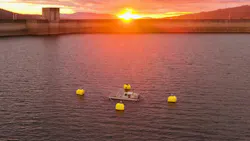
Fred. Olsen 1848 has completed a pilot installation of four automatic tension buoys at the EDP Floating PV (FPV) laboratory on the Alto Rabagão reservoir in Portugal, which is dedicated to testing technologies for floating and hydro solar power generation.
The dam lake site has water levels that can rise and fall by up to 50 m, which suits the tension buoy's adaptive mooring technology as it is designed to ensure stability and performance of FPV systems during large water level variations.
The self-adjusting tensioning system can be tailored to any site, according to Fred. Olsen, enabling operation in reservoirs and dams with practically no limits on water-level range or bathymetry.
Installation was executed over five days under a collaboration with EDP, Sperra and local partners. Sperra’s 3D-printed gravity anchor was deployed alongside the tension buoy system, the aim being to validate new anchoring technologies under extreme year-round conditions.
The tension buoy’s self-adjusting anchoring system is designed to secure floating solar and hybrid installations in all conditions. Solar power can be switched on to supplement hydropower during bright hours or dry periods, while the dams continue supplying baseload where required.
The mooring chain runs over a winch integrated on top of the buoy. As the water level varies, the winch is designed to adjust the length of the chain to maintain mooring line tension. The chain is fed from underneath the buoy, through the center, over the gypsy and down through the center once more (the leftover chain is left to hang freely).
Port of Bilbao to host pilot project for floating solar energy system
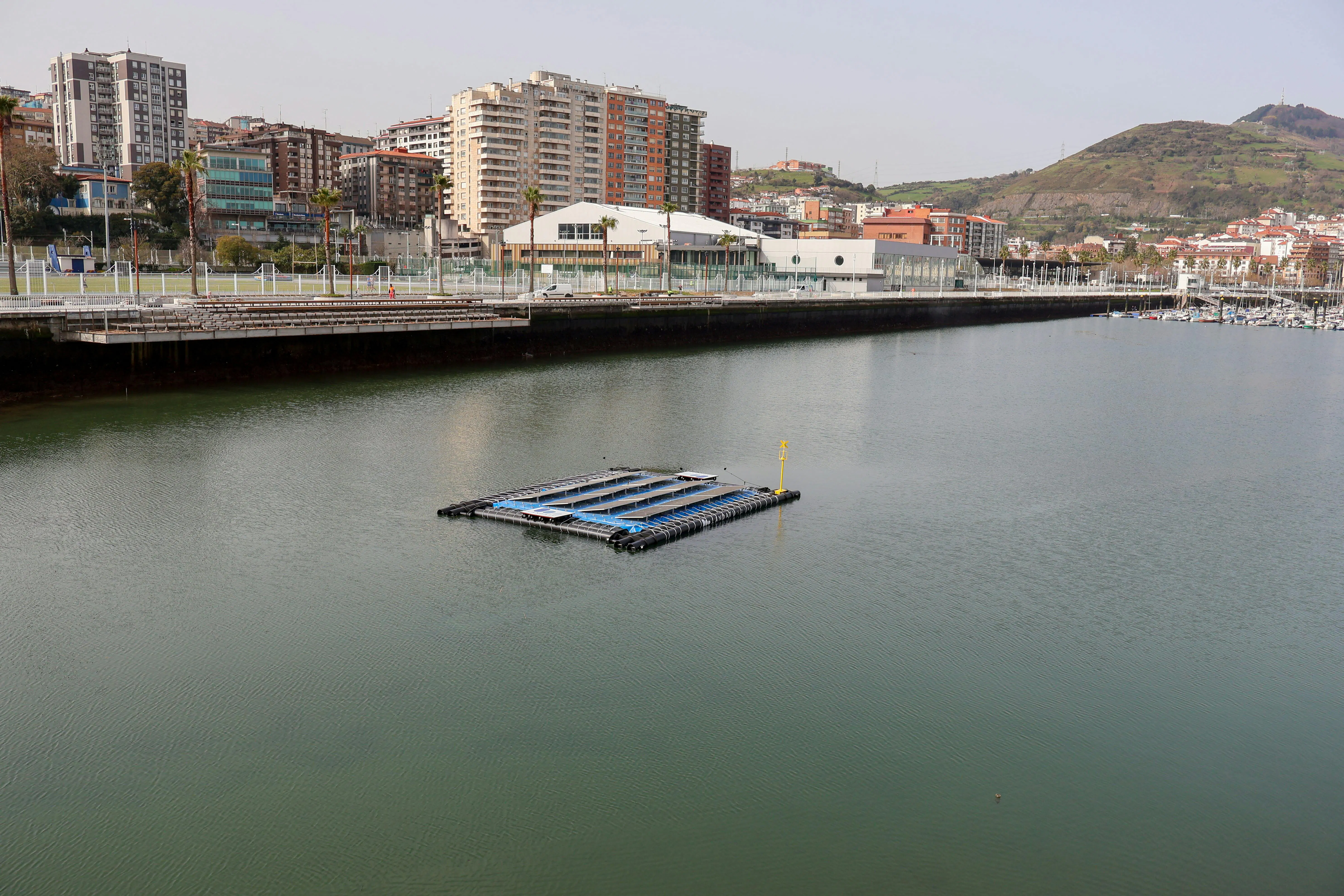
At the Port of Bilbao in northeast Spain, Landatu Solar has installed a modular floating solar energy demonstration system. The main goals are to assess the performance and to incorporate the results for potential future use in offshore environments.
The trial should provide insights into how waves, wind, corrosion and the anchoring system impact the structural performance of the technology, enabling future scale-up phases to be planned.
The 12x12-m pilot, moored in the waters of the Santurtzi dock, comprises a modular stretched membrane and mesh structure with an outer frame said to provide buoyancy and overall rigidity. This helps the system adapt to the dynamic loads of the waves.
It is part of the Seamod project to develop a modular floating solution for PV solar energy in the marine environment, with the proposed solution designed for future scaling up and integration with other marine renewable energy sources, such as offshore wind.
Landatu Solar has developed Seamod wth the support of the Basque government’s Hazitek 2024 program, co-financed by the Basque government's Department of Economic Development, Sustainability and the Environment and the European Union’s European Regional Development Fund.
SolarDuck forms advisory board to advance offshore floating solar for subsea applications
SolarDuck has established a new advisory board to support the development of its offshore floating solar technology for subsea and offshore energy applications.
The board will provide strategic and technical guidance as the company adapts its Offshore Floating Power Hub to supply power and communications for subsea assets, including in offshore CCS projects.
Initial members include former Woodside Energy chief scientist Neil Kavanagh and Norwegian Energy Partners senior adviser Tore Moe, bringing experience across offshore operations, technology development and energy strategy.
About the Author
 Jeremy Beckman
Jeremy Beckman
Staff Writer / Editor, Europe
Jeremy Beckman has been Editor Europe, Offshore since 1992. Prior to joining Offshore he was a freelance journalist for eight years, working for a variety of electronics, computing and scientific journals in the UK. He regularly writes news columns on trends and events both in the NW Europe offshore region and globally. He also writes features on developments and technology in exploration and production.