Vineyard Wind project wraps up construction
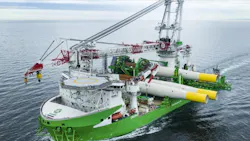
Vineyard Wind 1, the self-proclaimed “first large-scale offshore wind project in the United States,” has completed construction, according to several local online news outlets.
The $4.5-billion project is being developed by a joint venture between Avangrid and Copenhagen Infrastructure Partners. The project is located 15 miles south of Martha’s Vineyard and Nantucket, Massachusetts, is said to be capable of generating 800 megawatts of power.
Now completed, Vineyard Wind (1) consists of:
- 62 × GE Haliade-X turbines, each rated at 13 MW, on fixed-bottom foundations, in water depths ranging from 37–49.5 m (121–162 ft).
- One 800 MW electrical service platform/offshore substation, which steps voltage from 66 kV (collection) to 220 kV (export).
- All 62 turbines and the offshore substation are placed on monopile foundations.
- Some 275 km of inter-array cables which connect the turbines to the offshore substation.
- Two independent 220 kV submarine (HVAC) export cables from the OSS to the onshore landing point at Covell’s Beach, Barnstable.
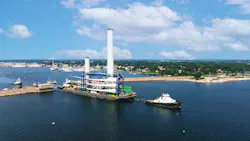
Project challenges
The project has had its challenges. It hit a major construction snag on July 13, 2024, when one of its turbines suffered a blade failure. Fiberglass fragments of a blade broke apart and began washing onto Nantucket beaches in during the peak of tourist season. BOEM halted construction and power generation. Manufacturer GE Vernova agreed to pay $10.5 million in a settlement to compensate island businesses that suffered losses.
In January 2025, the BOEM reauthorized construction to continue, and completed wind turbines were allowed to generate power again.
But last December, Vineyard Wind – along with four other East Coast offshore wind projects – was shut down by the Trump administration, citing national security concerns.
Developers and states sued, and federal judges allowed all five to resume construction, essentially concluding that the government did not show that the national security risk was so imminent that construction must halt.
Another one of the five, Revolution Wind, also recently wrapped up construction, sending power for the first time to New England’s electric grid last week and will scale up in the weeks ahead until it is fully operational.
While Revolution Wind just began delivering power, Vineyard Wind has been doing so for over a year under a phased approach, as more turbines have come online.
Full commercial operations (all turbines commissioned and at maximum output under the power-purchase agreements, or PPAs) are still ramping up—targeted around late 2026, with some commissioning/testing still needed.
Vineyard Wind 2
There had been a planned Vineyard Wind 2 (sometimes called Vineyard Northeast or tied to lease area OCS-A 0501/0522, up to ~1,200 MW). It was intended as a follow-on project by the same Vineyard Offshore team.
But the project is effectively in limbo, or on the major back burner. It needed additional federal approvals and state power-purchase agreements (PPAs). Connecticut declined to join Massachusetts in buying power from it, which killed momentum.
Then, the developer (Vineyard Offshore/Avangrid) withdrew or paused the project amidst the broader 2024–2025 procurement troubles and economic/political uncertainty.
As of the March 2026, Vineyard Wind 2 is often described as “stalled” and requiring several federal and state actions that do not seem to be in the offing.
Earlier US offshore wind farms
The first US offshore wind farm opened off Rhode Island’s Block Island in 2016, at the end of President Barack Obama’s tenure. But with just five turbines, it was not a commercial-scale wind farm.
The nation’s first commercial-scale offshore wind farm officially opened in March 2024, when Orsted and Eversource completed work on a 12-turbine wind farm, called South Fork Wind, 35 miles east of Montauk Point, New York.
But Vineyard Wind’s 62 turbine count far eclipses that of South Fork Wind’s 12 turbines.
About the Author
 Bruce Beaubouef
Bruce Beaubouef
Senior Lead Reporter / Managing Editor
Bruce Beaubouef is Managing Editor for Offshore magazine. In that capacity, he plans and oversees content for the magazine; writes features on technologies and trends for the magazine; writes news updates for the website; creates and moderates topical webinars; and creates videos that focus on offshore oil and gas and renewable energies. Beaubouef has been in the oil and gas trade media for 25 years, starting out as Editor of Hart’s Pipeline Digest in 1998. From there, he went on to serve as Associate Editor for Pipe Line and Gas Industry for Gulf Publishing for four years before rejoining Hart Publications as Editor of PipeLine and Gas Technology in 2003. He joined Offshore magazine as Managing Editor in 2010, at that time owned by PennWell Corp. Beaubouef earned his Ph.D. at the University of Houston in 1997, and his dissertation was published in book form by Texas A&M University Press in September 2007 as The Strategic Petroleum Reserve: U.S. Energy Security and Oil Politics, 1975-2005.