Wave energy finds a route to market through subsea electrification and offshore AI
Key takeaways:
-
Mocean Energy is making the case that wave power may reach commercialization by serving offshore oil and gas infrastructure rather than competing directly with mainstream electricity generation.
-
The company's strategy connects wave energy with two emerging offshore themes: subsea electrification and AI-enabled offshore operations.
-
CEO Cameron McNatt provides concrete operational data, including an 18‑month deployment and continuous operation in harsh sea states, addressing one of the industry's longstanding concerns around survivability.
Wave energy has long struggled to move beyond pilot projects.
Mocean Energy CEO Cameron McNatt argues the sector's mistake was trying to compete immediately with established grid-scale power generation.

"The first generation of wave energy companies aimed straight for grid-scale power, and that was a very hard place to start," McNatt told Offshore. "Taking a first-of-a-kind technology to cost parity with mature utility-scale generation is a tall order for any industry, and waves bring their own engineering challenges. Wave motion oscillates rather than rotates, so it needs a new kind of power takeoff, and working out how best to capture that energy is far less straightforward than spinning a turbine."
Rather than pursuing cost parity with utility-scale renewables, Mocean Energy is targeting niche offshore markets where wave-powered systems can provide electricity for subsea equipment, remote monitoring and future offshore computing infrastructure.
A different route to commercialization
Instead of competing directly with conventional power generation, developers are focusing on offshore applications where wave energy can solve specific operational challenges.
"Developers, Mocean included, are now finding markets where wave energy already makes commercial sense," McNatt added.
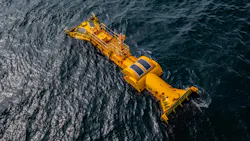
The company's Blue Star technology serves the offshore oil and gas industry as a renewable power station for subsea equipment, delivering power to remote locations at sea.
Mocean has worked with TotalEnergies, Shell and Baker Hughes through the Renewables for Subsea Power project, signed memorandum of understanding with OneSubsea, and it is now preparing for its next demonstration, OceanPULSE (Ocean Power Unlocking Subsea Electrification). In addition, the company is also working on its Blue Cortex ocean-powered offshore AI data center.
"Compute at sea is a huge opportunity, and wave energy is well placed to power it," he added.
Powering subsea infrastructure
Wave-powered systems could support a range of offshore applications, including subsea valves, pumps, tiebacks and carbon capture infrastructure in locations where conventional electrification is costly or impractical.
Growing demand for subsea tiebacks, electrified production systems and offshore carbon capture projects is creating interest in alternative power solutions that can reduce reliance on umbilicals, topside generation and battery replacement campaigns. McNatt believes wave-powered systems could help fill that gap in remote offshore locations.
"Blue Star was built to power electric subsea equipment such as valves, sensors and pumps in remote locations at sea, where getting electricity is difficult and expensive," McNatt explained. "That includes subsea tiebacks for both oil and gas and carbon capture. Depending on the project, it can save operators tens of millions of dollars, and in some cases more than $100 million."
The technology can also support remote monitoring and ocean-observation applications.
Proving survivability at sea
Mocean Energy aims to provide both technical and commercial evidence that wave energy is ready for broader deployment.
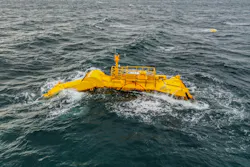
"On the technical side, Blue Star spent 18 months at sea in the Renewables for Subsea Power project, including 13 months of continuous operation," McNatt said. "It produced power from waves, worked alongside solar and battery storage, and delivered power to subsea equipment. It rode out 40-ft seas and kept generating throughout."
The company will now be providing upgraded equipment for its OceanPULSE demonstration project, which is supported by several major operators (including Woodside Energy) and service companies. McNatt said the company hopes OceanPULSE will help unlock broader adoption of subsea electrification technologies.
He also said the company is running a scaled compute-at-sea demonstration with major companies from the data center infrastructure market.
"On the commercial side, the strongest signal is that energy companies keep coming back to help us bring the technology to market," he explained. "Looking further ahead, demand for compute is enormous. Companies that can provide power and sites for AI, including offshore sites, have a huge opportunity to support its growth, and wave energy gives us a way to do exactly that."
The AI opportunity offshore
As for the company's Blue Cortex offshore data center, McNatt said this is designed to bring frontline compute to the assets themselves.
"That compute will support the robotic systems that inspect, monitor and maintain offshore oil and gas infrastructure," he added.
McNatt believes offshore computing could become one of wave energy's most promising emerging markets.
"Compute is one of the most heavily financed sectors in the world, and tying wave energy to AI infrastructure brings it into a market where capital is already flowing," he added.
The path to bankability
Beyond proving technical performance, McNatt said wave energy developers must establish links to markets where investment capital is already being deployed.
He also believes AI infrastructure policy could help accelerate commercialization.
"Governments are racing to build AI capacity," he said. "Including ocean-powered compute in sovereign compute programs, grid-relief incentives and fast-track siting would accelerate wave energy alongside it."
According to McNatt, wave energy will become bankable when developers can demonstrate a proven operating track record at sea, secure independent certification and warranties, and generate revenue through commercial customer contracts.
About the Author
 Ariana Hurtado
Editor-in-Chief
With more than a decade of copy editing, project management and journalism experience, Ariana Hurtado is a seasoned managing editor born and raised in the energy capital of the world—Houston, Texas. She currently serves as editor-in-chief of Offshore, overseeing the editorial team, its content and the brand's growth from a digital perspective.
Utilizing her editorial expertise, she manages digital media for the Offshore team. She also helps create and oversee new special industry reports and revolutionizes existing supplements, while also contributing content to Offshore's magazine, newsletters and website as a copy editor and writer.
Prior to her current role, she served as Offshore's editor and director of special reports from April 2022 to December 2024. Before joining Offshore, she served as senior managing editor of publications with Hart Energy. Prior to her nearly nine years with Hart, she worked on the copy desk as a news editor at the Houston Chronicle.
She graduated magna cum laude with a bachelor's degree in journalism from the University of Houston.
Related
 Blue X on the dockside at Hatston Pier in Orkney following its five-month test program.