bp starts production on its Atlantis Major Facility Expansion project
Why this news matters:
-
The Atlantis expansion demonstrates how operators continue to unlock additional value from producing Gulf of Mexico hubs, extending field life and maximizing returns from existing offshore infrastructure rather than relying solely on new standalone developments.
-
Bringing new production online through established facilities can help accelerate project payback, lower development costs and add barrels more quickly than building entirely new offshore production systems.
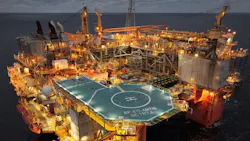
bp says that it has started up its Atlantis Major Facility Expansion project in the US Gulf of Mexico.
The Atlantis field, discovered in 1998 and located about 150 miles south of New Orleans in the Green Canyon area (primarily Block 743 and surrounding blocks), ranks among the larger deepwater oil fields in the region, with estimated ultimate reserves around 600 million barrels.
The Atlantis semisubmersible platform is moored in roughly 7,074 feet of water and has production capacity of up to about 200,000 barrels of oil and 180 million cubic feet of natural gas per day.
First production began in 2007 (with ramp-up into 2008), making it one of bp’s longest-running and flagship Gulf assets after nearly 20 years online. bp operates it with a 56% working interest; Woodside Energy holds the remaining 44%.
The expansion is a classic brownfield project: it leverages existing infrastructure rather than building a new greenfield development. It added two new subsea water injection wells to increase pressure in targeted reservoirs, unlocking additional barrels and extending the field’s producing life.
bp also installed new subsea trees and new water injection pumps on the topsides of the Atlantis platform, while enabling future water-injection capability. Water injection is a well-established enhanced oil recovery technique in mature offshore fields, helping maintain reservoir pressure as natural drive declines.
“Atlantis has been one of the anchors of our Gulf business for nearly two decades, and this expansion proves there is still more value to be generated,” said Andy Krieger, senior vice president for the Gulf of America and Canada. The project was delivered ahead of schedule and under budget.
The project adds approximately 10,000 barrels of oil equivalent per day (boe/d) of gross peak annualized average production, with around 5,000 boe/d net to bp. This fits bp’s broader approach in the Gulf of maximizing output from its five operated hubs (Argos, Atlantis, Mad Dog, Na Kika, and Thunder Horse) through lower-risk, capital-efficient brownfield work—such as subsea tiebacks and facility upgrades—while advancing larger new developments.
Recent examples include the Argos Southwest Extension (online in 2025, adding roughly 20,000 boe/d gross) and the Atlantis Drill Center 1 expansion (first oil in December 2025, adding around 15,000 boe/d gross). These efforts support bp’s aim to grow US Gulf of Mexico production capacity above 400,000 boe/d by 2030.
bp also recently sanctioned two new production platforms, Kaskida and Tiber, which together are expected to add 160,000 barrels per day of new oil production capacity in the US offshore region by the end of 2030.
Across the Gulf of Mexico more generally, operators increasingly pursue brownfield projects on mature assets—using advanced seismic imaging, subsea tiebacks to existing platforms, water or gas injection, and topsides upgrades—to extend field life, improve recovery factors, and generate returns with lower capital intensity than new hubs. Mature fields still account for a large share of regional (and global) conventional production, making these investments a core part of sustaining output while new deepwater projects come online.
About the Author
 Bruce Beaubouef
Bruce Beaubouef
Senior Lead Reporter / Managing Editor
Bruce Beaubouef is Managing Editor for Offshore magazine. In that capacity, he plans and oversees content for the magazine; writes features on technologies and trends for the magazine; writes news updates for the website; creates and moderates topical webinars; and creates videos that focus on offshore oil and gas and renewable energies. Beaubouef has been in the oil and gas trade media for 25 years, starting out as Editor of Hart’s Pipeline Digest in 1998. From there, he went on to serve as Associate Editor for Pipe Line and Gas Industry for Gulf Publishing for four years before rejoining Hart Publications as Editor of PipeLine and Gas Technology in 2003. He joined Offshore magazine as Managing Editor in 2010, at that time owned by PennWell Corp. Beaubouef earned his Ph.D. at the University of Houston in 1997, and his dissertation was published in book form by Texas A&M University Press in September 2007 as The Strategic Petroleum Reserve: U.S. Energy Security and Oil Politics, 1975-2005.