Equinor finds more gas at North Sea Gullfaks complex
Why this news matters:
-
The discovery could help extend the productive life of the Gullfaks area by adding new gas resources near existing infrastructure.
-
Near-field discoveries can often be developed more quickly and cost-effectively than standalone projects, improving project economics.
-
The find reinforces the North Sea’s ongoing potential to deliver additional hydrocarbons from mature producing basins.
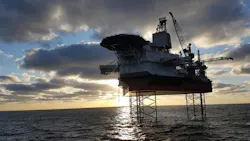
Equinor has made a small but probably commercial gas discovery at the Gullfaks South field in the Norwegian North Sea, 190 km northwest of Bergen.
The jackup Askeladden drilled the 34/10-D-4 BH exploration well during operations on a production well. Equinor estimates recoverable reserves in the range 3.3 to 10.3 MMboe.
The discovery is a modest, infrastructure-led gas find that fits Equinor’s long-running strategy of extracting more value from mature North Sea assets, while the simultaneous Snøhvit Future cost increase highlights ongoing challenges on larger northern projects.
Equinor and partners announced the result in early October 2026. The exploration well 34/10-D-4 BH was drilled as a sidetrack during work on a production well by the Askeladden, a Cat-J-class jackup that has long been associated with Gullfaks satellite work.
The well lies within the existing Gullfaks production license (PL 050 area). Recoverable resources are estimated at 0.5–1.6 million standard cubic meters of oil equivalent, or roughly 3.3–10.3 million barrels of oil equivalent (MMboe). The well was drilled in about 134 m of water to a measured depth of around 5,515 m and was subsequently plugged.
License interests are Equinor Energy 51% (operator), Petoro 30%, and OMV Norge 19%. Gullfaks South is a satellite to the main Gullfaks field; it has been producing since 1998 via subsea templates tied back to the Gullfaks A and C platforms. Gas is processed on Gullfaks C and exported via Statpipe to the Kårstø terminal.
The commercial case rests on low cost and proximity rather than volume. Drilling the exploration sidetrack as part of an ongoing production-well campaign avoids a standalone exploration program, and any development can use existing subsea and platform infrastructure.
Gullfaks EVP Gunnar Egge said: “It is very positive that it is possible to make discoveries of this size with such cost-effective exploration wells. These will be profitable barrels that can help maintain activity and production on the Gullfaks field.”
Similar modest near-infrastructure finds have repeatedly been made in the Tampen area over the years for the same reasons. Relative to Norway’s overall output or Equinor’s equity production, the volumes are small (on the order of a few days of company-wide output at the upper end), but they support the mature-field maximization approach that has kept Norwegian North Sea production relatively resilient.
The main Gullfaks field itself (three large concrete Condeep platforms A, B and C) started production in 1986—making it roughly 40 years old—and was the first fully Norwegian-operated development. It peaked in the mid-1990s and has been sustained by improved recovery, satellite tiebacks (including Rimfaks, Skinfaks and Gullveig), and near-field exploration. Platforms are partly powered by the Hywind Tampen floating wind farm. Production life has been extended into the 2030s–2040s range through such incremental work.
About the Author
 Jeremy Beckman
Jeremy Beckman
Staff Writer / Editor, Europe
Jeremy Beckman has been Editor Europe, Offshore since 1992. Prior to joining Offshore he was a freelance journalist for eight years, working for a variety of electronics, computing and scientific journals in the UK. He regularly writes news columns on trends and events both in the NW Europe offshore region and globally. He also writes features on developments and technology in exploration and production.