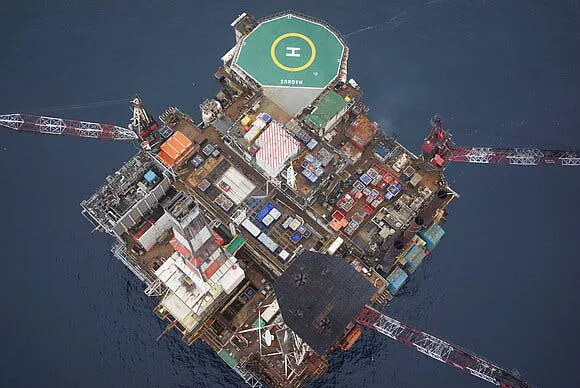
EnQuest advances polymer flooding project at offshore Kraken Field
Why this news matters:
-
Polymer flooding remains relatively uncommon offshore due to facility and injection challenges, making Kraken a potentially significant North Sea EOR application if the project reaches FID.
-
A full-field deployment could recover an additional 30-40 MMbbl of oil, demonstrating how operators are using advanced recovery technologies to extend production from mature basin assets.
Kraken EOR project at a glance
-
Operator: EnQuest (operator)
-
Location: East Shetland Basin, UK northern North Sea
-
Technology: Polymer flooding enhanced oil recovery (EOR)
-
Phase 1 potential: ~5 MMbbl additional recovery
-
Phase 2 potential: 30-40 MMbbl additional recovery
-
Total upside: Up to 45 MMbbl
-
Next milestone: Decision-stage gate later this year, followed by FEED and potential FID
EnQuest is progressing an enhanced oil recovery (EOR) project at the Kraken Field in the East Shetland Basin in the UK northern North Sea, according to the company’s latest results report.
Up to 45 MMbbl of additional recovery targeted
EnQuest envisages a two-phased deployment:
- Phase 1, involving a pilot polymer delivery at a single drill center, should help recover a further 5 MMbbl of oil.
- Phase 2, which represents a full-field development, could deliver an additional 30-40 MMbbl.
Improved polymer design supports offshore deployment
Following initial polymer testing, the partners have since chosen an improved polymer chemistry that can be delivered ready-made and blended into the injection water in-line.
The simplified design reduces topsides complexity and lowers modification and polymer system costs, while ensuring the reservoir chemicals remain compatible with FPSO process equipment.
A specialist laboratory tested the chosen polymer within live Kraken fluids across a full range of production temperatures, EnQuest added, including via the separation process on the FPSO.
Polymer injection-well modeling—completed for one Kraken drill center and calibrated against empirical well data—has confirmed that the wells can accept polymer at the optimal reservoir viscosity.
Project advancing toward FID
The partners are targeting the next decision-stage gate later this year, followed by front-end engineering design (FEED) ahead of a final investment decision (FID).
If approved, the project would represent one of the more significant offshore polymer flooding applications in the UK North Sea, where operators are increasingly pursuing EOR technologies to maximize production from mature assets rather than developing entirely new infrastructure.
Kraken fits broader life-extension strategy
The EOR program forms part of a broader effort to extend Kraken's productive life while reducing operating costs and emissions from field operations.
Other plans for Kraken include accessing the remaining 2P/2C reserves through future infill drilling as well as advancing the Bressay gas import project as a subsea tieback to the Kraken FPSO, via discussions with new joint venture partner Harbour Energy.
This could displace most of the diesel used currently to power Kraken operations, reducing emissions from the FPSO and operating costs.
And the asset team is also assessing the use of hydrogenated vegetable oil as a replacement fuel to diesel, and a flare gas recovery solution for Kraken.
Updates across EnQuest's North Sea portfolio
Elsewhere in its North Sea portfolio, EnQuest is seeking to eliminate the Magnus Field's exposure to the CNR-operated Ninian Central Platform (NCP). Here, unplanned downtime caused mainly by storm damage caused Magnus’ production to be shut-in for six weeks earlier in the year.
The new Ninian Bypass Project pipeline, a co-venture with Neo Next +, should be completed in 2027. Also at Magnus, the semisub Well Safe Defender rig has started P&A activities on subsea wells at Magnus South, following an intervention campaign earlier in the year using the Well Enhancer light well intervention vessel.
As for EnQuest-operated fields in the region that have ceased production completely, engineering and planning is underway for removal of the Thistle platform, starting with the topsides in 2027 and followed by the jacket in 2028.
The Heather topsides, removed in August 2025, are currently undergoing dismantling at the MARS yard in Denmark. Heather’s jacket is currently due to be removed in 2028.
In the Greater Kittiwake Area of the UK central North Sea, a hydraulic workover unit has been installed on the Kittiwake platform, and P&A operations have begun on the first of eight platform wells.
About the Author
Jeremy BeckmanJeremy Beckman
Staff Writer / Editor, Europe
Jeremy Beckman has been Editor Europe, Offshore since 1992. Prior to joining Offshore he was a freelance journalist for eight years, working for a variety of electronics, computing and scientific journals in the UK. He regularly writes news columns on trends and events both in the NW Europe offshore region and globally. He also writes features on developments and technology in exploration and production.
Related