NOD urging greater emphasis on tight reservoir development offshore Norway
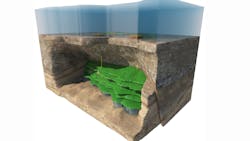
The Norwegian Offshore Directorate (NOD) has called on E&P companies active on the Norwegian Continental Shelf (NCS) to cooperate on implementing new technologies that could support profitable production from tight reservoirs.
About 90 discoveries located in tight reservoirs offshore Norway are still awaiting a development decision, the NOD pointed out.
“To achieve profitable production, we're dependent on existing infrastructure. In other words, this is time-critical," said Arne Jacobsen, assistant director for Technology and Subsurface.
The lack of development progress is largely due to the complex reservoir characteristics and properties and the associated risks. Also, profitability of tight reservoir discoveries tends to be lower than other Norwegian reservoirs that have so far been produced.
Following a request from Norway’s Ministry of Energy, the NOD has detailed the status, challenges and measures that might be taken to develop these resources. It has identified various technologies that could increase production from tight reservoirs:
- Hydraulic fracturing: Fracturing the reservoir rock and keeping the fractures open by filling them with sand, helping the oil and gas to flow more easily into the well, and increasing the production potential;
- Slim-hole drilling: A technique for drilling wells with smaller diameters leading to a slimmer borehole, and the equipment and well structure are both designed to be light and less cost-intensive;
- Coiled tubing drilling: A long, flexible pipe is pushed through the well as one long component without seams, leading to a faster, more flexible and often lower-cost operation; and
- CAJ technology: Controlled acid jetting (CAJ) has been developed to increase productivity in long horizontal wells.
“Several of these technologies are well-tested elsewhere around the world,” Jacobsen said. “They aren't entirely new on the NCS either, but are underused. We need more experience to improve our risk understanding and bring the costs down."
Modeling and studies of the undeveloped Victoria, Warka, Sabina and Linnorm discoveries indicates that alternative technologies could be applied to lift recovery rates.
The APA 2025 license awards earlier this year included numerous accumulations with tight reservoirs, notably Victoria in the Norwegian Sea, where hydraulic fracturing could be a game changer.
To speed up development of tight reservoirs, the NOD is advocating:
- Strengthened cooperation between E&P companies, for instance via as cooperative forum in which the companies share their experiences on the NCS and internationally;
- Systematic follow-up of relevant projects, with sharing of production data and experience from wells where techniques have been applied to improve recovery from tight reservoirs; and
- Support from cooperative associations such as Force, national oil and gas research centers, and Offshore Norge, to facilitate the exchange of experience and building competence.