Barents Sea Snøhvit Future project behind schedule
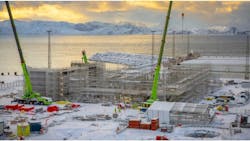
Equinor has pushed back the start-up date for the Snøhvit Future development project in the Barents Sea by a year, due to escalating costs and engineering issues.
The project features two main components:
- The addition of onshore compression at the Hammerfest LNG complex on Melkøya Island in northern Norway to help sustain plateau production when the pressure in the Snøhvit area offshore reservoirs falls
- Electrification of the complex with a view to reducing its annual CO2 emissions by 850,000 metric tons.
Trond Bokn, Equinor's senior vice president for project development, said that at present, Snøhvit Future was around the midway completion point. “It is demanding to execute such a large project in an operating plant.
“In addition, there has been an extensive turnaround at Melkøya this year, and we underestimated the complexity of planning and executing the project under these circumstances. We also had temporary safety shutdowns that have affected progress.”
Onshore compression is now set to begin in 2029, one year behind the originally planned timing.
Each fall, Norway’s offshore operators are obliged to issue a status report on projects proceeding on the basis of a submitted plan for development and operation (PDO). Although Equinor could not deliver cost estimates in time for Snøhvit Future, it did communicate that projected investments would increase.
The current estimated overall price tag now exceeds NOK 20 billion ($1.98 billion), compared with NOK13.12 billion ($1.31 billion) when the company submitted the original PDO in 2022.
Negative factors that have helped slow progress and push costs higher over the past year included harsh weather last winter that limited activity in certain areas of the LNG plant; more complex integration into existing facilities than anticipated; and a prolonged turnaround exercise this summer that caused resumption of work on the project at Melkøya to be pushed back.

High inflation has also exacerbated equipment costs.
Other partners in the project are Petoro, TotalEnergies EP Norge, Vår Energi, and Harbour Energy Norge.
Snøhvit background
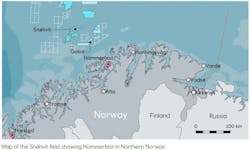
The Snøhvit development comprises three fields – Snøhvit, Albatross and Askeladd. These lie in the Barents Sea, about 140km north-west of Hammerfest in northern Norway. The fields were discovered in 1984 in 250-345 m of water and extend across seven production licences.
Snøhvit is the first major development on the Norwegian continental shelf without a fixed or floating unit. Instead, a subsea production system on the seabed feeds a land-based plant on the north-west coast of Melkøya, at the entrance to the shipping channel into Hammerfest via a 68 cm ID, 160-km gas pipeline. In addition two chemical lines, an umbilical and a separate pipeline for transporting carbon dioxide were laid in 2005.
Both the subsea production system located on the field and pipeline transport are monitored and controlled from a control room at Melkøya, where operators open and close valves on the seabed 140 km away with signals transmitted along fiber-optic cables and high-voltage electrical and hydraulic power lines.
Other Equinor news
Var Energi, in a production update, also highlighted an issue with the offloading hose at the Equinor-operated Johan Castberg development in the Barents Sea. This has periodically impacted production since November, although normal service should by now have been restored.
Better news for Equinor in the Norwegian Sea, where the first exploration well in production license 1121, awarded in 2021, has led to small oil/condensate/gas discovery in the Tyrihans Øst prospect, 250 km southwest of Brønnøysund.
The Norwegian Offshore Directorate estimates recoverable reserves in the range 1-8 MMboe, adding that the licensees will consider a potential production well from the same location, with output connected to the Kristin semisubmersible platform.
Well 6407/1-B-2 H, drilled by the semisubmersible Transocean Encourage, penetrated a 6-m condensate/light oil column in the Garn Formation and a 63-m gas/condensate column in the Ile Formation. The well will now be temporarily P&A’d.
About the Author
 Jeremy Beckman
Jeremy Beckman
Staff Writer / Editor, Europe
Jeremy Beckman has been Editor Europe, Offshore since 1992. Prior to joining Offshore he was a freelance journalist for eight years, working for a variety of electronics, computing and scientific journals in the UK. He regularly writes news columns on trends and events both in the NW Europe offshore region and globally. He also writes features on developments and technology in exploration and production.