Shell exploration well offshore Egypt indicates possible commercial discovery
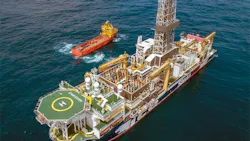
Shell’s Velox-1X exploration well offshore Egypt has encountered promising oil indicators, and raises the prospect of the first crude oil discovery in the underexplored Western Mediterranean region. [See editor's note below on regional nomenclature]
The early results of the well were reported by See.news, the English language site of Sada Elbalad (also styled Sada El-Balad), a major Egyptian media outlet. See.news said it has sourced the information from statements made by Egypt’s Ministry of Petroleum and Mineral Resources, and related official Egyptian sources.
Drilling of the Velox-1X well in the North Cleopatra concession (also referred to as the Herodotus Basin area) began on May 23, 2026, and reached planned geological targets at a total depth of approximately 6,500 meters.
The well was drilled in about 2,800 meters of water — reportedly the deepest water depth for any well drilled in the Mediterranean to date — using the Stena IceMAX drillship. Operations finished about 10 days ahead of schedule and under budget. The site is located roughly 90 kilometers off Egypt’s Mediterranean coast.
Shell operates the well in partnership with the Egyptian Natural Gas Holding Company (EGAS), Chevron, and Egypt’s Tharwa Petroleum. QatarEnergy is reportedly in the process of joining the partnership.
Exploration teams recovered a crude oil sample, and teams are analyzing geological and technical data (including electrical logging results) to assess the findings and decide on next steps, which could include additional appraisal or exploration wells.
Egyptian officials and industry reports describe the results as confirming an active petroleum system and the presence of crude oil. This boosts chances of a commercial oil discovery in the Western Mediterranean, an area that covers roughly 40% of the Mediterranean but has seen only a handful of exploration wells (around four), compared with more than 1,000 in the eastern Mediterranean.
The well is part of Shell’s broader 2026 offshore campaign in Egypt, which has also included encouraging gas indications at other wells such as Sirius-1X earlier in the year, alongside ongoing development of prior gas finds like Mina West.
Egypt has been pushing exploration to reverse gas production declines and support domestic supply, with reforms aimed at improving the investment climate.
No commercial volumes or full appraisal results have been announced yet; evaluation is ongoing. Egypt’s Minister of Petroleum and Mineral Resources, Karim Badawi, visited the site earlier in July 2026. A successful commercial outcome could open a new frontier for both oil and gas in the western basin and further attract upstream investment.
Further updates on technical evaluation will determine the scale and commercial potential.
Editor’s note
The Western Mediterranean is generally considered to be the western basin of the sea (roughly west of the Strait of Sicily/Italian peninsula, covering areas between Spain, France, Italy, Algeria, Tunisia, etc.), while everything from Sicily eastward to the Levant (including all of Egypt’s coast) is the Eastern Mediterranean.
But in Egyptian oil and gas industry usage, “Western Mediterranean” (or “West Mediterranean Sea”) has a more local meaning. It refers to the western portion of Egypt’s own Mediterranean offshore waters — specifically the area west of the Nile Delta cone, in the Herodotus Basin and related domains, extending toward the Libyan border.
This contrasts with the more heavily explored central and eastern Egyptian offshore zones (Nile Delta proper and areas toward Sinai/Levantine Basin). The Herodotus Basin/North Cleopatra area (where Velox-1X was drilled) sits in that northwestern Egyptian sector and has been treated as a frontier “Western Mediterranean” play for years in Egyptian petroleum literature and ministry statements.
About the Author

Bruce Beaubouef
Managing Editor
Bruce Beaubouef is Managing Editor for Offshore magazine. In that capacity, he plans and oversees content for the magazine; writes features on technologies and trends for the magazine; writes news updates for the website; creates and moderates topical webinars; and creates videos that focus on offshore oil and gas and renewable energies. Beaubouef has been in the oil and gas trade media for 25 years, starting out as Editor of Hart’s Pipeline Digest in 1998. From there, he went on to serve as Associate Editor for Pipe Line and Gas Industry for Gulf Publishing for four years before rejoining Hart Publications as Editor of PipeLine and Gas Technology in 2003. He joined Offshore magazine as Managing Editor in 2010, at that time owned by PennWell Corp. Beaubouef earned his Ph.D. at the University of Houston in 1997, and his dissertation was published in book form by Texas A&M University Press in September 2007 as The Strategic Petroleum Reserve: U.S. Energy Security and Oil Politics, 1975-2005.