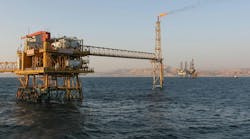
Syria agrees to offshore exploration deal with Chevron, Qatar’s UCC
Syria’s state-owned Syrian Petroleum Company has signed a memorandum of understanding (MoU) with Chevron International and Qatari firm UCC Holding to evaluate oil and gas exploration in Syrian waters, according to the state-owned Syrian news agency SANA.
The exploration would take place in Syria’s territorial waters in the eastern Mediterranean. The deal marks the country’s first attempt to develop its offshore oil and gas reserves after nearly 14 years of civil war.
The signing ceremony took place at the People’s Palace, attended by representatives of both parties, diplomatic figures and media personnel, including the US special envoy to Syria. Officials described the move as historic and the beginning of a new phase in reviving the nation’s energy sector after years of decline caused by conflict and economic sanctions.
The memorandum calls for cooperation in offshore exploration and the development of oil and gas resources in Syrian waters, as well as broader efforts to support investment and energy sector development.
Youssef Qublawi, CEO of the Syrian Petroleum Company, told local reporters that he expects that a specialized technical team will follow up on the process of converting the preliminary MoU into full executive contracts in the near future.
The projected E&P campaign would mark Syria’s first move into offshore oil and gas development. Most of the country’s current production comes from onshore fields in the northeast, including the Omar oil field, which is its largest.
Syria has previously attempted offshore exploration. In 2013, Russian firm Soyuzneftegaz signed a deal to explore in Syrian waters, but the project was abandoned two years later due to the civil war.
UCC Holding, a unit of Qatari-based Power International Holding, has been a major investor in Syria under the administration of President Ahmed al-Sharaa. Besides this potential offshore agreement, the Qatari firm has also been involved in other billion-dollar deals in postwar Syria, including in real estate, electricity and the development of Damascus International Airport.
Syria’s territorial waters in the eastern Mediterranean have been described as a “strategic area” that has witnessed major natural gas discoveries in recent years in countries such as Egypt, Israel, Cyprus and Lebanon.
Analysts say that signing an MoU with global companies such as Chevron reflects an international trend to evaluate Syria’s hydrocarbon potential, especially following the relative stabilization of the security situation along the Syrian coasts. However, experts caution that moving from the exploration phase to actual production will require advanced technical equipment, continuous international cooperation and sophisticated maritime infrastructure that Syria has not previously possessed.
Economic experts say that the viability of Syria’s proposed offshore campaign will depend on several internal and external factors, chiefly the stability of Syria’s political and legal climate; the creation of an investment environment attractive to foreign companies; and the management of risks tied to ongoing international sanctions that continue to restrict the flow of capital.
Analysts also warn that the absence of clearly defined maritime borders with Lebanon and Turkey could pose future disputes affecting project implementation, which may require ongoing diplomatic dialogue to prevent conflicts over exploration rights.
Survey and exploration operations are expected to begin in the coming months, but achieving actual oil and gas production may take several years—possibly between three to five—according to expert estimates, placing the agreement within the framework of a long-term project rather than as a quick solution to energy shortages.