TotalEnergies to invest $1.5 billion in offshore Argentina project
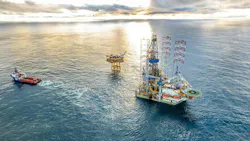
TotalEnergies has outlined a portfolio of oil and gas projects in Argentina of about $10 billion, including up to $1.5 billion for a new offshore gas development off Tierra del Fuego that the company and Argentine President Javier Milei have named Proyecto Alberdi.
The announcement was reported by Reuters, Seeking Alpha, and other online sources.
Chief executive Patrick Pouyanné presented the plans in Paris during Argentina Week, as Milei visited France to court foreign capital. The wider package also covers onshore shale work in Vaca Muerta: an expansion of gas production at Aguada Pichana Este, described in a range of roughly $4 billion to $5 billion; and development of the San Roque oil block, put at about $5 billion and aimed at as much as 60,000 barrels a day.
Pouyanné linked the commitments to clearer rules on dividend repatriation and to Argentina’s Régimen de Incentivo para Grandes Inversiones (RIGI). Country manager Sergio Mengoni has said the San Roque oil project is expected to be submitted under RIGI before July 2027.
The offshore piece is the nearest item in the portfolio. Alberdi is planned inside the Cuenca Marina Austral-1 (CMA-1) concession, where TotalEnergies already operates and holds 37.5%, alongside Harbour Energy (37.5%) and Pan American Energy (25%).
Mengoni said studies are very advanced and that the development contemplates three to five subsea wells using newer technology. Pouyanné has referred to electric subsea wells. The concept described by the company and in local technical coverage is a subsea tieback: wells completed on the seabed and connected to platforms already in the area, rather than a new platform for each accumulation, with electric actuators allowing remote operation.
Exact location, water depth and expected flow rates have not been published, and a final investment decision has not been announced. The project is intended to sit on infrastructure already feeding onshore treatment plants at Río Cullen and Cañadón Alfa, which deliver gas into the national system.
That system is the reason Alberdi matters to TotalEnergies’ Argentine position. The company accounts for about a quarter of national gas production and has operated offshore Tierra del Fuego for decades. Current offshore output is on the order of 20 million cubic meters a day, from fields that include Hidra, Kaus, Carina, Aries, Vega Pléyade and Fénix.
Fénix, the most recent development, started production in September 2024, about two years after a final investment decision of roughly $706 million. It is an unmanned platform about 60 kilometers off the coast in roughly 70 meters of water, tied by a subsea pipeline of about 35 kilometers to Vega Pléyade, and is sized for about 10 million cubic meters a day.
Alberdi would be the follow-on phase, at roughly twice the capital of Fénix, aimed at holding offshore deliveries as older fields decline. In June, Mengoni had already pointed to satellite subsea wells tied back to the six existing platforms as a way to add production without building a full new installation for every accumulation. The October announcement puts a name and a figure on that option.
The rest of the $10 billion remains onshore. Most of the capital is directed at Neuquén, where TotalEnergies wants to raise gas output associated with Aguada Pichana and, in a shift after selling some pilot shale-oil interests to YPF in 2025, reopen an oil growth case at San Roque.
Pouyanné said the company produces about 20 million cubic meters a day offshore and about 15 million onshore, and described conditions off Tierra del Fuego as harsh but the resource base as large enough to justify staying.
Alberdi is not a frontier exploration well. Separate from this portfolio, TotalEnergies still holds exploration interests farther south, including in Malvinas Oeste, where 3D seismic has been acquired. Those blocks were not part of the $1.5 billion figure cited in Paris. What was announced is a development project on a concession the company has produced for years, still short of a final investment decision, and framed as one leg of a larger Argentine commitment built mostly on Vaca Muerta.
About the Author
 Bruce Beaubouef
Bruce Beaubouef
Senior Lead Reporter / Managing Editor
Bruce Beaubouef is Managing Editor for Offshore magazine. In that capacity, he plans and oversees content for the magazine; writes features on technologies and trends for the magazine; writes news updates for the website; creates and moderates topical webinars; and creates videos that focus on offshore oil and gas and renewable energies. Beaubouef has been in the oil and gas trade media for 25 years, starting out as Editor of Hart’s Pipeline Digest in 1998. From there, he went on to serve as Associate Editor for Pipe Line and Gas Industry for Gulf Publishing for four years before rejoining Hart Publications as Editor of PipeLine and Gas Technology in 2003. He joined Offshore magazine as Managing Editor in 2010, at that time owned by PennWell Corp. Beaubouef earned his Ph.D. at the University of Houston in 1997, and his dissertation was published in book form by Texas A&M University Press in September 2007 as The Strategic Petroleum Reserve: U.S. Energy Security and Oil Politics, 1975-2005.