Report: Shell shelves Aphrodite gas project offshore Trinidad and Tobago
Why this news matters:
- A setback for Trinidad and Tobago's gas growth plans: Shell's decision to shelve Aphrodite removes a potential future source of offshore gas supply at a time when Trinidad and Tobago is seeking new developments to offset declining production and support LNG exports.
-
Highlights stricter project economics for offshore gas: The move underscores how operators are increasingly prioritizing capital discipline, advancing only those gas projects that can compete for investment amid cost pressures, market uncertainty and global portfolio optimization efforts.
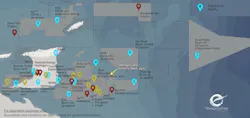
Shell has put its Aphrodite offshore natural gas project in Trinidad and Tobago on hold after failing to reach agreement on commercial terms with the country’s National Gas Company (NGC), according to a recent Reuters report.
The decision follows a positive final investment decision taken in 2025. The Aphrodite field, located in the East Coast Marine Area (Blocks 5a and E), was discovered in 2022.
Shell holds a 100% working interest and planned a subsea tieback to existing infrastructure, with first gas targeted for 2027 and peak production of approximately 18,400 barrels of oil equivalent per day (about 107 million standard cubic feet per day). The gas was intended to support both the domestic market via NGC and Atlantic LNG, where Shell holds a 45% stake.
Negotiations with NGC, Trinidad and Tobago’s gas aggregator, broke down over the sale of the project’s expected output of around 100 million cubic feet per day. As a result, Shell has released the jackup rig previously contracted to drill the production wells.
“Shell is in ongoing negotiations and confirms that the initial rig slot for Aphrodite has been released,” the company said in a statement, as quoted in the Reuters report. “The company will continue to evaluate the overall integrated project schedule.”
NGC Chairman Gerald Ramdeen has indicated that talks with Shell remain ongoing. The pause represents a setback for Trinidad and Tobago’s efforts to reverse years of declining natural gas production that have constrained LNG exports and petrochemical output. Trinidad remains the largest LNG exporter in Latin America.
Development of Aphrodite remains subject to regulatory approvals and successful resolution of commercial discussions.
Maturing fields and declining production
Trinidad and Tobago’s energy sector has faced persistent challenges from maturing fields and declining production. Natural gas output, which peaked near 4.3 billion cubic feet per day around 2010, has fallen to roughly 2.5 billion cubic feet per day in recent years. Oil production has also dropped sharply from historical highs.
These declines have reduced feedstock for the Point Lisas petrochemical complex (leading to curtailments and idle capacity at ammonia and methanol plants) and for Atlantic LNG, Latin America’s largest LNG facility. Atlantic LNG has operated well below capacity for years; Train 1 was mothballed due to gas shortages and later permanently closed, while remaining trains have faced underutilization and maintenance-related outages.
In response, the government and operators have pursued a mix of near-term domestic projects and cross-border opportunities with Venezuela. Positive developments in 2025 included first gas from bpTT’s Cypre project and the BP/EOG Mento joint venture.
A cluster of projects targeting 2027—including BP’s Ginger, the BP/EOG Coconut development, and Shell’s larger Manatee field (with associated cross-border potential on the Venezuelan Loran side)—has raised hopes of a production rebound. Shell has advanced Manatee infrastructure, including pipeline capacity upgrades, while Venezuela has granted licenses for several cross-border schemes viewed as critical for longer-term supply to Atlantic LNG and domestic industry.
Deepwater exploration and other initiatives continue, though commercial, fiscal, and geopolitical factors (including past US sanctions affecting Venezuelan gas) have complicated timelines.
Overall, the sector is in a transitional phase: short-term supply constraints persist, but a pipeline of sanctioned and planned projects offers the strongest upstream outlook in years—provided commercial agreements and project execution hold.
Exclusive content:
 US and Venezuela flags
About the Author
 Bruce Beaubouef
Bruce Beaubouef
Senior Lead Reporter / Managing Editor
Bruce Beaubouef is Managing Editor for Offshore magazine. In that capacity, he plans and oversees content for the magazine; writes features on technologies and trends for the magazine; writes news updates for the website; creates and moderates topical webinars; and creates videos that focus on offshore oil and gas and renewable energies. Beaubouef has been in the oil and gas trade media for 25 years, starting out as Editor of Hart’s Pipeline Digest in 1998. From there, he went on to serve as Associate Editor for Pipe Line and Gas Industry for Gulf Publishing for four years before rejoining Hart Publications as Editor of PipeLine and Gas Technology in 2003. He joined Offshore magazine as Managing Editor in 2010, at that time owned by PennWell Corp. Beaubouef earned his Ph.D. at the University of Houston in 1997, and his dissertation was published in book form by Texas A&M University Press in September 2007 as The Strategic Petroleum Reserve: U.S. Energy Security and Oil Politics, 1975-2005.
Related
