Gran Morgu project advances toward 2028 first oil

Suriname’s milestone Gran Morgu (or GranMorgu) development in Block 58 is progressing steadily, marking the country’s first major offshore oil production project and a potential economic game-changer for the nation.
Operated by TotalEnergies (with APA Corporation as partner and Staatsolie holding up to 20% interest), the ~$10.5–12.2 billion project targets the Sapakara South and Krabdagu discoveries. These hold combined recoverable resources estimated above 700–760 million barrels of oil.
First oil remains on track for 2028, following a roughly four-year execution phase.
Key project highlights
- FPSO: A large spread-moored FPSO unit with nameplate capacity of 220,000 barrels of oil per day and associated gas handling up to 500 MMcf/d. It can store ~2 million barrels of crude. The design draws from proven Guyana Basin concepts, with added sustainability features.
- Scope: ~32 wells (producers and injectors), subsea infrastructure in 100–1,100 m water depths, and ~150 km offshore. The project supports future tiebacks.
- Progress: As of early-to-mid 2026, overall project advancement is reported around 25–50% (with FPSO construction notably advanced). First steel was cut in May 2025 at the BOMESC shipyard in China. Major contracts are underway with SBM Offshore/Technip Energies (FPSO), TechnipFMC, Saipem, and others.
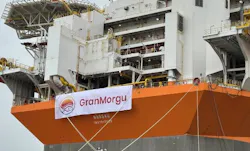
“All-electric” FPSO
The Gran Morgu FPSO is officially designed as an all-electric (or all-electric drive) configuration. This means that major equipment — compressors, pumps, and other process systems — will be electrically powered rather than using traditional direct mechanical drives from gas turbines.
Power comes from onboard gas turbine generators (reportedly five units producing ~150 MW).
The FPSO system will include:
- Zero routine flaring;
- Full reinjection of associated gas into the reservoirs (for pressure support and emissions reduction);
- Waste heat recovery and deep seawater cooling for efficiency; and
- Advanced methane detection/monitoring.
The FPSO design targets low emissions (under 16 kg CO₂ per barrel) and aligns with TotalEnergies’ and SBM Offshore’s carbon-efficiency goals. It is not “fully electric” in the sense of zero-fossil-fuel or shore-powered. But the design represents a modern, electrified topsides approach common in newer low-emission FPSOs.
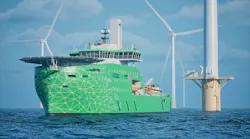 Bibby Marine eCSOV
Path forward
Exploration successes in Block 58 began in 2020, but appraisal challenges, seismic-drilling mismatches, and high gas content delayed FID (announced October 2024). Gran Morgu shifts Suriname from exploration to development in the Guyana-Suriname Basin, a region transformed by neighboring Guyana’s boom.
The project is expected to generate tens of billions in long-term revenue for Suriname through royalties, taxes, and dividends, while creating thousands of jobs and local content opportunities. Drilling is slated to ramp up later in 2026.
This “new dawn” (the meaning of Gran Morgu in the local language) positions Suriname as an emerging offshore player, with potential for further developments across multiple blocks. Construction and fabrication milestones will be closely watched through 2027.
Exclusive content:
 drillship offshore Namibia
About the Author
 Bruce Beaubouef
Bruce Beaubouef
Senior Lead Reporter / Managing Editor
Bruce Beaubouef is Managing Editor for Offshore magazine. In that capacity, he plans and oversees content for the magazine; writes features on technologies and trends for the magazine; writes news updates for the website; creates and moderates topical webinars; and creates videos that focus on offshore oil and gas and renewable energies. Beaubouef has been in the oil and gas trade media for 25 years, starting out as Editor of Hart’s Pipeline Digest in 1998. From there, he went on to serve as Associate Editor for Pipe Line and Gas Industry for Gulf Publishing for four years before rejoining Hart Publications as Editor of PipeLine and Gas Technology in 2003. He joined Offshore magazine as Managing Editor in 2010, at that time owned by PennWell Corp. Beaubouef earned his Ph.D. at the University of Houston in 1997, and his dissertation was published in book form by Texas A&M University Press in September 2007 as The Strategic Petroleum Reserve: U.S. Energy Security and Oil Politics, 1975-2005.