Can Brazil's offshore supply chain support Equatorial Margin growth?
Key highlights:
-
Petrobras plans to drill 15 Equatorial Margin wells between 2026 and 2030.
-
Morpho is located far from Brazil's established offshore service centers in the Southeast.
-
Additional exploration activity could create demand for logistics, vessel support, maintenance and emergency-response services in northern Brazil.

By Marcus A. Volz, Econosur
Petrobras’ discoveries at Morpho have brought renewed attention to offshore services in northern Brazil. Further drilling off Amapá will require vessel support, equipment and logistics far from the country’s main offshore service hubs.
Morpho shifts attention north
On Aug. 14, 2026, Petrobras confirmed hydrocarbons in the Morpho exploration well 1-BRSA-1405-APS, drilled in block FZA-M-59, around 175 km off the coast of Amapá in 2,886 meters of water. On Oct. 2, the company announced another oil-bearing interval in the same well, identified as drilling continued into deeper exploratory formations. Laboratory analyses also confirmed the good quality of the oil identified in August. These findings add to the geological evidence, but do not establish commercial viability.
Petrobras’ 2026-2030 plan allocates US$2.5 billion to the Equatorial Margin and foresees 15 new wells over five years.
On Sept. 3, 2026, Ibama expanded the environmental authorization for Block FZA-M-59 to include three additional wells: Manga, Crotalus and Morpho Extensão, alongside completion of Morpho. A single exploration well can be supported by temporarily mobilizing vessels, equipment and personnel. A campaign lasting several years needs reliable vessel turnaround, access to critical equipment and services that can respond quickly when problems arise.
Existing hubs remain critical
Brazil already has one of the world’s most developed deepwater supply ecosystems. Porto do Açu and the wider Rio-Campos network connect operators with vessel support, subsea services, maintenance and emergency response, backed by companies including Edison Chouest, NOV, TechnipFMC and InterMoor.
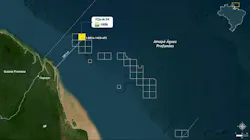
Morpho lies thousands of kilometers from Brazil’s main offshore service concentration in the Southeast. Specialized engineering, subsea manufacturing and high-value equipment can still come from established hubs farther south. Operations that depend on fast response or immediate access to spares are harder to serve from the Southeast.
Marine logistics, fuel, crew changes, warehousing, maintenance, spare parts and emergency response are therefore the clearest candidates for added capacity in northern Brazil.
Northern logistics capacity under scrutiny
Belém, in Pará, already serves as a logistics base for the exploration campaign. Oiapoque provides the air base for crew transfers and has environmental response infrastructure.
Speaking in Belém on Oct. 9, Petrobras CEO Magda Chambriard highlighted the city’s existing support role and its importance for a possible commercial phase. Its established infrastructure gives Belém an advantage over locations that would need new port and service facilities.
Within Amapá, the scope for a large industrial logistics base at Oiapoque is constrained. Calçoene offers proximity to offshore acreage and more room for greenfield development, though substantial infrastructure would have to be added. Santana, near Macapá, has an existing port and service base and has attracted interest from offshore support companies. Site studies are underway, but they have not yet established where additional capacity will be built.
Infrastructure challenges remain
The challenge extends inland. Amapá has no road connection to the rest of Brazil, while sections of BR-156 between Santana and Oiapoque remain unpaved. Heavy cargo, critical spares and time-sensitive equipment need predictable flows because logistics delays can translate directly into offshore downtime.
The potential market could extend beyond Petrobras. Brazil’s fifth Permanent Offer concession cycle resulted in 19 contracted blocks in the Foz do Amazonas Basin, involving groups led by Chevron with CNPC and Petrobras with ExxonMobil. Multiple operators would strengthen the economics of shared marine services and infrastructure if exploration expands.
Brazil already has the deepwater expertise needed for work offshore Amapá. The northern region needs more shore-base capacity, maintenance, warehousing, vessel support and emergency response services as activity grows. Açu concentrates these services at its offshore support base facing the Campos Basin.
Commercial discovery would bring new requirements
A commercial development would require subsea production systems, installation campaigns, FPSO-related packages and long-term maintenance.
Morpho has not reached that stage.
Suppliers assessing the opportunity today should plan around exploration and appraisal requirements; production-related demand will depend on the results of that work.
The next wells will help determine the scale of offshore support needed in northern Brazil. Belém has an established logistics role. Whether Santana or Calçoene attract further investment will depend on the drilling results and operators’ plans.
About the Author
 Marcus A. Volz
 Marcus A. Volz
Marcus A. Volz is a German market analyst and international B2B consultant based in Argentina, and he is also the founder of Econosur, an independent research platform focused on industrial markets in South America. His work examines investment projects, infrastructure, supply chains and supplier opportunities, connecting regional developments with the information needs of international industry. He also contributes articles on South American markets to European industry publications.
Related
