Environmental issues revisit the industry
The petroleum industry has made extraordinary progress in becoming more and more environment-friendly over the years, but the changes are not nearly enough to placate environmental groups. Greenpeace has won another dispute in Europe, and the result will hurt an already depressed sector of the oil business. The group says it won a "historic victory" against the British government, delaying new oil and gas exploration in the North Atlantic. According to the court ruling, the British government had failed to apply the European Commission's Habitat Directive in allocating exploration licenses. This means that the government cannot license new blocks in the Northeast Atlantic as part of the 19th Round scheduled for early next year until it takes into account the habitat directive.
Ten oil companies were party to the case with the government, including Texaco, Esso, Marathon, Mobil, Enterprise, Conoco, Statoil, Phillips, Elf, and British Gas. An oil industry legal representative said he thought the government will likely appeal the ruling. He also said licensing will certainly slow down, but "at the end of the day, it will not make a great deal of difference."
The decision, while it may not be all that detrimental, comes at a terrible time. The UK sector is still feeling the lag of the latest downturn and is in desperate need of new exploration to shake the "mature province" label applied to the region. Regardless, drilling will return.
The industry in the US is experiencing its' own environmental problems. Vice President (and presidential hopeful) Al Gore has pledged to ban new offshore drilling off California and Florida if elected, in what is widely seen as a desperate effort to drum up support for his flagging campaign.
Last year, US President Bill Clinton extended a ban against new oil drilling off areas of California, Washington, Oregon, Florida, Alaska, New England, and the Mid-Atlantic until 2012. But oil companies with existing leases off California and Florida are proposing new drilling programs. Now Gore wants to extend the Clinton ban.
Gore said the halt of drilling is valuable for the community and economy (he is apparently unaware of industry's economic contribution), a position favored by the large and powerful Sierra Club. What is interesting to note is that Gore's pledge came just after his Democratic rival Bill Bradley received the support of a smaller environmental group - Friends of the Earth - which is seen as a major shot to his campaign.
The American Petroleum Institute criticized Gore's policy, saying that there is "no rational reason" to continue the ban, especially considering Gore and Clinton's promotion of natural gas as a cleaner-burning fuel. "It (natural gas) does not rise, like magic, from beneath the ground into our home and factories. A fact which seems to get lost in the political arena is that natural gas is underground - and under the seabed in most cases."
Greenpeace, protesting oil and gas exploration in their oil-burning boats, say they are taking action for the good of the environment. Gore, on the other hand, is pushing environmental issues in his quest for the presidency.
Israeli deepwater could meet energy needs
For the past several years, Israel has been in talks with the Egyptian government over a 20-year contract, beginning in 2002, to buy 2 Bcm of Egyptian gas. Because of political disputes, the Egyptians have yet to sign the deal leaving Israel searching for ways to meet its energy needs. And it seems that some of those needs may be met by reserves lying in deepwater in the eastern Mediterranean.
In the past several months, two gas finds have been notched in the deepwater Israeli sector. In June, an international group including Samedan, Avner Exploration, Delek Drilling, and RB Mediterranean tested 30 MMcf/d of gas from the Noa-1 well in 2,555 ft of water on the PL 273 exploration license. More recently, an Isramco-led group made another gas discovery on the Ned Yavne license in over 2,200 ft water depths.
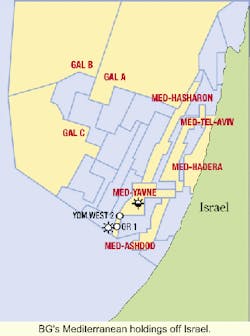
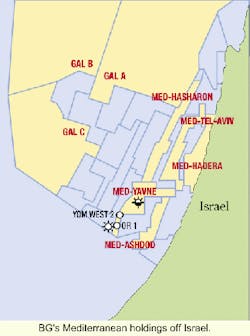
The group, consisting of Isramco as operator with 42%, BG with 50%, and Delek Drilling with 8%, spudded the Or-1 well which tested 21 MMcf/d of gas under restricted conditions.
These two finds may prove to be enough to supply Israeli gas needs at least for the short term, in addition to reducing the apparent need for Egyptian gas. Israeli Oil Commissioner Yehezkeel Drukman was reported as saying that from the initial calculations of the two discoveries, the gas could supply all the consumption needs of Israel Electric Corporation, the nation's largest fuel import consumer, for the next five years.
More importantly, these recent discoveries could induce some heavy international investment, which would eventually lead to a stronger domestic market. At least one big player, BG, has already noted the potential of the region and made a large investment in the market. The company paid Isramco $1.9 million and promised an additional $1.9 million by January 15 for a 50% interest in five offshore exploration licenses. These include the Med Yavne, Med Tel Aviv, Med Hadera, Med Ashdod, and Med Hasharon. In addition, BG will replace Isramco as the operator of Med Yavne no later than the first of the year.
At this rate of investment and discovery, Israel could be well on its way to becoming self-sufficient in energy needs.
Senegal on the move
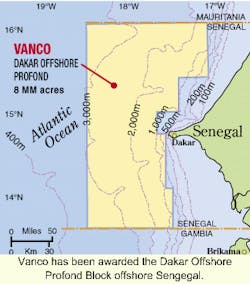
Vanco Energy has been awarded the first deepwater license offshore Senegal. Petrosen and the Ministry of Energy, Mines, and Industry signed the agreement with the US-based firm for the eight million-acre Dakar Offshore Profond deepwater block, the largest offshore concession the nation has awarded. The block lies in water depths ranging from 200 meters to 3,000 meters, and stretches from the Senegal-Mauritania border to the border with Gambia. Vanco holds a 100% interest in the block and will acquire at least 2,000 km of 2D seismic by 2002 and additional 2D and 3D seismic through 2003.
In addition, Senegal also signed on with Australia's Roc Oil for exploration of an 8,187-sq-km concession off the southern coast. The exploration deal is set for three years in which Roc has committed $3.4 million.