TotalEnergies announces Moho G oil discovery offshore Republic of Congo
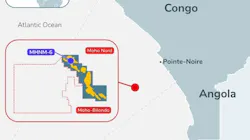
TotalEnergies EP Congo has discovered more oil in the Moho license, offshore the Republic of Congo.
The MHNM-6 NFW exploration well targeted the Moho G structure, and encountered a 160-m hydrocarbon column in good-quality Albian reservoirs.
Operations included data acquisition and sampling campaign to support the subsurface interpretation and a potential future development.
Moho G, along with the earlier and nearby Moho F discovery could hold close to 100 MMbbl. The company and its partners plan a tieback development to the established Moho production facilities, which include the FPUs Alima and Likouf.
TotalEnergies EP Congo operates the Moho license with a 63.5% interest, with Trident Energy holding 21.5% and the Société Nationale des Pétroles du Congo (SNPC) 15%.
Nicola Mavilla, Senior Vice-President Exploration at TotalEnergies, highlighted: “This new discovery on the Moho license benefits from its proximity to existing production infrastructure, allowing a short cycle, cost-effective tie-back development.”
The Moho area is part of the prolific Lower Congo Basin, one of Africa’s most productive deepwater provinces, shared between Angola and the Republic of Congo. Production in the Moho license began in the late 2000s, initially focusing on Miocene reservoirs.
Key infrastructure includes:
- Alima FPU (on stream since 2008, later upgraded)
- Likouf FPU (a modern all-electric unit added as part of the Moho Nord project).
Together, these facilities currently produce around 90,000 barrels of oil equivalent per day. The Moho Nord development (completed in phases around 2015–2017) significantly expanded the hub with subsea tiebacks, a tension-leg platform, and additional wells. The new Moho G (and Moho F) discoveries are in Albian-age reservoirs — older Cretaceous carbonates and mixed siliciclastic-carbonate layers common in the post-salt section of the Congo Basin. These reservoirs often deliver good porosity and permeability when not heavily cemented, supporting strong well deliverability.
This discovery continues TotalEnergies’ strategy of “infrastructure-led exploration” — finding near-field opportunities that can be quickly and economically brought online by leveraging brownfield facilities, which reduces both costs and development timelines compared to standalone greenfield projects.
Strategic importance
For TotalEnergies, this adds to its strong position in the Republic of Congo, where it has been a major operator for decades. The tie-back approach aligns with industry trends toward lower-emission, capital-efficient projects amid the energy transition. For the Republic of Congo, it helps sustain oil production (a key part of the national economy) and extends the life of existing assets.
The Lower Congo Basin remains highly prospective, with both post-salt (Albian and younger) and pre-salt plays. Discoveries like this demonstrate that even mature licenses can yield significant new volumes when modern seismic and drilling techniques are applied.
Lab analysis and further evaluation will refine volumes and reservoir characteristics, but the proximity to infrastructure makes this a particularly attractive addition. First oil from the tieback could potentially come within a few years if appraisal confirms the upside.
About the Author
 Jeremy Beckman
Jeremy Beckman
Staff Writer / Editor, Europe
Jeremy Beckman has been Editor Europe, Offshore since 1992. Prior to joining Offshore he was a freelance journalist for eight years, working for a variety of electronics, computing and scientific journals in the UK. He regularly writes news columns on trends and events both in the NW Europe offshore region and globally. He also writes features on developments and technology in exploration and production.