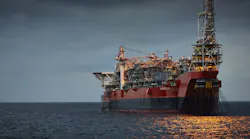
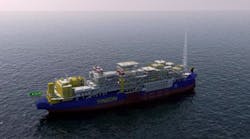
Yinson COO and CFO detail how Agogo FPSO reached first oil four months early
Key highlights:
-
Agogo FPSO achieved first oil about four months ahead of schedule following early engineering and procurement decisions.
-
The vessel incorporates emissions-reduction technologies and a pilot carbon-capture system aimed at lowering operational emissions.
-
A record US$1.458-billion project bond helped finance the development, marking the largest FPSO project bond issued to date.
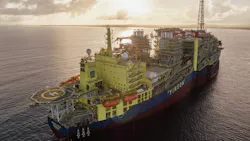
The Agogo FPSO combines emissions-reduction technologies, a pilot carbon-capture system and local workforce development to support efficient offshore operations in Angola.
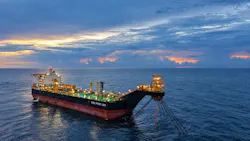
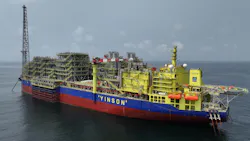
Yinson Production's COO Jahn Atle Høgberg and CFO Markus Wenker recently shared with Offshore how early engineering, procurement and collaboration helped deliver the Agogo FPSO around four months ahead of schedule.
Offshore: Agogo is one of the region's most closely watched developments. What project execution challenges and opportunities have emerged during the construction and delivery phase, and what lessons could benefit future FPSO projects?
Høgberg: One of the clearest lessons from the Agogo FPSO was the value of getting ahead of the work. We started vessel engineering around three months before contract awards and committed more than half of the project capital expenditure within the first month. That meant key designs, orders and contracts were in place early. Several activities could therefore begin in parallel once the vessel entered the yard, without waiting for engineering work to be completed.
We also stayed close to contractors and key suppliers. We worked with EPC-capable module suppliers and involved the operations team early. That helped us manage interfaces and prepare for a smoother transition into operations. We still had to work through supply-chain disruption, adverse weather in China and the closure of the Suez Canal.
For me, the main lesson is that schedule certainty comes from making key decisions early, being clear about accountability, and bringing construction and operations teams together from the start. Agogo achieved first oil on 29 July 2025, around four months ahead of schedule.
Offshore: Operators are increasingly focused on reducing project schedules and improving capital efficiency. How are FPSO contractors adapting their execution strategies to meet those expectations?
Høgberg: We can’t speak on behalf of our competitors, but we are seeing more key decisions move to the front end of a project. Early engineering and timely procurement of long-lead equipment, plus a clear contracting strategy can shorten the critical path and reduce rework later.
Tanker conversions can also give advantages on delivery schedule and capex compared to newbuilds where they are technically suitable.
Equally important, we look at an FPSO as a life-cycle asset, rather than treating engineering, construction and operations as separate phases. Under a lease-and-operate model, the company delivering the FPSO remains accountable for operating it safely and reliably for many years. That naturally puts more focus on practical design, maintainability, energy efficiency and uptime from the beginning.
Improving technology is important but is only part of the answer. The biggest gains still come from disciplined planning, quick decisions and close collaboration between the client, contractor, yard, suppliers and operations team.
Offshore: Decarbonization is becoming a growing consideration for offshore developments. What technologies or design approaches are having the greatest impact on reducing emissions from modern FPSOs?
Høgberg: In the near term, combined-cycle power generation offers the greatest potential for emissions reduction—up to approximately 25%, depending on the heating demand on the FPSO.
On Agogo, we complemented this with several other technologies, including all-electric drive systems with variable frequency drives on all large motors, a closed flare system, hydrocarbon blanketing, a seawater regeneration turbine and automated process controls. Together, the carbon-reducing technologies onboard are expected to reduce emissions by up to 27% compared with operating without them.
Agogo also hosts the first pilot post-combustion carbon capture system on an FPSO. This will give us practical operating experience and help us assess how the technology could be used more widely.
There is no one-size-fits-all configuration, so emissions reduction needs to be considered early and balanced with safety, reliability and life-cycle economics.
Offshore: Local content requirements continue to evolve across West Africa. How are FPSO developers and contractors working with local suppliers, shipyards and workforce development programs to support national objectives?
Høgberg: We see local content as something that should be built over the full life of a project. During execution, this can include locally fabricating suitable work packages that fit within the project schedule, as well as engaging local companies through procurement and service agreements. It can then continue into operations through employment, training and supplier development.
In Angola, we established a local office and developed an offshore trainee program with universities. Twenty-five young Angolans joined the Agogo team across production, marine, maintenance, electrical and instrumentation disciplines, and two have already progressed into junior roles. As with our other FPSOs, Agogo began operations with a majority-national workforce, with Angolans comprising close to 70% of the crew at startup, and that figure has been stable.
With local suppliers, we engage early and set clear expectations around safety, quality and delivery. The aim should go beyond meeting a percentage requirement. It should be to build lasting capability that supports safe and reliable operations, while also creating employment and business opportunities in the host country.
Offshore: Yinson Production recently announced the pricing of a US$1.458-billion project bond for the Agogo FPSO. How do project bonds contribute to advancing large-scale offshore developments, and do you expect similar financing structures to play a larger role in future FPSO projects?
Wenker: Access to financing is vital, particularly as new projects are increasingly capital-intensive. At the same time, evolving banking regulations have impacted the availability of long-term financing, whilst most export credit agencies and some banks have withdrawn from FPSO financing entirely due to ESG considerations.
The changed availability of these two traditional sources of FPSO financing, coupled with shorter maturities, has made the diversification of funding sources crucial to maintaining access to long-term financing.
Project bonds play a key role in this diversification, providing long-term capital that aligns with the long duration of lease-and-operate contracts, effectively eliminating refinancing risk whilst allowing us to optimize capital structures and funding costs, ultimately benefitting our clients through more attractive lease rates. However, project bonds are generally accessible only once an FPSO is operational, meaning banks remain essential during construction.
Therefore, we combine the best of both worlds: banks providing structural flexibility and the willingness to take construction risk, whilst bond markets provide long-duration, cost-efficient capital. This complementary approach is at the core of our capital velocity strategy. By refinancing operational assets through project bonds and prepaying banks, we free up lending capacity for new projects—or in other words, we can borrow the same dollar from our banks again and again and again.
Our USD$ 1.458 billion Agogo FPSO project bond was our third in three years, the largest FPSO project bond ever issued and the first outside Brazil, demonstrating strong investor appetite for this asset class across geographies.
Project bonds have certainly become a key instrument in our financing playbook, and I expect us to continue using them where they offer the best financing solution.
About the Author
 Ariana Hurtado
Editor-in-Chief
With more than a decade of copy editing, project management and journalism experience, Ariana Hurtado is a seasoned managing editor born and raised in the energy capital of the world—Houston, Texas. She currently serves as editor-in-chief of Offshore, overseeing the editorial team, its content and the brand's growth from a digital perspective.
Utilizing her editorial expertise, she manages digital media for the Offshore team. She also helps create and oversee new special industry reports and revolutionizes existing supplements, while also contributing content to Offshore's magazine, newsletters and website as a copy editor and writer.
Prior to her current role, she served as Offshore's editor and director of special reports from April 2022 to December 2024. Before joining Offshore, she served as senior managing editor of publications with Hart Energy. Prior to her nearly nine years with Hart, she worked on the copy desk as a news editor at the Houston Chronicle.
She graduated magna cum laude with a bachelor's degree in journalism from the University of Houston.
Related