Deferred artificial lift can improve capital efficiency
Key Highlights
- Upfront capex pressures are prompting operators to defer artificial lift decisions and maintain flexibility in deepwater projects.
- Installing lift infrastructure early often leads to unnecessary costs and reduced adaptability as reservoir conditions evolve over time.
- Deferred in-riser artificial lift solutions, enabled by advanced coiled tubing technologies, offer cost-effective and flexible alternatives to traditional systems.
- A lifecycle approach to artificial lift enhances project robustness by balancing technical feasibility with economic efficiency.
Kevin Keogh, Paradigm Flow Services Ltd.
Over the past couple of years, one theme has become impossible to ignore in deepwater project discussions: upfront capex is under sustained pressure.
What is striking is that this focus is not confined to investor presentations or high-level corporate strategy. It is heard repeatedly in practical conversations with operating company officials. In one-on-one meetings, and just as often on the floor of conferences and exhibitions such as the Subsea Tieback Forum, the message is consistent: defer capital wherever possible, avoid irreversible decisions too early, and preserve flexibility in the face of reservoir uncertainty.
Against that backdrop, it is worth re-examining how artificial lift decisions are timed in deepwater subsea developments.
Often a contingency
Artificial lift is a critical enabler of recovery. However, in many projects early production is driven primarily by reservoir energy, with artificial lift only becoming relevant later as pressure declines, water cut increases, or flow instability emerges. Despite this, lift infrastructure is frequently installed during construction because retrofitting later is perceived as complex or uneconomic. The result is that capital is often committed years before it is required.
Solutions such as riser-base gas lift (RBGL) are robust and proven where early-life lift is clearly required and reservoir uncertainty is low. The challenge arises when artificial lift is treated as a contingency rather than a certainty, yet infrastructure is still installed upfront due to limited alternatives.
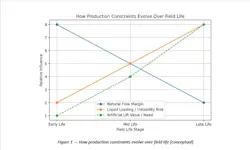
One reason this tension exists is that the constraints on production evolve over field life. In early life, strong natural flow margins typically offset system pressure losses, reducing the immediate need for lift. As production declines, this margin erodes while the risk of liquid loading and flow instability within the riser increases. These effects do not occur in isolation but progressively interact, with a crossover often emerging in mid-life where artificial lift transitions from optional to increasingly valuable. Figure 1 provides a simplified illustration of how natural flow capability, instability risk, and the value of artificial lift evolve relative to one another over time.
The cost of deciding too early
From an engineering perspective, FEED is the point at which uncertainty is highest, yet it is also where binary decisions are made that lock in long-term cost and complexity. When lift systems are installed early as a contingency, they introduce additional subsea construction scope, interfaces, and long-term integrity obligations. More importantly, early commitment reduces flexibility later in field life, when actual production behavior diverges from early forecasts.
A useful way to approach this challenge is to separate design intent from capital commitment. Design intent establishes whether an asset should be capable of accommodating artificial lift in the future. Capital commitment determines when that capability is realized. These decisions do not need to occur simultaneously.
Why timing matters economically
From a commercial perspective, the timing of artificial lift decisions can have a disproportionate impact on project economics. Installing lift infrastructure during construction often requires significant upfront capital, even when the functionality may not be utilized for several years. By contrast, deferred in-riser intervention approaches typically represent a fraction of the capital associated with fully integrated subsea or boosting solutions, while preserving the ability to respond to declining reservoir performance later in field life.
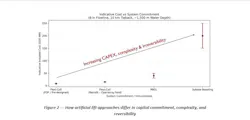
In broad terms, the capital required to retrofit in-riser artificial lift is often an order of magnitude lower than that associated with fully integrated subsea lift or boosting systems. While exact costs are highly project-specific, the ability to defer multi-tens or even hundreds of millions of dollars in upfront investment can materially improve sanction robustness for developments where artificial lift remains a contingency rather than a certainty.
By incorporating low-impact provisions during FEED—such as access points or hang-off concepts—future in-riser artificial lift capability can be preserved without installing full systems upfront. Doing so is typically straightforward during design, but disproportionately costly and disruptive to retrofit later in a brownfield environment.
Enabling flexibility inside the riser
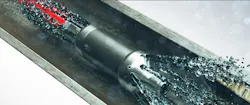
In-riser artificial lift enabled by composite coiled tubing technologies has expanded what is technically feasible in this regard. By allowing velocity strings or gas injection to be deployed inside the riser from surface, without subsea construction, these approaches enable lift deployment to be aligned with observed reservoir performance rather than early-life predictions alone.
A lifecycle view
Viewed through a lifecycle lens, deferred artificial lift can improve capital efficiency, reduce exposure to idle infrastructure, and preserve flexibility as production conditions evolve. In an environment where uncertainty is unavoidable, aligning artificial lift commitment with reservoir reality may be one of the most effective ways to improve project robustness.
About the Author
 Kevin Keogh
 Kevin Keogh
Kevin Keogh is VP of Commercial for Paradigm’s Flow Services business, based in Houston, Texas, a position he has held since 2016. Keogh has led the efforts to commercialize Paradigm’s ‘Flexi-Coil’ technology, including its diversification from its core application of remediation of solids deposits in risers and flowlines into providing a low-cost retrofit artificial lift solution to improve recovery from deepwater subsea wells, for which he is patent pending.