Study looks at generic gas field production in ultra-deep GoM

EnerSea Transport LLC and Kerr-McGee Oil & Gas Corp. awarded a study to Paragon Engineering Services Inc. and Advanced Production and Loading Inc. to develop the field architecture of a generic gas field in the ultra-deep Gulf of Mexico. The study team looked at Enersea’s Gas Production and Storage Shuttle (GPSS) technology and assessed the technical viability of a new concept to develop smaller gas reserves in the ultra-deep GoM where economics may not justify the construction of a fixed production facility with a tieback to existing gas pipelines.
In the case studied, subsea wells produce sweet, dry, lean gas in 8,000 ft of water, 150 mi offshore to interchangeable GPSS vessels. The production collects onboard each GPSS vessel under volume-optimized conditions, which is 1,765 psia and -20° F, for compressed natural gas transport. Two GPSS vessels, each 645 ft long and able to store 220 MMcf, enable continuous production. Gas and condensate produce onto the GPSS vessels and accumulate separately. Produced gas and condensate unload as a comingled fluid stream into a GoM gas trunk-line system at a site 120 mi from the gas field.
The design production rate is 100 MMcf/d with 500 b/d of condensate and very little water (less than 2 lb/MMcf). Production continues uninterrupted except for hurricanes. It is therefore necessary to have two GPSS vessels and two submerged turret production (STP) loading facilities.

The reservoir fluids produce through two standard 10,000-psi horizontal trees used in the deepwater GoM. The operating pressure at the production swivel above the loading buoy is 2,000 psig. The swivel is designed to ANSI/ASME Class 900. A high-pressure protection system (HIPPS) allows the subsea system to accommodate a shut-in pressure of 8,500 psig.
Dynamically positioned, self-contained semisubmersible rigs support drilling and major well maintenance operations. The space between the drilling area and the STP mooring systems requires a horizontal clearance of 1,000 ft. The two STP loading buoys sit one nautical mile apart to moor an arriving GPSS at one buoy while the other GPSS
loads at the other buoy.
The team accounted for metocean conditions in the area including Loop Current, Eddy Currents, and submerged currents. The soil conditions allow suction piles.
Field architecture subsea
Subsea lines operate partially in the hydrate formation region, which is typical for many gas production lines. The system prevents hydrate formation through methanol injection at the wellhead. Dedicated tubing in the umbilicals distributes methanol. Because the gas is cold, the GPSS recovers most of the methanol for reuse. The team also uses depressurization as a primary hydrate remediation measure and coiled tubing intervention as a secondary measure.
Three alternatives the team considered for risers include flexibles, steel catenary risers (SCR), and hybrid riser towers (HRT). They chose the HRT because it allows optimal use of the seafloor space. A manifold at the top of the HRT directs production alternatively to one GPSS or the other, provides coiled tubing intervention access, and offers isolation, should it become necessary to change a flexible.
Required well locations, selection of subsea completion and drilling rig, and the mooring pattern of the loading buoys drive the field layout design. The minimum safe horizontal distance between the drilling rig and the mooring zone of the loading buoys determines the length of the flowline.
Semi-taut lines at an average angle of 45° moor the STP buoys. The team arranged the buoy moorings in three sets of paired lines at 120°. This configuration and the HRT allow an open layout.
The HRT is vertical and in the vertical plane, which passes between the loading buoys. The team arranged the mooring lines of the loading buoys to allow full access for umbilical replacement. Future lines and future umbilicals can readily be added.
Subsea systems
Enhanced horizontal trees rated for 10,000 psi and 10,000 ft provide production control at the wellhead. The system connects hydraulic and chemical injection lines with flying leads and cobra style connectors and makes electric power and signal connections through electric cables flying leads.
The system then connects each well to a pipeline end termination (PLET) with a 6-in. nominal M-shaped rigid pipe jumper fitted with a subsea wet gas flow meter. The PLET includes a hub connection for future expansion. ROV API 10,000 gate valves operate the valves on the PLETs.
Stolt Offshore developed the proposed HRT system, which consisted of:
- A suction anchor
- Rotolatch-type connection and a flexjoint
- Bottom connection section
- Continuous cross-section comprising a central gas line and a casing holding the buoyancy modules
- Top section to receive the valves and the coiled tubing connection
- Flexibles to the STP buoys.
The team divides the STP into two separate systems - the field related equipment and the shipboard system, which is the STP related structure and equipment on the GPSS vessel. The field related equipment includes the STP buoy, jumpers, and mooring system.
The mooring system is made up of six semi-taut lines configured in three clusters of two lines. Spacing between the two lines within each cluster is 10°, while 110° separates the clusters. The team investigated two different mooring line compositins and found both systems viable, but preferred the chain and steel wire rope with intermediate line buoys to the chain and polyester option.

The STP buoy provides buoyancy to carry the mooring and an integrated turret system to allow the GPSS vessel to fully weathervane. For this particular ultra-deepwater application, the buoy has a turret tank below the mooring line connections, like the Pierce STP buoy and the Åasgard STL (Submerged Turret Loading) buoy in the North Sea, to obtain the required buoyancy with the same vessel interface as for previous applications. The STP buoy consists of the following main assemblies:
- Buoyancy cone
- Integrated turret
- Bearings
- Mooring connections
- Riser connection
- Umbilical connection
- Pick-up system
A HIPPS is at the turret top between the upper end of the riser and the male part of the connector. The purpose of the HIPPS is to separate the 8,500-psi system from the class 900 ANSI/ASME ship piping system.
For the example application, the required total net buoyancy of the STP buoy is only 185 tonnes distributed among mooring system (100 tonnes), riser system (75 tonnes), and HIPPS (10 tonnes). The HRT takes the weight of the production line.
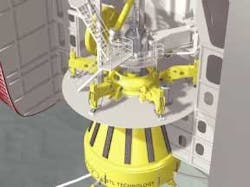
The STP shipboard system comprises the STP compartment, STP mating cone, and associated systems and equipment. All the associated systems and equipment are inside the sheltered STP compartment, which extends from the STP deck, about 6 m above the bottom plate of the ship, to 3 m above main deck. The STP compartment is extended above the main deck to provide green water protection and elevate blast panels above main deck personnel areas. Below the compartment, the STP mating cone forms the direct structural interface between the ship and the buoy.
Other STP related shipboard equipment and systems comprise a 130-tonne-capacity traction winch for pull-in of the STP buoy, a rope guide for centralizing the pick-up rope during pull-in, a heave compensator to avoid snap loads, hydraulically operated locking devices to secure the STP buoy to its fixed position, a cone hatch to seal off the compartment against seawater during transit, and filling valves and drain pumps to fill and empty water in the compartment.
With respect to the gas transfer system, the most important shipboard system is the STP swivel and connector system, including the swivel stack assembly and gas connector.
The GPSS team determined that they could assemble the subsea architecture from field-proven components for the well systems, flowlines, riser, jumpers, umbilicals, STP buoys, valves, and moorings, such that a conclusion of feasibility is well supported from this perspective. The HRT and the STP buoy systems serve as the subsea backbone for this innovative development scenario.