UK drilling enters upturn amid economic downturn

Chris Bully - Hannon Westwood
For more than a year, the UK’s oil and gas business has been impacted by financial constraints as the continuing effects of the downturn make their mark, restricting the flow of funds available for those looking to drill-out prospectivity or advance discoveries.
This has hit the smaller players particularly hard, especially those with very shallow pockets and no cash flow from production. It is the non-majors that some see as the future of the UK oil industry, given the inclination for the majors to pursue larger prizes outside the UK. Yet it is these very same majors that have the staying power and experience to operate in the most challenging provinces such as deepwater Atlantic Margin and deep, high-pressure/high-temperature Central Graben, where risks are high but the prizes equally so.
During the first half of 2010, there had been 23 well spuds and five sidetracks across the UK shelf, comprising 13 exploration and 10 appraisal wells. With the exception of 2008, and disregarding sidetrack wells, this represents the highest level of E&A drilling in the sector for the first half of the year over the past five years, despite the ongoing effects of the global economic downturn.
1-in-3 hit rate
Twelve of this year’s 13 exploration starts are already complete with four known to be technical discoveries, equating to a hit rate of 1-in-3. They are:
- Valiant’s Tybalt (East) and Tybalt (West) oil discovery in the northern sector
- EnCore’s Catcher and Catcher East oil find in the central North Sea
- Dana’s Platypus and Centrica’s Olympus gas discoveries in the southern North Sea. Successful appraisals also occurred at Tern North, Stella, and Cygnus.
In 2009, although fewer wells were drilled compared to 2008, the “bangs per buck” increased owing to much higher success rates. A spend of about $1,250 million returned 1,224 MMboe of new/appraised reserves giving an overall rate of $1.02/boe. This compares favorably to a 2008 spend of around $2,106 billion which generated only 841 MMboe of new reserves at an overall rate of $2.5/boe.
Last year’s depressed well numbers could be viewed as a poor show compared to 2008 levels. However, in terms of spend per boe found/appraised, drilling in 2009 was a resounding success, with cost/boe at 40% of the 2008 level.
When put into context with previous years, 2009’s performance was on a par with 2006 and 2007. Over the last five years, 2008 could be regarded as the worst performing year in every respect apart from the total number of wells drilled. The overall success rate in 2009 was a creditable 68%, more than double the long-term UKCS historical average.
West of Shetland resurgence
Seven E&A wells were drilled in the West of Shetland sector in 2009 and a further nine sidetracks initiated. In the deeper waters of the Atlantic Margin, this resulted in DONG’s Glenlivet discovery in 1,400 ft (427 m) of water and OMV’s Tornado discovery in 3,400 ft (1,036 m). Chevron appraised Cambo in 3,600 ft (1,097 m) and appraised Rosebank in 3,800 ft (1,158 m) of water with two new wells and four associated sidetracks, although the latter program was protracted due to riser problems with the newbuild drillshipStena Carron.
However, almost six months into 2010, only Hurricane has returned to the sector for E&A drilling with a re-entry to appraise its Lancaster discovery, a sidetrack in a little over 500 ft (152 m) of water. BP, currently the only producing field operator in the deeper waters of the Atlantic margin, continues production drilling at its Foinaven field in waters around 1,600 ft (487 m) deep in addition to ongoing development of the shallower water Clair field.
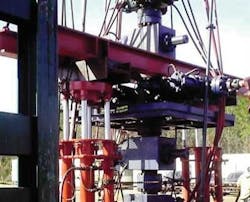
The deep reservoirs of the Central Graben – typically 15,000 to 20,000 ft (4,572-6,096 m) subsea – and the deep waters of the Atlantic margin present different challenges. Traditionally, both are the domain of the larger, more established players with deeper pockets and staying power.
By nature, the difficult areas are high risk but also, in the right circumstances, high reward. If a major player can apparently get it wrong (i.e. BP at Macondo), this may not be considered territory for smaller fry to dabble in, irrespective of the potential prize at the end of the day.
Lead-in times for well planning, design and execution are necessarily protracted and such programs are more likely undertaken by companies with a balanced portfolio, including lower risk exploration acreage, appraisal opportunities and strong cash flow from less demanding basins.
Total recently started development of its West Franklin field which, when onstream, will join Shell’s Shearwater and Total’s Elgin and Franklin fields in producing from this relatively shallow water province.
Moratorium not the answer
The US administration has sought to impose a moratorium on deepwater drilling, and Norway appears set to follow in certain parts of the Norwegian shelf. On the UKCS, a significant number of deepwater wells are on the cards. As yet, no moratorium has been announced for the UK, although a safety review is planned.

The GoM blowout will, however, focus the collective mind and provide much opportunity for introspection as operating consortia meet with the UK’s Department of Energy and Climate Change (DECC) and other agencies to reaffirm that contingency plans are in place and potentially detrimental short cuts are avoided. There can be no senior personnel in any E&P company or rig operating company that have not asked the question: “what can be done to mitigate against disaster” – and “what if that was us?” Although too soon to know what the outcome will be for deepwater drilling on the UKCS, it is likely that both operating practices and H&SE regulations will be amended and tightened.
In the shallower water West of Shetland basin, nine wells were considered possible or probable drill candidates for 2010, including seven exploration targets and two appraisals of existing discoveries, the majority in the hands of smaller operators. In all, 10 wells are listed for the deeper waters of the Atlantic Margin, in water depths around 4,000 ft (1,219 m), but by and large these are controlled by the majors.
The Macondo incident comes shortly after the approval in March of Total’s plans for the West of Shetland gas gathering system, which will see development of the Laggan and Tormore fields in 2,000 ft (609 m) of water to recover some 220 MMboe, with production scheduled to start in 2014. Total and partner DONG will already have had emergency meetings internally and with relevant external authorities to check and re-check that the “what if” scenarios are covered.
Lower rig rates
The southern gas basin, by contrast, is a genuine shallow water province, and currently the busiest in the UK. Despite uncertainties over gas prices, the lag on rig rates appears to have caught up with the effects of the financial downturn. Operators are taking rigs at a significant discount to 2009 and drilling out prospectivity or progressing discoveries to early production.
Another shallow water province helped bolster 2009 exploration and appraisal drilling levels. A drilling club of different operators employed a single jackup to drill a sequence of exploration and appraisal wells and a single development well in the shallow waters, typically 50-100 ft (15-30.5 m), in the East Irish Sea basin northwest of England. Without that 10-well program, seven wells of which started during 2009, last year’s statistics would have looked dire. Also positive, the program resulted in three discoveries and the progression through appraisal of an existing discovery, with further activity likely on the back of the drilling results.
Investment critical
The UK authorities will think long and hard before applying moratoria in the deepwater sector. Safety should always be paramount and the sector has learned the hard way through a series of incidents since activity began on the shelf in 1964.
The survival of the sector requires investment. Prospectivity is not lacking and the trend in exploration drilling is slowly upward, although the number of E&A farm-ins completed thus far in 2010 is small compared to previous years. Mid-2010 on the UKCS certainly feels different from mid-2009, when the situation seemed to be deteriorating rapidly. Most companies have ridden the storm and falling rig day rates may be driving the increase in activity.
The pool of planned E&A wells through to 2015 remains significant, hovering around the 170 to 200 mark, as does the number of wells – around half – requiring currently elusive third-party funding. Awards in this year’s 26th License Round will add further pressure to the drilling pot with 25th Round Licenses still being formally awarded, following delays to deal with environmental concerns.
Firm commitment wells outstanding on 21st to 25th Round acreage amount to 34 wells, with an estimated resource potential of nearly 750 MMboe. Over 70% may require third-party funding, or may have to be deferred until this materializes, perhaps prompted by the opportunity to secure rigs at lower cost. •
Offshore August 2010