Offshore Europe
Norway striving for bigger oil
Norway’s Petroleum Directorate (NPD) is calling for new measures to lift production across the Norwegian shelf. In its latest national Resources Report, NPD estimates the country’s recoverable oil and gas reserves at 12.9 bcm, and predicts that new developments in the coming decade could bring in a net 580 MMcm. But NPD sees potential for additional growth over the same period of 220 MMcm, equivalent to 5 billion bbl.
This could be achieved through discoveries resulting from the currently widespread exploration and production drilling programs, and through more concerted application of new measures to increase oil recovery. NPD calculates that gas injection has generated an extra 180-220 MMcm of oil and condensate from Norway’s fields, with much of that gas later produced and sold. Recovery could be lifted further by cutting field operating costs. An NPD study of eight Norwegian facilities identified potential for a 30% cost reduction, through implementing experience from other projects.
On the exploration front, the most closely watched wells at present are two on new Mid-Norwegian plays in the Moere Basin (Statoil-Tulipan) and the Norwegian Sea (Hydro-Stetind). There are also plans to resume drilling in the Barents Sea later during the fall. This region provides nearly half the 64 blocks advertised recently under Norway’s 19th Licensing Round, the remainder being spread around the Norwegian Sea.
The big new Norwegian projects moving closer to sanction are BP’s Skarv and the Valhall redevelopment, the latter based around a new production platform. Wood Group in the UK is working on front-end engineering design, with a brief from BP to transfer practice applied by subsidiary Mustang in the Gulf of Mexico and on the recent Clair project West of Shetland.
As for innovations in recovery, Statoil is looking to extract a further 35 MMbbl of oil in two phases from the Tordis field in the North Sea. Phase 1. Due onstream in October 2006, it involves modification to the host platform, Gullfaks C, to allow conversion of Tordis to low-pressure production. Under a Nkr625-million contract just awarded to Kongsberg FMC, Statoil will implement subsea separation, with the equipment due to be operational late in 2007.
Hydro is looking at ways of building incremental production throughout the Oseberg field complex. Two small satellite fields are currently under development or entering production, and Hydro has recently issued a plan to tie the Oseberg Delta satellite to the Oseberg D platform, via the same receptor employed for the Tune (subsea) field. The operator has allocated NOK 1.8 billion for this work, designed to realize 8 bcm of gas and 2.7 bcm of fluids, and the associated four-slot drilling template could be used to tie in further structures nearby, such as G-central.
Brighter future
Higher oil prices are halting the UK’s production decline, through increased new and “brownfield” development. According to the latest Economic Report from the UK Offshore Operators Association (Ukooa), investment activity continues to strengthen, placing the government-industry target of 3 MMboe/d in 2010 within reach.
A few years ago, a much steeper decline seemed likely, but independent oil companies in particular have rejuvenated the sector. Mike Tholen, Ukooa’s Economics Director, said that 33 new companies accounted for 26% of investment on the UK shelf last year, and 10% of total production.
Last year, total oil and gas output dropped to 3.6 MMboe/d, lower than expected, but the new projects and incremental development of existing fields should halve the rate of decline through the end of this decade. Ukooa forecasts average output of 3.4-3.5 MMboe/d this year and 3.4 MMboe/d in 2006.
Total oil/liquids production in 2004 was 725 MMbbl, and this level should be sustained through 2007 at least, thanks to additions from new developments such as Nexen’s Buzzard (200,000/boe/d), ConocoPhillips’ Callanish/Brodgar (60,000boe/d) and Talisman’s Tweedsmuir (30,000 boe/d).
UK gas production last year totaled 95bcm, a drop of 6.8% on 2003, and is set to slide around 6% annually in the short term, although this could be offset by harnessing supplies from fields west of Shetland.
Overall spending on exploration, appraisal, development, and operations should reach £9 billion this year, according to Ukooa’s projections, with total capital investment of £13 billion from now to the end of the decade, 13% up on last year’s forecast. Operating costs also should be ending up £500 million/yr higher than previous predictions, due in part to the cost of extending the life of existing platforms and pipelines. Any new environmental and regulatory costs could push the bill up further, Ukooa warns.
As for drilling, the recent upswing mirrors worldwide trends. The industry drilled 63 exploration and appraisal wells across the shelf last year, a 40% increase, and current estimates are for 74 E&A wells in 2005.
Emission storage
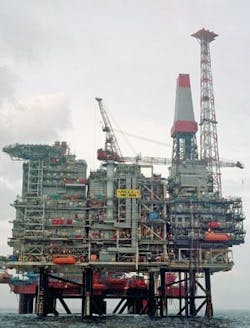
Miller, a declining oilfield in the central North Sea, could be assigned a new storage role under a proposed scheme to generate hydrogen-fuelled power. Operator BP and partners ConocoPhillips and Shell are looking to produce “de-carbonized” fuel for use at a planned 350MW power station near Peterhead, north of Aberdeen. A newly built reformer plant would convert up to 70MMcf/d of natural gas into hydrogen and carbon dioxide (CO2), with the latter sent through North Sea trunklines to Miller, 240-km away. BP would adapt the field’s platform, which has been in service since 1992, to allow injection of CO2into the reservoir, 4-km below the seabed.
The partners, in association with utility Scottish and Southern Energy, have completed engineering facility studies, and are now working on detailed front-end engineering design, with the aim of deciding late next year whether to commit to the investment. They estimate an upfront cost of $600 million, with start-up probably in 2009, assuming regulatory approval for the scheme.
The target is to capture around 1.3 MM tons/year of CO2, which might otherwise be emitted to the atmosphere. Injection might also extend field life at Miller by 15-20 years, increasing oil recovery by 40 MM bbl.
BP’s announcement followed publication of a new report by the UK government advocating development of carbon abatement technologies. The Ukooa responded that its members had been investigating various schemes, but had raised numerous doubts over feasibility. For instance, although carbon sequestration has been proven on Statoil’s Sleipner gas field in the Norwegian North Sea, the removed CO2 is actually re-injected into a saline aquifer, not the Sleipner reservoir.
Diverting CO2 through offshore pipelines for reservoir injection would be more costly, Ukooa added, in terms of modifications and platform equipment retrofits. It also pointed out that the Ospar convention currently questions the legality of transporting CO2 from land to the sea for offshore disposal. •