GEOSCIENCES
Opening access
The oil industry has been hobbled for years from operating in certain areas of the world. That is changing with an “opening access” trend gaining strength around the globe. New areas are opening for exploration off Libya, India, South China Sea, and the US Arctic National Wildlife Refuge (ANWR).
Increasing demand for petroleum from the developing world and economically-recovering developed economies, combined with the limited ability of OPEC and other producers to meet the rising demand, is forcing governments to rethink their ability to finance and explore protected areas using in-country resources. They are opening new territories to attract foreign direct investment in energy projects that they cannot finance on their own. This action also opens a developing economy to the latest efficient technology for exploration and development of its territories.
Libya was under economic sanction for years, but last year met the conditions for sanction removal. The country immediately opened its territory to oil companies to refurbish deteriorated oil fields and to explore for fields in new areas. Closed offshore areas are now accessible.
Last month, India sent a team around the world to promote its new, more open and attractive licensing scheme as well as new areas for the industry to invest in. The policy change was dramatic from ONGC’s earlier protective lock on the licensing process and the limited areas made available for the industry to review. The international industry had largely considered that earlier approach as uneconomic.
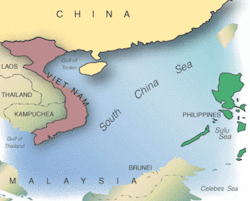
In areas of overlapping claims, governments are finding that cooperation is the path to testing the potential of areas that have been off-limits to exploration. The South China Sea has been a contentious region for years with overlapping claims by the border states keeping the industry from testing the sea’s potential. That stumbling block is being removed with the recent agreement between China, Philippines, and Vietnam to explore the region with a joint seismic survey (see related item). This agreement was preceded by earlier cooperative examples between Australia and Indonesia in the Zone of Cooperation Agreement for the Timor Sea and more recently the agreement between São Tomé & Principe and Nigeria covering their overlapping claims in the Gulf of Guinea.
The last example is the move within the US to open the Arctic plain of Alaska to exploration. ANWR has been under a drilling moratorium, imposed by the environmental movement, for many years. The pressure of the present economic reality is putting the logic of that earlier decision into question. No decision has been made yet to change the status of ANWR, but the consideration of a change is significant. It demonstrates that governments across the globe realize that to meet their countries’ need for petroleum all areas with potential need to be explored.
Change is good and is the only constant in exploration. The growing demand for liquid and gaseous energy is forcing the former barriers to fall and is opening new exploration territories for the industry. Now it is the time for the industry to respond by increasing its personnel to find the hidden resources in these diverse new plays.
TECHNOLOGYRussian computing
Paradigm upgraded its seismic data processing centers in Russia with 90-processor computation clusters, based on the Intel processors. The new system shortens project completion time and enables pre-stack depth imaging.
“The increased demand for advanced seismic data processing services and the considerable growth in our clients’ requirements for high quality project performance, have resulted in the second significant upgrade of our processing centers in the past three years,” says Nikolai Baranskiy, president of Paradigm CIS Operations.
AVO
Seismic Micro-Technology announced a new module for Kingdom 7.5. AVOpak enables users to analyze pre-stack gathers with two button clicks. Highlights include the ability to:
- Interpret horizons on gathers and view amplitude response in cross plots
- Integrate AVO gathers into a conventional stacked data workflow
- Correlate logs, synthetics, and stacked data with AVO gathers
- Extract and display commonly used AVO attributes
- Cross-plot AVO attributes.
Cooperation begins
China National Offshore Oil Co., the Philippines National Oil Corp., and Vietnam Oil and Gas Corp. have agreed to jointly explore areas in the South China Sea over their overlapping claims. The “Tripartate Agreement for the Joint Marine Seismic Undertaking in the Agreement Area of the South China Sea” will run for three years and explore 142,886 sq km around the Spratly Islands. The survey is estimated to cost $15 million, split equally between the three countries. No bid announcement has been made for the work.
Nodal survey
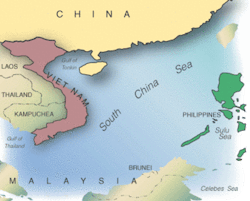
Fairfield Industries will acquire 145-160 sq km of seismic data for BP across the Atlantis field in the deepwater Gulf of Mexico using the company’s 900-node Z 3000 system. The system uses self-contained nodes deployed and removed from the seafloor by remote operating vehicles.
“We are extremely pleased that our Z 3000 nodal technology has been selected to image subsalt formations underlying the Atlantis field,” says Walt Pharris, Fairfield’s president and CEO.
The nodes have no external connections or moving parts. Each node is rated for water depths of up to 3,000 m and uses flash memory and lithium-ion battery packs. The company will gather the data late this summer.
US West Coast data
ChevronTexaco Corp. donated thousands of miles of historic 2D and 3D seismic data covering offshore California and portions of the West Coast of the US to the American Geological Institute. AGI has partnered with the US Geological Survey (USGS) to create the “National Archive of Marine Seismic Surveys,” a repository for academic, government, and industrial researchers, marine geologists, and environmental engineers. The data are available through a USGS website: www//walrus.wr.usgs.gov/NAMSS/.
Norwegian plays
New information on eight Norwegian Sea geological plays, defined by Norwegian Petroleum Directorate, is now available online at www.npd.no. The NPD now has information available on the 24 geological plays in the North Sea, Barents Sea, and Norwegian Sea.