Offshore Europe
Maureen in line for re-development
A new North Sea independent, Fairfield Energy, has secured $200 million of investment funding. Much of it will be directed at resurrecting abandoned UK sector oilfields, partly in partnership with Apache.
London-based Fairfield is led by Chris Wright, a former senior VP for global exploration and technology at Unocal. Wright also brings experience of the North Sea independent scene, having earlier served as Lasmo’s group managing director. His former management colleague at that company, Mark McAllister, has joined Fairfield as CEO.
McAllister’s previous project was the formation of Acorn Oil and Gas, which partnered with Tuscan Energy on Ardmore in the UK Northern North Sea. This was the first stand-alone redevelopment of a defunct UK oilfield. However, although the scheme was technically sound - three wells producing through theGorilla VII jackup - financial constraints brought on by operational difficulties led to premature closure this spring.
Nevertheless, Fairfield is buying interests held by Acorn in adjacent acreage, including two further redevelopment prospects, Crawford and Maureen.
“In my view,” says McAllister, “Ardmore was a great success, in terms of two start-up companies obtaining the license in the first place, then bringing the field into production 19 months later. But our operating costs were too high, largely due to the fact that we opted to lease all the facilities rather than committing to upfront capex.”
In the coming months, Fairfield plans to drill appraisal wells on Crawford and on Maureen in the central sector, where it is partnering with operator Apache North Sea.The two companies acquired that acreage in May, following long negotiations.
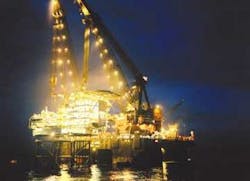
Maureen’s previous operator Phillips brought the field onstream in 1983 via the world’s first steel gravity base platform. It was also the UK’s first major production platform to undergo decommissioning and dismantling when the field was closed down early this decade.
At the time, Phillips said that infill drilling opportunities were virtually exhausted. However, the two new partners believe there may be untapped potential in Paleocene layers, analogous to the Forties field that Apache acquired from BP in 2003. McAllister points out that Apache has so far more than doubled production at Forties to 70,000 b/d, through a combination of infill wells, sidetracks, and workovers.
“BP itself had worked that field really hard, whereas Maureen perhaps wasn’t worked as hard,” he says.
The new analysis is based on the interpretation of 3D seismic acquired over Maureen this summer, the first new 3D acquisition on the acreage since 1993.
“If you overlay our seismic with Phillips’ 1993 data - aided by modern seismic interpretation - you can see movement of oil and gas in water within the reservoir. So there may be large pockets of unswept oil.”
Aside from appraisal wells, the partners plan to revisit two much smaller decommissioned satellite fields, Mary and Morag, and the previously undeveloped Mabel discovery. And to the south of Maureen, the BG Group recently appraised the Maria discovery in block 16/29.
“Maria’s setting possibly opens Jurassic potential into our block,” McAllister says.
Fairfield’s backers are led by private equity company, Warburg Pincus, which has invested in other high-flying newcomers such as Newfield and Spinnaker. It may also seek further funds for new acquisitions, possibly in the Dutch sector.
“I believe there is room in the UK for a substantial indigenous company,” McAllister adds. “At the moment, there is a slight mismatch in the sector between small start-up companies with little funding and mid-size North American independents.”
Wintershall hits big time
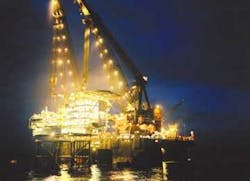
First gas was due late last month from F16-A in the Dutch sector. The platform - operator Wintershall’s largest to date - was built in 13 months, and supports 3,500 metric tons of topsides facilities, capable of producing and processing 6 MMcm/d of gas.
Wintershall now has 25 platforms in the Dutch North Sea. Most of these handle gas, but the company also produces oil through the Kotter complex, which came with its acquisition of Clyde in 2002. Production had been falling continuously for five years, dropping to just 1,100 b/d at the turn of this year. Following remedial work this summer - deepening an existing well and drilling a new well beside a defective older one - output has climbed to 3,000 b/d. Wintershall is now hoping to extend production through the end of 2009.
Pipelines ease Mittelplatte exports
Mittelplatte, Germany’s largest developed offshore oilfield, has been equipped for the first time with dedicated subsea pipelines. Previously, all production had to be shipped by barge the short distance to the northern (North Sea) coast to avoid damaging the ecologically sensitive Wattenmeer tidelands. However, this operation was itself restricted by tidal operations in the ultra-shallow waters.
The new pipeline system also extends across the mainland. The offshore section comprises two stainless lines, stretching 7.5 km over the tidal flats from the dyke line at Friedrichskooge-Spitze to the Mittelplatte production complex. From the coastal starting point, the lines head inland a further 2.8 km to existing treatment facilities at the Dieksand land station. One line, with a diameter of just over 10 in., transports crude from the field; the other, with a diameter of just over 6 in., returns reservoir water extracted at Dieksand for reinjection into the field.
Prior to the main offshore installation, prefabricated sections of pipes were drawn into two predrilled, parallel horizontal boreholes. After installation, the lines were buried at depths of up to 20 m, deep enough for them to pass safely under the tideways and the dyke. Inside the six construction pits along the offshore route, pipe runs were welded together at a depth of 5 m. Operator RWE Dea says the new system will cut out 2,000 journeys by double-hulled crude carriers, and should also reduce the field’s production lifespan by around 10 years.
In the eastern Mediterranean, another ambitious project has been sanctioned that will connect Italy and Greece to Turkey’s gas pipeline network. This in turn will allow these two countries to import gas from the Caspian Sea and the Middle East. Italy’s Edison and Greece’s Depa are responsible for construction of the 800-km line.•