OFFSHORE EUROPE
Jeremy Beckman • London
Norwegian operators lining up more projects
Norway’s oil and gas production last year dropped slightly to around 238 MMcm of oil equivalent, according to a review by the Norwegian Petroleum Directorate (NPD). Overall exploration and development activity, however, remained high, and investments are set to rise further.
Four new fields came on stream in 2007 – Talisman’s Blane and Enoch, and StatoilHydro’s Ormen Lange and Snøhvit. New additions this year will include the Alvheim, Vilje and Volve fields, all in the North Sea. The authorities approved development plans for nine more fields last year, NPD adds, and a further 10 plans likely will be submitted in 2008. StatoilHydro already has issued a request to tie the 1.75 bcm Yttergrytta gas discovery in the Norwegian Sea back to the Åsgard B platform via a subsea template, at a projected cost of $216 million.
Across the shelf, NPD counted 32 exploration well spuds in 2007, two more than in 2006. NPD expects this level of activity to be sustained in 2008. Some impetus may come from the 13 new companies pre-qualified last year as Norwegian sector licensees or operators; 14 more applicants are being considered currently.
Small and mid-sized companies featured strongly in block nominations for Norway’s upcoming 20th licensing round, said Petroleum and Energy Minister Aaslaug Haga. Forty-six companies participated in the proposal process compared with 19 for the 19th round, when a total of 301 blocks and part-blocks were nominated.
Most of the new intake are companies from Germany, Scandinavia, and the UK, notable exceptions being Canada’s Nexen and Italy’s Edison. All the majors except BP also nominated blocks. Based on the suggestions, the Ministry will delimit the areas on offer by mid-year, with license awards probably issued during spring 2009.
Fairfield plans Dunlin life extension
Shell and ExxonMobil have begun their phased retreat from the UK Northern North Sea, first detailed last June when the duo opted to sell most of their operated interests in the region, bar the Brent fields.
At that point, negotiations already were under way to transfer the Dunlin cluster fields to Fairfield Energy and Mitsubishi, and that sale has been concluded. The cluster, in Quadrant 211 northeast of Shetland, comprises the Dunlin, Dunlin South West, Merlin, and Osprey fields. Their collective output has fallen to 8,000 boe/d, rendering them somewhat marginal to Shell, which produces 360,000 boe/d from its UK interests.
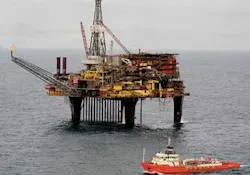
New operator Fairfield, however, sees scope for extending operations at the central production facility, the Dunlin A platform, by a further 10-15 years. The transaction also includes the associated production licenses, so there may be scope to tie in further accumulations.
Amec will serve as duty-holder for the platform and associated subsea facilities, leaving London-based Fairfield to focus on field development, drilling, and well maintenance.
In a separate agreement with Shell and ExxonMobil, the company also will acquire 100% of the Clipper South discovery area, encompassing three blocks in the southern gas basin. Fairfield plans a full subsurface evaluation of Clipper South, first drilled in 1983, with a view to a fast-track development of the Rotliegendes reservoir.
Chief executive Mark McAllister says this latest acquisition would bring Fairfield, formed late in 2005, closer to its goal of creating “a substantial UK independent company.” It has additional re-development interests in the central North Sea, including the Crawford oilfield, shut down by previous operator Hamilton in 1990.
Recent appraisal drilling proved a northerly extension of the field’s Triassic reservoir, also intersecting an oil column in the Tertiary section. Fairfield and its partners have a drilling slot secured with the semisubmersibleSedco 704, which could lead to an extended production test and more wells on Triassic prospects in the area. To the south, Fairfield is negotiating with Apache to take operatorship of the Maureen field, formerly produced by Phillips. BP’s Andrew is the nearest UK oil production complex in the region, if the potential re-development goes subsea.
Petrofac finds role for Northern Producer
Petrofac, better known for platform/facilities management, has submitted a plan for its first operated UK field development. This involves placing the currently idle semisubmersible production platformNorthern Producer in between the small Don SW and West Don oilfields, both located north of Dunlin, in a water depth of around 500 ft (152 m). Petrofac’s Energy Developments division acquired operatorship of both fields in 2006 from co-owners BP and ConocoPhillips.
TheNorthern Producer did duty formerly on Texaco’s Galley field, but was discharged when new operator Talisman opted to re-develop Galley via its Tartan platform. Petrofac has secured the facility under a lease arrangement, the cost based on a tariff linked to Brent oil prices. It will be modified to process fluids from Don SW and West Don, with capacity to handle 55,000 b/d of oil, plus associated gas and water injection. The oil could be exported via an offloading tanker or through local infrastructure.
Don SW’s oil is housed in dip and fault traps in Brent sequence sandstones, also the source of the nearby Thistle and South Magnus fields. West Don, discovered in 1979, has oil in Mid-Jurassic Brent sandstones.
Combined costs for the two developments could reach $700 million, including a program of seven wells to be drilled by the semisubJohn Shaw. Assuming UK government approval, drilling should get under way by mid-year, leading to first oil in 2009. According to partner Stratic Energy, West Don has proven and probable reserves of 21 MMbbl, with further upside in the field’s southern area. Don SW is due to undergo further appraisal drilling due to uncertainties over the middle and lower Brent reservoir sections.
Eco-friendly power may be costly
Long-distance power links to Norway’s production platforms could be more expensive than previous estimates, according to a report commissioned by the Ministry of Petroleum and Energy.
The study, conducted by a group including NPD and the Norwegian Pollution Control Authority, analyzed the cost of power from shore as a way of reducing carbon dioxide (CO2) emissions. The authors found that in the best case, powering existing offshore facilities could cost $288/metric ton (1.1 ton) of CO2. In the worst case, the estimate rose to $685/metric ton of CO2.
For installations in the Norwegian Sea, the economics look better if power comes from market sources. In some parts of the North Sea, however, best results come with power generated by purpose-built gas-fired plants.
According to the authors, the earliest date that power could be supplied from land would be 2015. The analysis covers electrification of existing offshore facilities, but not future development projects, as the technical and economic issues are different for new installations.
Norway’s government increasingly is pushing for power from shore to be included in development plans for new fields such as Eni’s Goliat in the Barents Sea.