Marathon unlocks fresh resources in 'mature' southern province
Nick Terdre
Contributing Editor
Marathon Petroleum's new multi-field Alvheim project underlines the potential of the supposedly mature Norwegian North Sea. Though not in the same class as the giant Snøhvit and Ormen Lange gas projects farther north, Alvheim represents a good medium-size development based pri-marily on oil reserves.
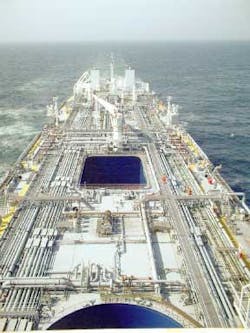
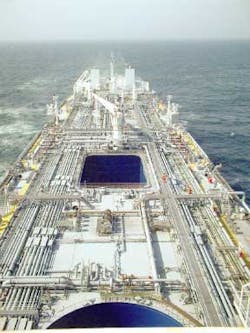
Marathon, as operator, holds a 65% interest in the development, with partners Conoco-Phillips (20%) and Lundin (15%). This summer, Marathon was due to submit a plan for development and operation (PDO) for Alvheim, which consists of three fields – Kameleon, Boa, and Kneler. The development is based on the use of an FPSO. The licensees have agreed to buy Statoil's Odin, a multipurpose shuttle tanker designed for easy conversion to a production ship. Up to 17 wells – 15 producers and two water disposal wells – will be tied back to the vessel, according to the environmental impact assessment (EIA) filed by the company in the spring.
The wells will be located at four drilling centers, two on Kneler and one each on Boa and Kameleon. They will be drilled in two phases, with the first, in 2005-07, encompassing 10 wells. The second phase is scheduled for 2008-09, though a final decision on how many additional wells to drill will depend on the production experience. All the wells will require gas-lift.
Government approval is anticipated in September, when detailed engineering is due to get under way. Drilling is scheduled to start in the first half of 2005, and fabrication in the spring. Offshore installation is set for September 2006, followed by start-up in October of that year, making this a genuinely fast-track project.
The capital expenditure is estimated at around NKr7.6 billion, with the topsides/ process facilities and the wells representing the big-ticket items. Operating costs will amount to some NKr300 million a year. Reserves are conservatively estimated at 29.1 MMcm of oil equivalent, of which 83% (152 MMbbl) are oil and only 17% (4.9 bcm) gas.
Oil production from Alvheim is expected to peak at 80,000 b/d in 2007, declining to less than 17,000 b/d from 2014. Gas production will reach an annual 0.33 bcm in 2007, decreasing to less than 0.1 bcm from 2010. It will rise toward 0.7 bcm in the period from 2022. Production is expected to continue for 20 years, according to the EIA.
null
Various measures are proposed to meet the ever-stricter environmental standards imposed in Norway. A zero discharge to sea policy has been adopted, whereby produced water will be reinjected. High-efficiency gas turbines will be used for power production, and cleaning technology will be installed to reduce volatile organic compounds (VOC) emissions during storage and offloading. The well templates will be fitted with over-trawlable covers to allow fishing activities to continue unimpeded.
In addition to the purchase of the ship, a number of contracts have been awarded, some on a provisional basis pending official approval. Aker Kværner Engineering & Technology is performing definition engineering for the FPSO topsides and hull, and ABB Offshore Systems for the subsea facilities. Kværner Oilfield Products will supply subsea equipment under a new frame agreement recently awarded by Marathon. Drilling will carried out by Odfjell semisubmersible Deepsea Bergen. In mid-year, tenders were out for the vessel conversion and provision of the turret, swivel, and moorings.
Alvheim lies in the west Heimdal area, between the Heimdal field and the median line with the UK sector. Boa, the most westerly of the fields, extends almost to the median line. Marathon has long been a partner in the Heimdal gas field, now in the final throes of production. However, Alvheim has resulted primarily from acreage acquired by the company in 2001. It lies almost completely on parts of blocks 25/4 and 24/6, which are divided between three licenses: PL 203, PL 088BS, and PL 036C.
Tieback potential
The commercial reserves turned out not to include a lower proportion of gas than had been earlier expected, and this appears to have been a disappointment. Gas is one of the main drivers behind the company's renewed interest in Norway. Its desire to get involved in gas transport became clear in 2002 when it announced plans to build Symphony, an 800-km, 36-in. gas pipeline from Heimdal to its Brae complex in the UK sector, and from there to Bacton, eastern England. Marathon also proposed this line for carrying gas from the Ormen Lange field to the UK. But Norsk Hydro, Ormen Lange's development operator, and Statoil, a key player in the Norwegian pipeline network, had other ideas. Symphony is now on hold, and looks unlikely to get off the ground.
This spring, Marathon carried out a further successful drilling campaign, which could yield future tie-backs to the Alvheim infrastructure. Appraisal well 24/9-7, which was suspended after three sidetracks, discovered oil and gas in the Hamsun prospect and also established communication between Hamsun and the overlapping Grieg reservoir. Grieg was originally drilled by Fina in 1994 as well, 24/9-5, but found only oil shows. If Hamsun proves to be commercial, it may also be viable to develop Grieg, according to Marathon.
The Grieg and Hamsun fields lie to the south of the Alvheim area, about 15 km from the likely Alvheim FPSO location. They are covered by license PL 150, in which Marathon holds 65% and Lundin 35%.
Another tie-back candidate is Norsk Hydro's Klegg field, in which 40-50 MMbbl of oil were discovered by exploration well 25/4-9S last year. Klegg is 21 km northeast of Alvheim on license PL 036, in which Hydro has 28.5% and Marathon 46.9%.