Offshore Europe
Jeremy Beckman • London
Majors, newcomers get 97 UK licenses
Britain's Energy Ministry has issued 97 offshore permits covering 163 blocks under the UK's 22nd licensing round. The UK awarded 58 companies, including 15 newcomers, all of which were granted Promote licenses that provide a two-year window for promoting the acreage's potential, mainly via reinterpreting existing well and seismic data.
According to analysts Wood Mackenzie, most of the new entrants were start-up companies formed specifically to bid for this round, such as Sosina. Its main shareholder is Danish seismic interpretation/processing specialist Odegaard. The UK offered only two new companies – Houston-based Endeavour and Century Exploration – traditional licenses. Century Exploration is focusing on the North Sea and gained four traditional licenses, two of which it will operate. Endeavour is also one of the few winners in this round to commit to drilling on blocks 31/26b and 39/1b.
Faroe Petroleum gained bit parts in four traditional and three Frontier licenses, all on the Atlantic Margin. Frontier terms allow for an initial screening period, followed by mandatory relinquishment of three-quarters of the acreage (typically larger than in traditional licenses). Most of the supermajors also picked up acreage in this region, led by ChevronTexaco, which secured five new operatorships.
ChevronTexaco and Eni are partners in the Laggan gas discovery, north of the Clair field west of the Shetlands. Operator Total recently undertook two successful appraisal wells on Laggan, the first on this structure since 1996. One, drilled by the semisubmersible Jack Bates in 600 m of water, test-flowed at nearly 38 MMcf/d. London-based field analysts at Britboss believe the partners are looking to bring Laggan onstream in 2008, possibly through subsea wells tied back 100 km to a new processing terminal on the Shetland Islands. These could be gathered together via a six-slot template controlled from the Clair platform.
The UK also offered the partners two new licenses west of Laggan and farther north, between the undeveloped Torridon and Laxford discoveries. The partners accepted both licenses as Frontier options. Eni's interest seems odd, given its recent pullout from operations in the central North Sea. But as Wood Mackenzie points out, the potentially gas-rich Atlantic Margin fits better with Eni's upstream gas supply ambitions.
Among the other notable awards, Apache picked up quantities of acreage in the northern North Sea that hold no significant discoveries. Wintershall acquired new blocks in the southern North Sea, close to the median line with The Netherlands, that may offer cross-border development potential. ExxonMobil and ConocoPhillips headed non-bidders in this round.
Small projects gaining momentum
Another report from Wood Mackenze has identified 35 new UK field developments likely to be sanctioned over the next three years. Combined yields from these projects, covering 42 separate offshore accumulations, are estimated at 1 Bboe, or 10% of total remaining commercial reserves on the UKCS. Over half of the fields are in the Central North Sea, still the most favored region for incremental or subsea development. The most technically challenging would be the high-pressure/high-temperature West Franklin and Kessog fields. Seven-teen of the fields are in the southern gas basin, with four probables in the Northern North Sea. Phase 2 of Burlington's Rivers field project in the Irish Sea would also add 21 MMboe.
null
As with the analysts' previous surveys, most of this year's "probables" are set for subsea solutions, but some would need fixed platforms. Six of the projects would involve developing more than one field via joint facilities. An emerging trend is the tieback of fields close to the median line with Norway, such as Blane and Enoch, to platforms on the other side.
Development activity could be further lifted by a new code of practice, drawn up by the UK government and offshore operators, to ease access by third parties to trunkline systems. As EnCana UK's Alan Booth pointed out, "many of today's new fields are too small to support their own cost-intensive production facilities and need to use existing systems to make them commercially viable." Under the code, the government will automatically be drafted into negotiations if a deal between the infrastructure provider and would-be user is not reached within six months.
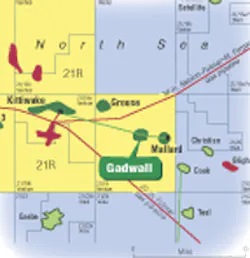
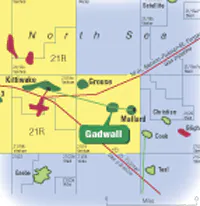
One new development definitely going forward is Gadwall, in central block 21/19. The semisubmersible Transocean 704 is drilling one producer and one injector, which will be tied back to the Kittiwake platform, co-owned by Dana Petroleum and Venture Production. Reserves are estimated at 7.3 MMboe, with a 10-year production span.
Gas imports on the rise
As gas production from UKCS fields continues to slide, rising demand from the mainland could lead to Britain becoming a net importer next year, according to a new study from the University of Aberdeen. By 2010, the authors say, imports could be furnishing 25-35% of national requirements; on the other hand, higher gas prices might also galvanize indigenous production.
One of the new import schemes is the BBL pipeline, operated by Dutch distributor Gasunie. This ¤500 m project will take up to 16 bcm/yr of gas from fields in The Netherlands. Saipem will install the main subsea section in 2006, which will stretch 235-km from Balgzand across the southern North Sea to Bacton on the English east coast. Corus Group's factory in Hartlepool, northeast England, will manufacture the 110,000 tonnes of 36-in. linepipe next year, with Bredero Shaw in Edinburgh providing anti-corrosion coating and concrete weight coating.
Russia/Norway review cooperation
Russia is expected to issue new proposals for joint oil and gas activity in the disputed zone of the Barents Sea adjoining Norwegian waters. According to Norwegian consultant Johann Petter Barlindhaug, "Norway says it needs strict border definitions first, then it can discuss cooperation. But Russia wants to do this the other way round."
Speaking at ONS Stavanger, Barlindhaug said some Russian geologists believe the currently off-limits zone may contain gas structures two to three times the size of the multi-tcf Shtockmanovskoye field in the Russian Barents Sea, which is finally moving toward development following years of procrastination. Any new discoveries of this order would need international cooperation and investment to develop, and might require construction of two new LNG reception complexes, one in Norway's Varanger fjord and another in Russia's Pechenga fjord (plus crude oil processing plants for commercial oil finds).
