TGS to create basin-wide seismic dataset for Ghana's offshore Keta Basin
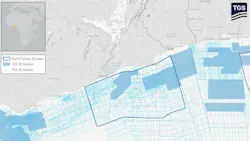
TGS, with the support of Ghana’s Petroleum Commission, will develop the Gulf of Guinea 2D-cubed project across the country’s offshore Keta Basin, the company reported earlier this week.
The aim is to provide E&P companies with a single, unified subsurface overview of this underexplored region and its deepwater fan system to assist prospect screening.
For Phase 1, TGS will take 5,500 sq km of 3D data and more than 14,700 km of 2D data from existing surveys for the 25,300-sq-km 2D-cubed project, covering the basin’s shelf and deepwater areas.
The 2D-cubed technology generates a single, structural conformable 3D seismic volume from existing datasets through use of an interpolation workflow to fill the gaps between lines and to suppress legacy migration artefacts.
The company said this results in a continuous, modern-quality 3D dataset that gives licensing/exploration teams a coherent, basin-wide picture, allowing them to take faster decisions on exploration and licensing activity without having to wait for new 3D data to be shot.
Final products should be delivered in first-quarter 2027.
Key questions about the Keta Basin:
Why is Keta Basin important?
The Keta Basin is one of the least-explored offshore areas along the West African Transform Margin, a geologic trend associated with major discoveries elsewhere in the region. Ghana views the basin as a potential source of future exploration growth beyond its established producing areas.
How explored is it?
Although only six exploration wells have been drilled in the basin since the 1970s, its location within the hydrocarbon-prone West African Transform Margin has sustained industry interest in its long-term resource potential.
What could the project mean for future exploration?
Improved seismic imaging could help operators reassess previously overlooked prospects and better define future exploration targets.
Why is TGS investing here now?
The project coincides with what Ghana's Petroleum Commission recently described as renewed interest in the country's upstream sector and increasing efforts to attract exploration investment. By upgrading legacy seismic data into a basin-wide dataset, TGS says it can offer operators a lower-cost way to evaluate opportunities before committing to new seismic acquisition.
Ghana's recent moves to boost upstream investment
In other recent developments, Ghana's Petroleum Commission has expanded collaboration with regional regulators as part of broader efforts to support upstream sector development.
Earlier this month, the commission and The Gambia's Petroleum Commission signed an MoU to strengthen cooperation and knowledge sharing in upstream petroleum regulation and development. The commission also signed a similar agreement with Liberia's Petroleum Regulatory Authority in June focused on regulatory cooperation, stakeholder engagement and knowledge exchange.
Why this news matters:
-
While industry attention has centered on frontier discoveries offshore Namibia, this project signals that companies are still searching for new opportunities along the broader West African margin, where underexplored basins could offer future exploration upside.
-
Readers should watch whether the upgraded dataset leads to new licensing interest, farm-in activity, or exploration commitments in Ghana. Those outcomes—not the seismic project itself—will ultimately determine its commercial significance.
About the Author
 Jeremy Beckman
Jeremy Beckman
Staff Writer / Editor, Europe
Jeremy Beckman has been Editor Europe, Offshore since 1992. Prior to joining Offshore he was a freelance journalist for eight years, working for a variety of electronics, computing and scientific journals in the UK. He regularly writes news columns on trends and events both in the NW Europe offshore region and globally. He also writes features on developments and technology in exploration and production.