TGS advances offshore seismic and wind data initiatives across Asia and Europe
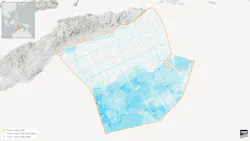
TGS, Timor‑Leste ANP expand collaboration with facies mapping products
TGS and Timor Leste’s Autoridade Nacional do Petróleo (ANP) will extend their 2D-cubed multi-client agreement to include development of Facies Map Browser (FMB) products.
These will be available to support exploration offshore Timor-Leste.
The partnership is working to improve regional geological understanding via integrated facies mapping data sets, to help operators/investors assess hydrocarbon potential and reduce exploration risk. Overall, the project covers a 53,500-sq-km offshore area.
TGS said the FMB products would be developed via integration of seismic interpretation, well data analysis and regional geological studies. The company will employ geospatial techniques to support accuracy and relevance of the outputs.
Initial FMB data sets should be ready within seven to eight months, supporting those considering participation in the third Timor-Leste petroleum licensing round.
TGS launches large‑scale 2D‑cubed seismic project offshore South Papua
TGS has also initiated a new 237,700-sq-km 2D-cubed project in offshore South Papua, Indonesia.
The South Papua 2D-cubed multi-client initiative will generate a regional-scale 3D seismic volume by integrating legacy 2D and 3D datasets across the offshore South Papua region.
TGS will deploy its 2D-cubed, structurally conformable interpolation technology to convert existing seismic data to what the company claims will be a coherent 3D volume supporting regional screening and exploration evaluation.
The project covers various underexplored frontier basins over a combined area of 237,700 sq km. This region is said to be surrounded by proven hydrocarbon systems, including the INPEX-operated Abadi (Masela) field.
To enhance data quality, machine learning (ML) technologies will feature throughout the processing workflow. ML-based denoise algorithms are applied to input datasets to improve signal fidelity, the company explained, while ML-driven quality control processes are said to support early-stage data conditioning.
That combination should increase processing efficiency and optimize input data prior to interpolation, leading to a better-quality 2D-cubed volume.
The South Papua 2D-cubed dataset will also tie together TGS’ existing West Berau 2D-cubed and Timor-Leste 2D-cubed projects, forming an expanded regional framework for basin-scale exploration evaluation across eastern Indonesia and the Timor Sea.
David Hajovsky, evp, Multi-Client, said the planned regional screening tool should support identification of structural and stratigraphic opportunities.”
TGS’ floating LiDAR campaign delivers long‑term offshore wind data in German Bight
TGS has also revealed that its floating lidar buoys in the German Bight have now been relaying data for an offshore wind investor campaign for more than two years.
The campaign includes continuous measurements of wind, metocean and environmental data, which is streamed to shore and used by the clients to support studies for current and future wind lease rounds in the region.
Since deployment began, both LiDAR buoys have delivered more than 96% data availability, TGS claims.
Offering customers access to the same floating LiDAR and metocean data can help cut development costs and timelines, the company added. Operating two systems has also allowed identification and quantification of long-distance wake effects from nearby wind farms.
About the Author
 Jeremy Beckman
Jeremy Beckman
Staff Writer / Editor, Europe
Jeremy Beckman has been Editor Europe, Offshore since 1992. Prior to joining Offshore he was a freelance journalist for eight years, working for a variety of electronics, computing and scientific journals in the UK. He regularly writes news columns on trends and events both in the NW Europe offshore region and globally. He also writes features on developments and technology in exploration and production.