Aker BP trialing Distributed Acoustic Sensing offshore Norway
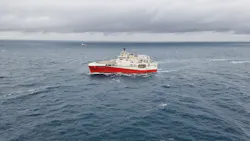
Aker BP is working on a project to qualify Distributed Acoustic Sensing (DAS) technology as an alternative to ocean bottom seismic monitoring for its fields offshore Norway.
With DAS, the company explained, fiber optic cables already on the seafloor could serve as dense networks of seismic sensors. By sending light signals through the cables, the technique can detect microscopic deformations in the fiber and convert these to seismic measurements.
The result is a continuous receiver system that follows the cable’s position on the seafloor or in wells.
Use of DAS this way to collect seismic data offshore, the company points out, would avoid the need to install thousands of sensors on the seabed.
Demand is growing for more cost-effective subsurface monitoring on the Norwegian continental shelf, it adds, to support both continued development of mature fields and carbon storage and geothermal energy, all of which will require more frequent reservoir monitoring.
Aker BP has performed various R&D trials to qualify the DAS technology as commercially practical for subsurface monitoring.
These started at the Ula field in the North Sea in 2022, where a single fiber optic cable was used to collect fiber optic data, with the results compared with conventional 2D seismic. In the Poseidon experiment the following year, the company investigated how acquisition geometry and cable response might impact imaging of the subsurface.
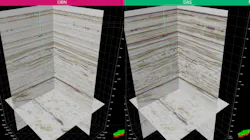
The most advanced tests took place during 2024 and 2025 at the Edvard Grieg field in the Utsira High region of the North Sea. In this case, the team used various fiber cables on the seabed and in the wells to acquire fiber optic data from the field.
Helene Hafslund Veire, Aker BP’s VP Exploration & Reservoir Development, said: “This is an important step towards more continuous and data-driven reservoir understanding.
“When we can collect data more frequently and at lower cost, we strengthen the basis for decision-making throughout the field’s lifetime.”
DAS’ biggest draw for the company is its potential for cutting the costs of data acquisition.
With traditional OBS, thousands of sensors must be positioned on and retrieved from the seabed, which involves deployment of multiple vessels, extensive logistics, and much lengthier operations compared to collecting DAS data.
Running DAS requires access to existing fiber cables, a recording system connected to the cable, and a single source vessel generating seismic signals. This combination, the company says, can cut data acquisition costs by an order of magnitude compared with conventional methods, with much reduced operational complexity.
These benefits could also open up new ways of working, such as taking more frequent measurements to improve insights into how reservoirs develop over time. That way, changes can be detected earlier and production can be more precisely optimized.
Aside from carbon capture and storage and geothermal energy, the applications could extend to monitoring of offshore infrastructure
And through use of fiber cables already installed, the company believes it can also cut the emissions associated with data acquisition using a traditional vessel spread.
Its team are now working on developing further methods acquisition, processing and interpretation of DAS data, with the analysis of 4D data from Edvard Grieg supporting investigations into whether the technology can be used to map production-related changes in the reservoir.
If successful, Aker BP claims, DAS could emerge in the future as a key tool for more widespread subsurface monitoring on the Norwegian continental shelf.