Uncrewed operations are reshaping offshore data acquisition
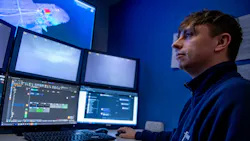
Connor Anderson, Fugro’s principal USV surveyor, shared his perspective with Offshore on how remote control, high‑bandwidth connectivity and cloud‑based data environments are influencing offshore geophysical operations, inspection practices and the evolving balance between offshore exposure, data quality and regulatory acceptance.
Offshore: How is the shift toward uncrewed and remote marine survey operations reshaping the standard workflow for offshore data acquisition and geophysics teams?
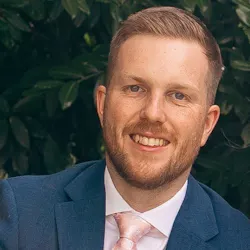
Anderson: The shift to uncrewed and remote marine survey operations is transforming offshore data acquisition and geophysics workflows by allowing our specialists to stay onshore while still delivering the same high technical standards expected offshore.
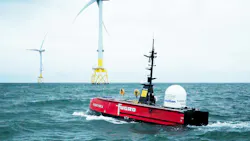
Our uncrewed surface vessels [USVs] use the same high‑specification sensors and survey systems as traditional vessels, so data quality remains uncompromised.
Through our global network of remote operations centers [ROCs], we mirror offshore control onshore. This lets experienced surveyors and geophysicists work in safer, more collaborative environments. Instead of placing the full project team on one vessel, our people can now support several projects from different regional hubs. For example, data acquisition might be managed from Aberdeen, while processing and interpretation teams collaborate from elsewhere in Europe or Africa.
Offshore: What technological advances are having the biggest impact on improving data quality and reducing offshore exposure?
Anderson: A key enabler has been the rapid advancement of satellite communications. Low Earth orbit systems now provide wider, faster, cheaper and more stable connectivity than legacy very small aperture terminal solutions. This allows continuous, high-volume data streaming from offshore assets directly to shore in near real time—something that simply wasn’t possible a few years ago.
For offshore survey operations, this means data no longer needs to be physically transported via hard drives or vessel port calls. This enables us to safely reduce the number of personnel required at sea, while still maintaining full operational oversight from our ROCs. These high-performance communication links are central to the evolution of our USVs, supporting increasingly complex, multi‑sensor survey scopes to be executed with the same data assurance standards as conventional vessels. Combined with cloud-based Geo-data platforms, they allow globally distributed teams to collaborate efficiently on large offshore datasets without delay.
Offshore: How are remote inspection workflows evolving, both technologically and culturally, and what breakthroughs are still needed to achieve full confidence and regulatory acceptance of remote‑first offshore energy operations?
Anderson: The main culture change is in how remote inspection jobs work now. Personnel can transition to onshore roles. Instead of being deployed for weeks at a time at sea, these new kinds of roles allow them to have much more regular working hours in an environment with less risk than offshore.
The integration of increasing levels of digitization and data science also means the industry is increasingly looking for skills in software engineering, Big Data and cloud computing, alongside the marine and geological expertise we have always needed. As part of this transition, we are supporting both the upskilling of our traditional marine workforce and the training of new talent to thrive in these emerging remote and onshore workflows.
Together with greater digital integration, regulatory assurance is equally important as remote and uncrewed operations scale. As one of the few operators to have achieved Maritime and Coastguard Agency (MCA) approval for our USVs, Fugro continues to operate within a formal maritime safety framework, which is critical for building confidence with clients.
Remote operations are not about removing people from the workflow; they are about transitioning people to a new way of working, while keeping their expertise fully embedded in the process.
Offshore: As marine geodata becomes increasingly digital, what challenges remain around data assurance, integration and interpretation across large‑scale offshore projects?
Anderson: Large-scale offshore developments can generate terabytes of multi-sensor, multi-platform data. Managing, structuring and quality controlling that volume of information remains a significant challenge. Without robust systems, datasets can become fragmented or difficult to access, slowing decision-making and extending project timelines.
At Fugro, we’re using VirGeo, our cloud-based file transfer storage environment specifically for geodata that eliminates the need to manually offload and transport data from vessels. Experts can access the latest datasets from anywhere in the world. It lets clients remotely monitor project progress, view data acquisition status and engage with datasets in near real time, which helps reduce bottlenecks, enhances collaboration, and keeps data accurate, accessible and actionable throughout the project lifecycle.
Offshore: How is the growing emphasis on decarbonization and sustainability influencing the tools, platforms and methodologies used in marine geoscience today?
Anderson: Decarbonization is accelerating the adoption of smaller, more energy-efficient platforms to carry out marine geoscience work. USVs and electric ROVs can use up to 95% less fuel than conventional large survey vessels, drastically reducing the carbon footprint for offshore projects.
For offshore energy operators, including both oil and gas operators and those in renewables, integrating USVs into survey scopes provides a practical way to reduce emissions without changing the technical requirements of the work. As sustainability metrics become increasingly embedded in project evaluation, these operational efficiencies are becoming an important differentiator in offshore marine geoscience.
About the Author

Ariana Hurtado
Editor-in-Chief
With more than a decade of copy editing, project management and journalism experience, Ariana Hurtado is a seasoned managing editor born and raised in the energy capital of the world—Houston, Texas. She currently serves as editor-in-chief of Offshore, overseeing the editorial team, its content and the brand's growth from a digital perspective.
Utilizing her editorial expertise, she manages digital media for the Offshore team. She also helps create and oversee new special industry reports and revolutionizes existing supplements, while also contributing content to Offshore's magazine, newsletters and website as a copy editor and writer.
Prior to her current role, she served as Offshore's editor and director of special reports from April 2022 to December 2024. Before joining Offshore, she served as senior managing editor of publications with Hart Energy. Prior to her nearly nine years with Hart, she worked on the copy desk as a news editor at the Houston Chronicle.
She graduated magna cum laude with a bachelor's degree in journalism from the University of Houston.