Advances in visualization support innovative interpretation
Philip Neri
Paradigm
The world of volume interpretation and visualization is evolving with the advent of a new parameter that exceeds the capabilities of traditional systems. While it has been possible to visualize pre-stack data for some time with some ingenious adaptations of a full multi-attribute 3D viewer, the azimuth component demands specific viewing techniques, as well as the support of tools such as illumination ray path features and attributes volumes. Together, they deliver a better view of a reservoir under a complex anisotropic overburden.
Visualization technologies have come a long way since the first 3D voxels started showing novel concepts such as transparency and sculpting on computer screens about 15 years ago. The evolution has followed two trends: One, handling ever-increasing amounts of data; two, enriching the visualization process with a larger number of data types and rendering of specific data objects.
In terms of simply viewing data, the possibility emerged in 2003 to use disk cache instead of live memory to store large data objects such as seismic, making it possible to view datasets many times larger than the physical memory of the computer. This led to the use of 3D display and interpretation tools within routine workflows, while leaving high-end capabilities such as automated sub-volume detection to the dedicated visualization tools which worked only on data in live computer memory.
More recently, the performance of input/output devices has improved dramatically, in parallel with a significant increase in the computer’s own internal bus speed and its improved data handling architecture. This opens the way to many capabilities once only possible from computer memory to become a realistic proposition for working on data residing mostly on disk. While this does not imply there is no need for dedicated voxel visualization tools, some key capabilities are emerging.
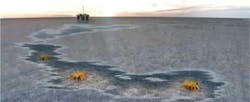
One of them is the application of transparency capabilities to 2D seismic surveys. This allows the geoscientist to line up a succession of 2D profiles and move the display around in three dimensions while looking for a preferential direction along which sometimes elusive features may come to the fore. Known as optical stacking, this eliminates tedious back-and-forth workflows to verify assumptions regarding a fault’s direction and development. This is particularly relevant to 2D seismic profiles, where ambiguities are more frequent due to the nature and limitations of the data and of sections, as opposed to 3D migrated volumes.
The age of pre-stack
In terms of real change, however, the growth of interest in pre-stack seismic data puts pressure on visualization tools to help interpreters manipulate not only large amounts of data, but also data objects that are not part of the post-stack x-y-time or x-y-depth coordinate system. This demand for visual access to pre-stack versions of the stacked image volume stems from the challenges of investigating very detailed and intricate features in the process of qualifying and characterizing the subsurface.
In the field of Amplitude Versus Offset (AVO), for a long time interpretation of such anomalies used 3D volumes of an attribute of the AVO effect, such as the AVO gradient, a value calculated for each point which assesses the variation in amplitude over a range of offsets. Such attribute volumes were more readily useable for interpreters, and they avoided the need to have pre-stack data accessible directly to the interpretation software. Often oil and gas operators do not have even access to pre-stack data, for example licenses to non-proprietary seismic data sets, so the availability of attribute volumes representing characteristics of the pre-stack data is acceptable. Amplitude Versus Angle (AVA) attributes are designed to extract elastic properties from the seismic data based on the Zoeppritz equation. In modern systems, it is good to co-visualize post stack data, pre-stack data, and AVA attributes, as AVA pitfalls are many.
Pre-stack data is stored mostly in an object generically described as a gather. This terminology denotes that all the traces are combined (stacked) into a single trace. That single trace is one of the constituent elements of either a 2D profile or a 3D volume. A common way to visualize pre-stack data for a single section or traverse within a 3D seismic survey has been to display the gathers along the y-axis of a 3D volume, with the x-axis representing each trace. This is not new; it has been practiced since the very early days of interpretation workstation technology, albeit with some background manipulation of data.
Azimuth added to attributes
The advent of voxel visualization added investigative possibilities to these pre-stack volumes. What stimulates further development and a more formal data environment is the advent of additional attributes associated with pre-stack data samples, notably azimuth. A gather has to embody a data parameter if it is to organize the traces in some order. Typically, this has been the offset, i.e. the distance from shot to receiver for each particular trace.
Target-based migration has introduced reflector angle as the sequencing parameter for gathers. However, by representing gathers of either type as a planar section, there is an implicit assumption that all the traces in the gather occurred in the same vertical plane. This is true mostly for 2D data, where the source and the receivers follow an identical and mostly rectilinear path. For 3D data and in modern offshore multi-streamer or onshore multi-swath acquisition patterns, there is a strong directional component to the energy which contributes to a gather. What began as a byproduct of larger and wider source-receiver patterns aimed mostly at cost-effective and high-productivity data acquisition, has become critical to the need to model and measure anisotropy where it exists.
Today, in many high-profile hydrocarbon plays, energy companies are ordering rich azimuth data, which entails the use of field acquisition geometries that optimize the spread of different source-receiver azimuth directions for the areas and depths of interest. Papers have been written about ways to plan, acquire, and process rich azimuth data. This article concentrates on the outcome, i.e. gathers where each trace is organized not only by reflector angle, but also with an azimuth component.
‘Natural’ display
The challenge is to develop a visual tool that naturally displays the information to the geoscientists, and allows them to understand what has become information-rich data. They need it to relate to the 3D volumes of processed data which they use to interpret the stratigraphic and structural elements of the subsurface, and to infer the characteristics of individual formations and reservoirs with the help of pre-stack information.

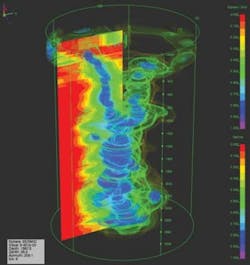
This new viewing tool uses the same visualization components as the traditional interpretation canvas; the novelty is the projection coordinate system. It consists of a cylinder, where the vertical dimension is depth, and the central axis carries the value zero for reflector angle. Points away from this axis are defined by angle and azimuth (0° to 360°), and their position on the vertical axis.
Where the background velocity is correct, any given reflector appears flat for all angles and all azimuths. The case of an asymmetric, non-flattened seismic event indicates velocity variations stemming from a higher level of heterogeneity and azimuthal anisotropy effects. This level of information becomes increasingly important as propagating seismic energy to deep targets under complex overburdens becomes more challenging.
The use of the cylindrical offset viewer is similar to a traditional voxel visualization tool, except for the circular reference system. Transparency, sculpting, and other methods can be applied to seek and to highlight events of a certain type or level of energy. A horizontal, circular slice tool can be moved up and down to see the whole value range in a transparent view. A vertical panel centered around the zero axis can be rotated around the 360° circle to see data projected onto it.
The slice or disk view is of particular interest to visualize complex illumination situations in an anisotropic environment. However, since the eye does not readily interpret an angle in a planar view, the viewer has an additional display space above the cylinder view that is shaped as a half-sphere or dome. As the slice tool slides up and down the vertical axis, the same data is projected into the dome, with the higher-angled data on the steeper flanks of the dome and the small angles close to the summit of the dome near the apex. This is visually more approachable and makes it easier to relate to effective angles.
One can obtain a detailed view of the constituent energies of any stack volume trace by clicking on it and activating the cylindrical viewer for full and interactive access to the original data. Once anomalous events are noted, the challenge is to understand their origin and to validate that they relate to overburden anisotropy or other verifiable particularities of the subsurface, and are not the result of processing or modeling error. The best verification is to visualize the actual assumed ray path that the seismic energy would have followed from the source to the target and back to the receiver.
Ray path viewing becomes necessary to the overall visualization, interpretation, and modeling workflow. The illumination function is not only operational, but also is linked to the pre-stack data viewer to make it possible to highlight a particular ray path or ray paths associated with a specific point in the subsurface.
Closing the loop
This closes the loop for the geoscientist: to investigate a crucial area of the subsurface, he uses a pointer tool to activate the pre-stack full azimuth viewer, and in the event of an indication of potential anisotropy or other preferred azimuth, can then see the ray paths that illuminate the area of interest on the current subsurface model.
This workflow is far from trivial, especially in the context of a large survey for which it is difficult to allocate the time and resources for all these checks. A number of derivative data volumes can help high-grade a dataset to focus on the areas with an azimuth-related risk to the prospect ranking and subsequent drilling activities. Azimuth gradients are an obvious candidate, but beyond such computations a more valuable indicator takes the form of a reliability attribute. This evaluates the complexity of the illumination of each point in the volume, and highlights areas of little or no zero-angle energy. Such areas, once brought to the geoscientist’s attention, should be investigated with the workflow established for pre-stack azimuth anomalies.
These new tools are at today’s technology frontier. It will be interesting to see how quickly they become a ubiquitous solution for routine activities.