Faroese exploration focus switching to new plays
Heri Ziska, Jardfeingi
Operators on the Faroese continental shelf are taking a more measured, longer-term approach to exploration, as they and their partners weigh plans for future wells.
The primary trap type under review is one that has in recent years brought a success rate per wells drilled of around 60%. That figure does not include the Rosebank and Cambo discoveries, both of which currently are undergoing appraisal.
Should Chevron achieve positive results from its first appraisal well on Rosebank, in UK waters west of Shetland, there will be a significant impact on activity in nearby acreage, with the Rosebank equity holders being the same as those on adjoining license L008 on the Faroese side of the boundary.
The first wave of Faroese offshore exploration was launched with intense optimism and talk of field development even before the first spud. The actual outcome was one outright discovery (Marjun), one well with “hydrocarbons in non-commercial quantities,” one well with shows, and one totally dry well, all of which engendered a general feeling of despair over future exploration activity on the shelf.
Fortunately, the pessimism soon turned to optimism, because the discovery ratio has been high since 2003. Amerada Hess drilled the Cambo well (204/10-1) that year, with persistent rumors of a successful outcome. Hess, however, has not released any information about the well.
Chevron drilled Rosebank/Lochnagar (213/ 27-1) in 2004, and this has been confirmed as a discovery on two geological levels. That same year, Total drilled an appraisal well on the Laggan discovery, the well being tested with positive results.
The common denominator for all these wells is that they have been drilled on structural highs, as was the case with Marjun, a first Faroese licensing round discovery. Most recent dry wells in the Faroe/Shetland channel have targeted prospects with a significant stratigraphic component.
Nick Loizou at the UK Department of Trade and Industry analyzed the relationship between success rates and trap type during 1995 - 2002. His results show that the success rate for wells targeting structural traps is 60%, while stratigraphic trap wells have had a zero success rate. Traps with both structural and stratigraphic elements had a 25% success rate.
The exploration focus since moved from one of chasing stratigraphic traps with a structural element in one sub-basin, to a more conventional approach involving a search for large-scale structures in the area of the Faroe/Shetland basin, where all the finds previously mentioned are located.
There had been an assumption that large, structural traps would be found under Palaeogene flood basalts, which cover most of the Faroese continental shelf. Early data, however, had a detrimental effect on imaging of the underlying rocks. The flood basalts still have a negative impact on seismic data, but mapping structures beneath the flood basalts is no longer seen as an obstacle to exploration at these levels.
On the basis of these new findings, the Faroese Minster of Trade and Industry has approved the transfer of work commitments from the stratigraphic play in the Judd basin - which is free of basalt cover - to structural traps further into the basalt-covered area.
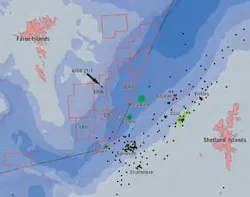
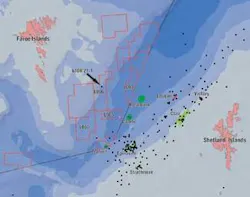
The first of these wells, 6104/21-1, was spudded by Statoil in mid-July in offshore license L006 (see map). BP plans to drill the second of these wells in L007 in 2007. ENI also will drill a well in the near future on 1st Round license 005, under renegotiated terms which grant it an extension of the original license period.
All these wells are being drilled on structural closures located above different basement highs, where the underlying geology has yet to be proven by a well. It is not possible, therefore, to predict with great certainty if future discoveries will be analogous to finds in similar settings in the Faroe Shetland Channel, such as Rosebank and Cambo (stratigraphic levels not disclosed), Strathmore (Triassic), Victory (Cretaceous), and Clair (Devonian, Carboniferous).
However, the knowledge that these discoveries have been made on many different basin highs and different stratigraphic levels - coupled with the current well program on this part of the Atlantic Margin - do inspire optimism for the future of exploration on the Faroese shelf.
For more information, contact Heri Ziska, Jardfeingi (Faroese Earth and Energy Directorate):[email protected].