Eni hires Saipem for intensive subsea construction program at Baleine offshore Côte d’Ivoire
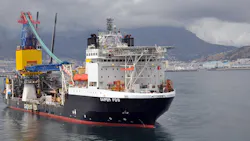
Eni has awarded Saipem a wider-ranging contract covering the subsea facilities for the deepwater Baleine Phase 3 oil and gas field development offshore Côte d’Ivoire.
Saipem’s work scope covers engineering, fabrication, transportation and installation of around 50 km of rigid pipelines and associated subsea structures; and T&I of flexible risers, flexible jumpers, subsea production systems, a 3-km-long flexible gas export flowline and 22 km of subsea umbilical.
Water depths across the project area are up to 1,300 m.
Saipem will allocate the construction vessels FDS and Shen Da during the three-year program.
Baleine is Eni’s major deepwater oil and gas development offshore Côte d’Ivoire (Ivory Coast)—the country’s largest hydrocarbon discovery and its first commercial find since 2001.
Discovery and field basics
Eni discovered the field in 2021 in blocks CI-101 and CI-802 (roughly 70 km offshore Abidjan). Water depths range from about 700–1,300 m. Estimated resources have been reported around 2.5 billion barrels of oil and 3.3 tcf of associated gas (or up to ~3 billion boe in some accounts).
It is described as Africa’s first net-zero emissions (Scope 1 and 2) upstream project. Eni has been active in Côte d’Ivoire since 2015 and also made the nearby Calao discovery.
Partners include (with approximate current interests): Eni as operator (~47.25%), Vitol (30%), and state company Petroci (~22.75%).
Phased, fast-track development
Eni has used a phased approach for early production while optimizing costs and leveraging infrastructure:
- Phase 1 — First oil in August 2023 (under ~2 years from discovery). Refurbished FPSO handling initially ~15–18 kb/d oil and ~25 MMcf/d gas.
- Phase 2 — Brought online in late 2024, raising output to around 60 kb/d oil and ~70–80 MMcf/d gas (using additional floating facilities, including the Petrojarl Kong FPSO and an FSO).
- Phase 3 — Final investment decision (FID) taken in late May 2026 in Abidjan (with government attendance). Capex estimates for the phase are in the ~$2.5–4 billion range. It will add a new FPSO and related subsea infrastructure to take total field production to ~150 kb/d oil and 200 MMcf/d gas. All gas is earmarked for the domestic market (power generation and industry).
The new FPSO (Altera Infrastructure, with construction by China’s Wison New Energies) is designed for ~90 kb/d oil production, ~160 MMcf/d gas processing, and ~1.4 million barrels storage; it is expected to support the mid-to-late decade ramp-up.
Context of the Saipem award
The news release covers Saipem’s contract for a major subsea construction and installation package on Phase 3: engineering, fabrication, transportation, and installation of ~50 km of rigid pipelines and associated structures; T&I of flexible risers, jumpers, subsea production systems, a 3 km flexible gas export flowline, and 22 km of umbilicals. Water depths reach 1,300 m; the program is expected to last about three years and will use the vessels FDS and Shen Da.
This fits a broader wave of Phase 3 awards after the May 2026 FID, including:
- SLB OneSubsea for subsea production systems (for 13 wells),
- TechnipFMC for flexible flowlines and risers,
- Altera/Wison for the FPSO,
- and a separate Saipem drilling contract (~$260 million) involving the Santorini drillship (operations targeted from early 2027).
Saipem’s Baleine work formed part of a larger ~€800 million award package from Eni entities that also included an onshore deoxygenation unit at Enilive’s Venice biorefinery.
Overall, Phase 3 continues Eni’s fast-track model in the country, aiming to more than double current oil output while directing gas to local needs and supporting Côte d’Ivoire’s energy security and industrial growth. Production from the full Phase 3 development is targeted within roughly three years of FID.
About the Author
 Jeremy Beckman
Jeremy Beckman
Staff Writer / Editor, Europe
Jeremy Beckman has been Editor Europe, Offshore since 1992. Prior to joining Offshore he was a freelance journalist for eight years, working for a variety of electronics, computing and scientific journals in the UK. He regularly writes news columns on trends and events both in the NW Europe offshore region and globally. He also writes features on developments and technology in exploration and production.