Murphy Oil pursuing hub and spokes approach for offshore Vietnam discoveries

By Jeremy Beckman, Editor, Europe
Murphy Oil sees potential for two hub developments on its blocks in the Cuu Long Basin offshore southern Vietnam, following a string of exploration successes over the past few years. The first hub will be at the current Lac Da Vang (Golden Camel) development in Block 15-1/05, due to deliver first oil toward the end of this year.
Last year’s Hai Su Vang (Golden Sea Lion) discovery in Block 15-2/17 should form the lynchpin of a second hub, depending on the outcome of ongoing appraisal and future exploration drilling in the area.
Senior representatives outlined Murphy’s plans during a recent webcast.
Exploration success sets the foundation
President and CEO Eric Hambly said the journey to get to this position started in the 2000s when the company acquired two blocks offshore Malaysia that were previously owned by a supermajor.
“Early on we discovered and quickly developed the West Patricia oil field – the cashflow from that financed further exploration, including the Kikeh [deepwater oil] discovery," he said. "And that led to more discoveries.”
Murphy’s exploration team had wondered whether some of the initial gas finds could in fact be gas caps of underlying oil reservoirs.
“That hypothesis proved correct,” Hambly said, spurring drilling and discovery of more oil fields. “It became the showcase of Murphy’s technical creativity – taking what were considered marginal assets and unlocking additional volumes."
He continued, “PetroVietnam took notice, recognized our success in delivering on exploration and development and invited Murphy directly to explore in the Cuu Long Basin in 2018.”
(The company had entered Vietnam in 2012 and the Cuu Long Basin in 2015, partnering with PVEP in shallow-water blocks and in the deepwater Phu Kanh Basin).
Why Vietnam works for Murphy
Chris Olson, svp of Exploration and Subsurface, said Vietnam’s government has ambitions for the country to be a high-income nation by 2045. The Cuu Long Basin, which currently provides 80% of Vietnam’s oil production, is positive for Murphy as a low-cost operating environment.
“Why is Vietnam’s energy landscape structurally attractive? The government recognizes the need for foreign participation. The economy depends on fossil fuels for over 50% of power generation, but domestic production has been declining for over a decade while consumption is increasing. There is a growing reliance on oil imports [around 200 MMbbl/d at present], and also imports of LNG," Olson said. “But Vietnam has meaningful remaining potential with 6 Bbbl of crude reserves and 38 Tcf of proven gas. Unlocking the reserves requires new investment, which fits Murphy’s operational model."
Over the past few years, “Vietnam has emerged as a stable, reliable place to invest in by implementing major investment and business reforms, and this has driven an influx of global capital," he continued. “Today, foreign investment accounts for more than half the country’s GDP…And its terms are globally competitive.”
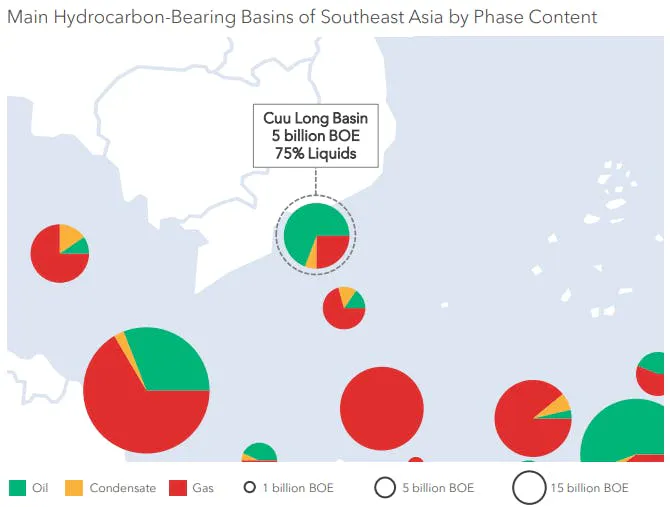
The Cuu Long Basin has 57 discovered fields containing 5 Bboe, and still has potential for future finds, Olson said, adding that Murphy’s blocks are in the center of the basin’s prolific oil-prone source rock area.
“Hai Su Vang is optimally placed to this mature source rock with favorable migration pathways,” he said. The basin’s source rock features nearly every permeable/porous layer from the pre-Cretaceous/Miocene. “This oil accumulates, with various exploration opportunities that remain to be tested. And that materially reduces the exploration risk,” he added.
Murphy’s initial discovery of the White Camel (LDT) Field in Block 15-1/05 in 2019 led to further discoveries.
Hub-and-spoke development at Lac Da Vang
Francisco Garcia, svp of Development and Engineering, said in 2021, “we fixed on a hub model to maximize efficiency [and] shorten cycle times. The hub-and-spokes approach supports processing and export infrastructure and tiebacks of possible future finds.”
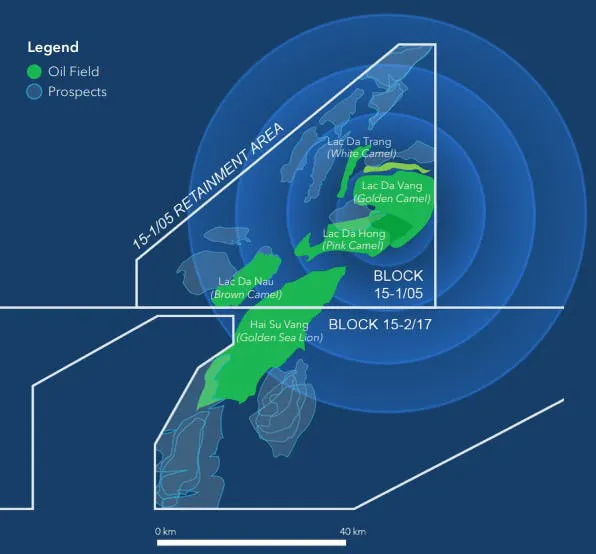
The Lac Da Vang (LDV) project, sanctioned in late 2023, is on track for first oil in the fourth quarter. The initial phase is designed to recover 100 MMboe from Eocene sandstones, with 10,000-15,000 boe/d net to Murphy (Petrovietnam and SK Earthon are the other partners).
The floating storage and offloading (FSO) vessel arrived at the field earlier this year, and the topsides for the central complex Lac Da Vang-A platform are due to be installed in the third quarter.
Expanding LDV through tiebacks and new drilling
Next-phase plans include adding a second platform, LDV-B, and drilling more wells through 2029. In the future, the facilities will serve as a hub for tie-ins of other discovered fields, including LDT and Lac Da Hong (Pink Camel), although some may need further appraisal before the partners commit to development.
The complex could also host tiebacks of future discoveries targeting different play types, Garcia said.
“All the tieback opportunities are large enough, and there is potential in other accumulations on 15-1/105, with a very good chance we will continue to find oil in these prospects,” he continued.
Hambly added that an exploration well will be drilled later this year on the White Camel North prospect in Block 15-1/05.
“In 2027-29, we have quite an active exploration program on remaining prospects to work up for development," he said. “We’re looking at 20-40 MMboe for the future tiebacks range for optimal development over time. That could mean adding an FPSO and pipeline infrastructure – or we may need to expand LDV with more processing.”
Hai Su Vang appraisal targets second hub
Hai Su Vang (HSV) on Block 15-2/17V is undergoing further appraisal/delineation drilling this year to firm up the recoverable resource, currently estimated at 170 MMboe to 430 MMboe.
Prospectivity on the block had been identified for several decades, Garcia said. It was previously operated by a supermajor.
“By leveraging previous learnings, we came up with a unique concept for a play that has largely not been tested on the Cuu Long Basin," he said. “We were impressed by the quality of reservoirs discovered, and the targeted Oligocene-H sands represented the first approach to that different concept.”
Based on the two successful wells drilled to date, the field’s aerial extent appears to be the size of Manhattan, he suggested.
“But we still have a lot to learn about the field. [This year] we are working on drilling the 3/X and 4/X appraisal wells - 3X on a northeast extension of the field, 4/X on the southwestern part of the field,” he said.
3/X is designed to test the potential of four deeper reservoirs than those drilled to date.
“These two wells will give us four penetrations in the reservoirs, covering the breadth of the structure. We will have an update on the wells and resource range in the middle of the year, or August,” he added.
Development options and economics under review
Going forward, the company has various development options under consideration. “The next milestones will be to sanction the project by end-2027, followed by first oil in 2031,” he said.
Murphy has started to evaluate concepts, Garcia said. “One is a design similar to Golden Camel – the main issues include determining what are the costs and what it takes to deliver.
“The other concept is an FPSO redeployment. Each has trade-offs when it comes to scale, schedule, opex and capex estimates. We will use our proven field development tieback record for accelerating first oil. Once online, HSV will be our second hub, and once the infrastructure is in place, we can explore further.”
Murphy estimates $390 million capex for the initial development, rising to $950 million in total as more platforms and wells are added. “One partner in the block is offering 25% for sale – we could pre-empt this," he added.
“HSV may prove more cost-efficient to drill than LDV,” Olson said, “and may need fewer wells that are higher-performing from the same reservoirs. But it’s a large structure so we may also need multiple drill centers."
He continued, “The 1/X well delivered 10,000 bbl/d in a flow test, while 2/X flowed 12,000 bbl/d, both better than the basin average from other reservoirs developed. Within the pay section porosity varies, but we do have confidence in highly productive reservoirs. Porosity is also one of the seven factors that will determine how much oil is recovered.”
About the Author
 Jeremy Beckman
Jeremy Beckman
Staff Writer / Editor, Europe
Jeremy Beckman has been Editor Europe, Offshore since 1992. Prior to joining Offshore he was a freelance journalist for eight years, working for a variety of electronics, computing and scientific journals in the UK. He regularly writes news columns on trends and events both in the NW Europe offshore region and globally. He also writes features on developments and technology in exploration and production.
Related
