Expanding possibilities
The upstream industry will likely do more this year because of capex increases of 15-20% by several oil companies. So, now is the time to consider what “visions” to pursue.
Yes, current projects need to be completed, and much of the newly available money will go to support those efforts. But, what are your “exploration dreams”?
• Maybe you dream of an untapped exploration territory: seek out the Ganges Fan or the Australian Bight. Both are seriously under-explored and hold many cubic miles of potentially productive sediment
• Maybe you envision natural gas potential: consider Jamaica and review its first licensing round offerings. The Caribbean is gaining traction as a natural gas supplier to the US, and a new offshore LNG facility has just gone into operation
• Maybe you dream of more efficient exploration: try some of the broader technologies like gravity, magnetics, or controlled source electromagnetic exploration. Nodal seismic and geochemical surveys can reduce your exploration risk as well and help focus your company’s drilling efforts for a fraction of the cost of a dry hole.
To extend Pratt’s famous quote regarding oil exploration: Oil is found in the dreams of the exploration mind. Choose an unexplored vision to test in 2005. It makes a great resolution.
Deep gas research
The US Department of Energy awarded five cost-shared research projects to help meet America’s growing demand for natural gas. The new projects will develop advanced diagnostic tools and technologies to reduce exploration and development risk for deeper gas and tight fractured reservoirs. These new projects are supported by $4.2 million in Energy Department funding:
•3DGeo Development Inc. will use wave-equation migration, angle-gathers velocity model building, and wave-equation illumination and amplitude compensation technology to improve image resolution and reservoir characterization of ultra-deep geologic structures
•Paulsson Geophysical Services Inc. will develop and test a robust multi-component sensor that combines fiber-optic and micro-electro mechanical systems technology for use in a borehole seismic array
•RDSP I LP will improve deep gas reservoir characterization using inelastic rock properties that result in frequency-dependent wave velocities and intrinsic wave attenuation to discriminate pore fluids and lithology
• Technology International Inc. will develop an integrated seismic-while-drilling system to provide real-time pore pressure and seismic imaging ahead of the drill bit
• The University of Texas at Austin will evaluate a new marine seismic technology able to image gas resources at depths not possible with previous marine seismic data.
Ocean research
BP America and Scripps Institution of Oceanography at the University of California, San Diego, signed a three-year, $3-million partnership to image and characterize the seafloor and sub-seafloor.
The focus of the program is developing and evaluating new technologies for this task using a wide variety of surveying techniques: electromagnetics, fiber optics, acoustics, autonomous underwater vehicles, and ocean bottom seismographs.
“We need to understand better the processes that control the architecture of continental margins across a variety of spatial and temporal scales,” says Neal Driscoll, a professor in the Geosciences Research Division at Scripps and principal investigator of the project. The project is similar in concept to other BP partnerships with Cambridge University, Princeton University, and the California Institute of Technology.
TECHNOLOGY
Integrated software suite
HRH Geological Services has launched its integrated software suite, Gravitas. The software collects well site data, produces geological logs, and generates reports on oil and gas exploration wells within one suite of programs.
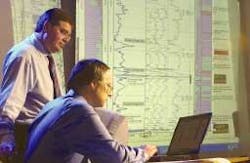
“Gravitas was developed in close cooperation with oil and gas major, Total,” HRH founder David Harrison says. “It comprises three key software components that ensure integrity, accuracy, and facilitate data manipulation and presentation about wells anywhere in the world.”
Computing on-demand
Massively Parallel Technologies is developing the world’s first Virtual Power Center (VPC), a new means of accessing supercomputing power. Using Howard technology, VPCs will deliver supercomputer-like processing power through the Internet to users on-demand.
VPCs simplify high performance computing with:
• A menu bar to select and control the system
• “Steerable computing” that gives the user real-time control
• Holographic check-pointing to redirect activity from a failing node
• Real-time scalability that lets the system increase the number of processors in the middle of a job
• Computational starts before the ideal number of processors is available
• Automatic addition of processors as they become available
• A heterogeneous system that allows PC and Apple nodes to work within the same cluster.
Massively Parallel’s Howard technology solves the problems described in Amdahl’s Law and allows for near linear scalability of parallel processing.
EXPLORATION
Kenya survey
ThePolar Duke vessel began seismic acquisition of a 3,600-km infill 2D survey in blocks L-5 and L-7 offshore Kenya for Dana Petroleum. The survey will build upon and refine the 2003 survey data to guide selection of exploration well locations scheduled for late 2005.
Jamaica licensing
The Jamaican government and the Petroleum Corp. of Jamaica (PCJ) launched their first formal licensing round, with 22 offshore blocks offered in the Walton basin on the south side of the island. Water depths range up to 750 m. Eleven wells have been drilled in Jamaica’s territory, but only two offshore.
The exploration phase includes a 2-year seismic evaluation period, 3-year drilling phase, and 1-year extension, if PCJ approves. Other terms include a 33-1/3% income tax, 12.5% royalty, and carried interests for PCJ.
The licensing round opened Jan. 1, and will close July 15. Data packages and related reports are available. Contact Dr. Raymond Wright, Petroleum Corp. of Jamaica at email: [email protected] or www.pcj.com.
