Advancements in logging technology
Fiber optic sensor opens new way for wellbore intervention
John Waggoner
Technology Editor, Drilling & Production
Logging is no longer just for coiled tubing or wireline operations. Advanced fiber optics technology now is available that provides continuous wellbore information along the entire length of a compact sensing cable.
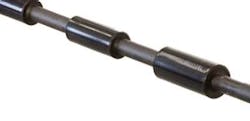
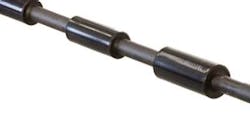
The ZipLog tool, developed jointly by Ziebel and Sensornet, represents an advance for reservoir management technology in declining and complex fields since the cable itself is the sensing device.
It combines Sensornet and Ziebel patent applications with experience in developing novel technology for downhole solutions.
The fiber optic sensor is incorporated into a spooled, semi-rigid, self-straightening composite rod that is pushed into wellbores for logging much like coiled tubing interventions. Once run to depth (without the need for a wellbore "tractor") and "parked," the tool can be monitored over the length of the sensing cable for production and/or injection rate data without repositioning.
Since the sensing cable is compact and has no moving parts, it is immune to some of the vibrations and interferences that can affect other wellbore monitors. It also is able to withstand high temperatures. This allows surveying in some wells where wireline is not possible and it also enables limited rig-up interventions.
The proprietary surface system and logging rod is compact enough that rig-up and deployment are possible on wellheads with limited head room.
The surface deployment system has an injector mechanism that pushes the rod into the well through the BOP with a pack-off sealing system above. The rod is guided through a "goose neck" from the spooling unit, where the rod is contained safely on a specially made drum with brake facilities. If needed, the specially designed shear-ram system can cut the composite rode and/or seal against it.
A Ziebel control and monitoring package operates the system and collects real-time data from the surface and downhole sensors.
Since smaller offshore structures can have lighter crane capabilities and minimum deck space, a unique solution was devised to mobilize and rig-up the system. This system took about two years to develop and qualify, including exposure to NACE standard chemicals and testing of a number of rod dimensions and constructions. The resulting system was qualified with a 3,900-m (12,795-ft) spool of rod with a tailor-made surface injector and pressure control system. Later a 6,000-m (20,000-ft) long rod was introduced into US horizontal wells.
With these characteristics, ZipLog can be used for:
- Well integrity issues such as leaks and gas lift optimization
- Flow allocation from temperature profiling
- Injection allocation
- Cross-flow verification and monitoring
- Inflow/injection valve operation
- Steam flooding performance.
Bridging the gap
One advantage of ZipLog is its ability to close the "gap" between the data available to operators, and what actually is occurring in the well at the time that data is understood.
Unlike conventional production logging, the new device does not require instruments to be moved up and down the wellbore to log the different zones. Therefore, it avoids time consuming and complex procedures that can lead to lost production, says Sensornet general manager, Richard Kluth.
According to a presentation at SPE’s Coil Tubing & Well Intervention Conference and Exposition earlier this year, the operational efficiency of the new well intervention methodology is impressive. The complete system has been rigged up on an offshore facility in two hours, compared with historical rig-up time closer to 24 hours.
Data acquisition system
The ZipLog tool uses a fiber-optic technology called Distributed Temperature Sensing (DTS). DTS provides continuous information along the entire length of the cable with measurements every 1 m (3.2 ft), instead of collecting data from individual temperature sensors.

Interventions in the winter of North Dakota, USA, at a surface temperature of -20° C (-4° F).
The effectiveness of the system relies on the ability to detect subtle differences in temperature (even less than 0.01º C) at all points along the sensing cable. The system provides a fully distributed temperature profile, with detailed information on both well integrity and flow. Since the system operates in real time, the operator can use the data to respond to events in the reservoir virtually as they occur.
The surface DTS data acquisition system designed by Sensornet is called the "Sentinel." The Sentinel has a laser source for interrogating the sensing fibers contained in the composite rod, and updates the data along its entire length every 10 seconds. Its unique high resolution Temperature Data makes it possible to model the temperature profile across the reservoir to an Inflow Performance Curve related to well production and injection.
To determine pressure, Sensornet’s partner Ziebel has developed a high-precision fiber optic sensor, embedded in the "bull nose" at the lower end of the composite rod. The sensor is based on eccentric Fabry-Perot interferometer (EFPI) technology, which gives an accurate air gap measurement. According to the manufacturers, this sensor has advantages over other fiber optics, due to its fine-tuned calibrations and immunity to electromagnetic interference.
In addition, they have developed a point temperature sensor also embedded into the same "bull nose." Motion sensing is also built into the "bull nose" to show movement at the lower end of the rod in horizontal wellbore sections. This feature improves the safety of the system, since an operator will know from the Ziebel surface real-time display if the "bull nose" is snagged downhole in time to avoid equipment failure by halting insertion.
Verifying depth from the surface is always important, but the combination of using the monitoring devices and the surface panel to measure force applied to the rod makes it possible to verify movement and position. With reach simulations for push and pull forces combined with the stiffness and virtually no stretch in the rod, surface depth counters, the downhole movement verification tool, and the DTS data, it is possible to get a very accurate depth control system, says Hansen.
To date, eight wellbore interventions have been performed in challenging open hole wellbore sections with substantial debris present in horizontal sections. These interventions provided valuable learning and experience, leading to improvements to the system and procedures. Ziebel has a number of new wells to be investigated and expects the first offshore deployment soon.
Typical information acquired from open hole interventions performed:
Middle East – Horizontal oil production well
- Flow allocation - Identified and quantified inflow distribution in the horizontal wellbore section
- Maximization of gas lift valve operation - Operational performance and gas lifting efficiency evaluated
- Gas lift injection rates versus inflow efficiency from horizontal wellbore evaluated
- Pressure data - Acquired pressure build-up and drawdown data, as well as fluid gradient from surface to horizontal section.
Middle East – Horizontal water injection wells
- Injection distribution - Identified and quantified injection rates in the horizontal wellbore section
- More accurate data - Low OD of Zip-Log "rod" system enabled operator to inject at standard full rates, compared to reduced rates required for larger OD coiled tubing and/or wireline well "tractor" solutions. Data acquired was more representative to better understand well behavior
- Pressure data - Acquired during injection and shut-in conditions.
USA – Horizontal oil production wells
- Performed interventions into horizontal wellbore sections to establish baseline temperature data for DTS surveys to be performed after wells are stimulated
- When stimulated, it is the intention to identify and quantify zonal contribution in the horizontal wellbore sections
- Enable operator to produce at standard full rates due to low OD of ZipLog "rod" system, compared to reduced rates required for larger OD coiled tubing and/or wireline well "tractor" solutions
- Acquire pressure data during drawdown and shut-in conditions.
Conclusions
Fiber-optic technology has opened opportunities for sophisticated wellbore intervention. With successful onshore applications, negotiations are under way for its first deployment in an offshore application where its fast rig-up time is a key advantage.
"A new conveyance methodology for wellbore interventions has been developed, where we now will go into the next phase of taking this into the third wellbore intervention method," Henning Hansen with Ziebel says. "Now, we are to expand this solution to perform a variety of downhole tasks that traditionally are done by wireline and coiled tubing, but taking advantages of the many opportunities for tool operation verification that are here available."