Avoiding deepwater hazards using LWD acoustic data
Fabrizio Citta'
Charles Russell
ENI Petroleum
Ron Deady
David Hinz
Halliburton Sperry-Sun
Drilling expensive and challenging wells in deepwater requires significant pre-well planning to mitigate the risks. Understanding of the regional drilling hazards that nearby operators have encountered and correlating them to the current project must be done to gain a clear appreciation of potential problem hole sections.
In a Gulf of Mexico deepwater well drilled by ENI, significant efforts were taken to evaluate the potential for a shallow-water flow in the top-hole section. Another operator in a nearby block had recently lost a well due to a shallow-water flow. The loss caused heightened concern among the asset team.
An extensive pore-pressure analysis of the surface seismic data was performed for the current project. The analysis indicated a strong potential for a shallow-water flow also existed in this well. To build the best possible understanding of the pore pressure profile for the well, the surface seismic pressure analysis was taken much deeper than customary; in this case to the top of the salt. Pre-well pore-pressure models were constructed and confirmed ENI's surface seismic pore-pressure assessment. As a result, real-time pore-pressure monitoring services were deemed essential to monitor the progress of the well and, with that information, make real-time adjustments to the drilling parameters (e.g., mud weight) as they became necessary.
An important and sometimes overlooked aspect of real-time interactivity is the definition of each team member's role and how team members interact. Assembling a team and defining their roles and responsibilities in the planning phase streamlines the time-critical decision-making process and allows for a decisive, unambiguous, work flow path. The operations geologist was the decision-making focal point, with multiple inputs of data and assessments coming from the rig. The operations geologist managed input from other members of the asset team and from partners in the well. This geologist also made a final interpretation of the pore pressure assessment and acted as the point of contact to communicate changes in the drilling plan to the company man on location.
Since there was a critical need for a flow of real-time information to be used in the pore pressure/hazard avoidance interpretation, ENI choose to run logging-while-drilling (LWD) tools that provided gamma ray, propagation resistivity, borehole annular and internal pressures, and sonic compressional Δt measurements. This project was the first successful use of any 9 1/2-in. sonic LWD tool in a 30-in. hole.
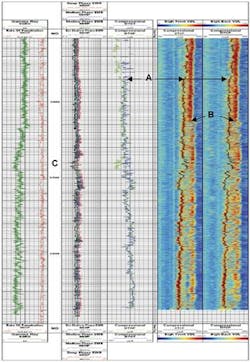
- Track one displays the gamma ray and rate of penetration curves in a log from a 24-in. hole section. Track two displays the four-phase shift resistivity curves. Track three plots the compressional Δt data with the blue curve representing the telemetered downhole picked data and the green curve as the post processed Δt from the memory waveform data. Tracks four and five are coherence VDLs derived from the front set of receivers and from the backset of receivers for the 12-15 KHz firings. The black curve overlaying both of the variable density logs is the semblance weighted average of the front and back composite compressional Δt picks from the recorded data.
Logging tool selection
The 9 1/2-in. LWD sonic tool was run in combination with 9 1/2-in. directional, annular and bore pressure, gamma ray, and propagation resistivity sensors. Additional detector tubes were added to the 9 1/2-in. gamma ray sensor to increase detection efficiency of the natural formation gamma rays and offset the borehole effects in large boreholes. The 9 1/2-in. propagation resistivity tool was also modified to minimize borehole effects. The 9 1/2-in. resistivity tool has its transmitter-to-receiver spacings extended to 18, 24, 30, and 42 in., minimizing borehole effects, particularly for the shorter-spacing measurements. Pressure-while-drilling tools were necessary to acquire borehole pressures for equivalent circulating density calculations of the drilling fluid, as this was to be, at the beginning, a riserless "pump and dump" operation.
Directional, gamma ray, resistivity, sonic, and downhole pressure measurements provide the basic real-time information for safely drilling and evaluating large boreholes. Resistivity, sonic, and annular pressure logs can provide pore pressure and overbalance information, while the gamma ray, resistivity, and sonic Δtc logs provide lithology, porosity, and water saturation information. Continuous surface-to-total depth sonic logs can also be valuable in seismic interpretation and time-depth correlation. Continuous logs are important in light of the cost and difficulty often associated with obtaining wireline sonic data in large surface holes.
Data acquisition
Pre-run planning is required to optimally configure the LWD sonic tool with a viable acceptance set parameters to process and determine the compressional Δt while downhole. Along with a refracted formation compressional wave, large diameter boreholes will support additional modes. A variable density log (VDL) in track four showed a compressional arrival and both fluid and leaky-p modes in a 30-in. hole section. Leaky-p modes exist between the formation's compressional velocity and the borehole fluid's velocity. The challenge is to discriminate, in real-time downhole, the formation compressional arrival from that of the fluid and leaky-p modes.
A closer look at a semblance plot showed more than one coherent event in the acquisition. There is a discernable compressional arrival as well as coherent events slower and later in time. The slower events are those of the fluid speed, in this case seawater, and compressional leaky modes. The snapshot was taken from a section of the well where the modeling and these field observations suggest a significant fluid and leaky mode contribution. A snapshot deeper in the well showed a more discernable or separated, faster, compressional arrival with less of a leaky-p mode contribution.
While the intention was to acquire both memory and real-time telemetered compressional data, there was some further optimization of real-time pick parameters or time "windows" programmed to the downhole tool after the initial run. Before running in the hole, the LWD sonic tool was programmed with a transmission input range for the anticipated compressional velocities, which ENI expected to encounter during the logging run. The tool was programmed to "look" for the point with the highest semblance for each acquisition series within a given window. Especially critical is the selection of the upper cutoff of this transmission range when the formation compressional slowness is just less than the leaky-p and fluid modes. An understanding of the formation refracted compressional, fluid, and compressional leaky mode velocities are beneficial in selecting the downhole pick parameters. The tool transmitted a computed semblance-weighted average from four Δtc determinations from the front and back arrays acquired from the high and low frequency firings. The transmitted points don't necessarily originate from the compressional arrival from the formation, but rather from the highest coherent event that was detected in the real-time acceptance window. Therefore, pre-job planning and review of offset data aids greatly in the selection of an optimal acceptance window. Information from the pre-job planning sessions enabled the team to decide on the best possible windows that will focus the tool's search area in the range of the anticipated compressional arrival while not allowing the tool to search a slowness range that is too wide and that would allow the sensor to pick and to telemeter other, highly coherent, but unwanted arrivals.
Data analysis
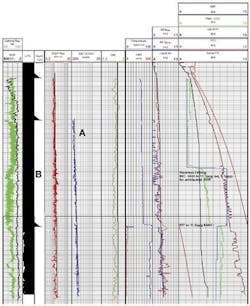
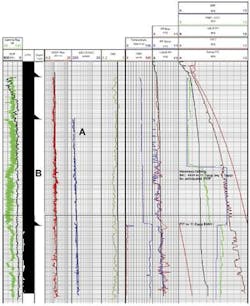
Data reflected optimized transmission window setups for the large top hole section based on the knowledge gained from previous runs to and offset information to pick the formation compressional arrival as soon as compaction became apparent (point A). At the point of compaction, telemetered real-time data closely matched the post-processed data as shown in track three. The increase in compressional velocity indicates sediment compaction has begun to occur. From this point forward in the well, if a porous permeable zone is drilled, the possibility of a shallow drilling hazard is significant. With a compaction trend verified, ENI operations chose to "mud up" in advance to better contain the possible shallow water flow (point C) encountered in the previous well. The change in drilling fluid at the mud-up point can be seen in the semblance VDL (point B) with slower arrival of the fluid mode.
By mudding-up in advance of the shallow water flow, ENI saved nine hours of rig time compared with the previously drilled well and was able to place the casing point 78 ft deeper in the section than on the offset well. The composite pore pressure profile plot indicates compaction (at point A) and the shallow water flow (point B). The section of the anticipated shallow water flow was drilled riserless with an 11.5 ppg drilling fluid. The mud weight curve (blue curve in the far right hand track) indicates the pressure in the hole would have been exceeded the fracture gradient with a continual mud column to the surface (with a riser). Pressure-while-drilling data proved valuable in computing and monitoring the equivalent mud weight in the hole and ensuring that the fracture gradient was not exceeded.
null
Plan ahead
In high-risk deepwater operations, significant consideration must be given to selection of the LWD services required for the well, and close attention must be paid to the configuration of the logging suite. A well thought out organizational structure must be defined and communicated through out the entire asset team, contractors, and partners so that there is a clear-cut, well-defined decision-making and reporting process. Pre-well risk assessment and real-time monitoring and interpretation of ongoing operations are critical to insuring a successful outcome. This paper demonstrated, for the first time, the real-time operation of a 9 1/2-in. acoustic LWD tool in identifying the potential for – and avoidance of – a deepwater drilling hazard.
Acknowledgements
The authors would like to thank ENI Petroleum and Sperry-Sun Halliburton management permission to write and present this paper.
For a complete list of references, please contact Ron Deady, at [email protected].