Long-term production fears driving renewed interest in ultradeepwater exploration
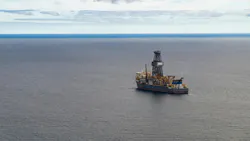
Steep production declines facing the world's 30 largest E&P companies are driving renewed investment in ultradeepwater frontier exploration, according to analysis by Wood Mackenzie.
The upstream industry overall faces a 300 Bbbl oil shortfall by 2050, the consultants predict.
Fields currently onstream are only likely to generate 700 Bbbl of the almost 1,000 Bbbl required to satisfy cumulative liquids demand through 2050 under Wood Mackenzie's base case without new discoveries or field extensions.
Exploration has an important part to play: the majors are taking majority ownership positions in frontier prospects to secure promising resources that could displace higher-cost production.
For example, bp holds 100% equity in last year’s deepwater Bumerangue oil, gas and condensate discovery in the presalt Santos Basin offshore Brazil.
Seven majors and some NOCs, including Petrobras, PETRONAS and TPAO, have the technical capability for ultradeepwater operations at depths above 1,500 m, the consultants noted, along with the willingness to take risks.
And independents such as Murphy Oil, APA Corp. and Woodside are increasingly operating in deep water.
Between 2021 and 2025, the industry’s average expenditure across 633 exploration wells drilled was $19 billion/year, with investment remaining stable despite near-doubling of rig day rates.
Some of the non-operating partners, such as QatarEnergy, provided additional capital through joint ventures offshore Brazil, Namibia, Cyprus and Republic of Congo.
“The first four big wells we tracked in 2026 came in dry—that’s the game, and players know the risks," Andrew Latham, SVP of Energy Research at Wood Mackenzie, said. “When ultradeepwater exploration works, single discoveries like Bumerangue generate many billions in value. Companies with deepwater expertise are taking concentrated equity positions because the economics work at $65 Brent.”
Most of the ultradeepwater drilling is currently driven in areas where the majors delivered breakthrough finds, such as ExxonMobil offshore Guyana, Eni in Côte D'Ivoire, Cyprus and Indonesia, bp in Brazil, and TPAO in the Black Sea.
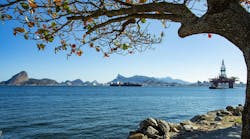 oil and gas operations offshore Brazil
But frontier exploration is also now extending to little explored basins such as Brazil's Foz do Amazonas and extensions of existing plays offshore Angola and Suriname.
Wood Mackenzie has identified 23 high-impact wells that could be drilled this year.
Among these are Petrobras' Morpho-1 (800 MMboe), which could confirm the potential of the Foz do Amazonas Basin. A successful outcome to Equinor's S-M-1378-1 in the Santos Basin could support the viability of presalt microbial carbonates beyond the Bumerangue discovery.
About the Author
 Jeremy Beckman
Jeremy Beckman
Staff Writer / Editor, Europe
Jeremy Beckman has been Editor Europe, Offshore since 1992. Prior to joining Offshore he was a freelance journalist for eight years, working for a variety of electronics, computing and scientific journals in the UK. He regularly writes news columns on trends and events both in the NW Europe offshore region and globally. He also writes features on developments and technology in exploration and production.