Ultra deepwater increases flow assurance challenges
New technology takes up the gauntlet
Chris Houston
Nalco
Judy Maksoud
International Editor
Over the past ten years, flow assurance has become a critical concern for deepwater project developments. While oilfield chemicals have been in use since the early 20th century, in areas ranging from the US to Azerbaijan, Venezuela, and Indonesia, the onset of deepwater exploration and production has changed the nature of oilfield production chemical applications.
Previously, oilfield production chemical applications were primarily onshore or in shallow water offshore. Oilfield chemicals were used to treat generally mild conditions and were not required to withstand high-temperature/high-pressure (HT/HP) environments.
Now, deepwater operations are changing the game of oilfield production chemicals, requiring significant innovation, as well as modifications to the existing technology, to be effective. Traditional “onshore” chemistries are not viable under the substantially higher pressures and wellhead and seabed temperatures that range from 275° F to 35° F. Additionally, injecting chemicals into umbilicals over 25 mi requires a rigorous chemical approach to ensure flow.
Since the ability to remediate deepwater production systems is both costly and time consuming, the benefits of chemical inhibitors are magnified in deepwater. This change in operating environment has led to new technology from oilfield production chemical service companies.
Flow assurance options
The deepwater environment is extremely conducive to hydrate formation. Low dosage hydrate inhibitors (LDHIs) are an example of the new chemistries that address the issues deepwater production presents. LDHIs have been under research since the mid 1980s, but commercial applications have seen an exponential increase over the past ten years. The potential application of an LDHI program starts with a systematic approach that involves three steps: deepwater system assessment, simulating hydrate formation conditions, and lab testing. It is estimated that there are more than 100 ongoing LDHI applications worldwide with new projects being added weekly.
While LHDIs can remedy hydrate formations, wax and asphaltene inhibitors have also become critical to flow assurance in deepwater. Many wax inhibitors employ polymers that can be very viscous or solid at room temperature, which makes understanding the effects of these products at cold seabed temperatures, as well as HT/HP conditions, critical.
Deepwater projects often have a wide temperature range, with wellhead temperatures in the 250°-300° F range to seabed temperatures of around 35° F. Early deepwater wax inhibitors attempted to ensure flow by lowering the active component percentage in the product. Unfortunately, this decrease in activity (by roughly 50%) also diminishes the cost effectiveness of the product.

New deepwater specific wax inhibitors can solve this problem because they perform under a wide range of temperature and pressure conditions. Nalco uses a new polymer-based system (introduced in 2003) that does not have to be diluted and therefore reduces transportation and storage costs in the deepwater. The new polymers have been used in a number of deepwater projects in the Gulf of Mexico and in West Africa on projects offshore Nigeria and Angola.
Testing
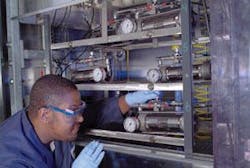
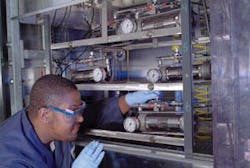
Developing new oilfield chemistry has required innovations in laboratory testing to closely simulate the deepwater environment. Oilfield production chemical service companies have spent millions of dollars to provide the necessary deepwater testing apparatus to simulate deepwater conditions. Field condition simulation tools, such as autoclaves and rocking cells, are now necessary to provide LDHI application information at varying water cuts, salinities, and pressures. Flow loops, which can simulate pipeline fluid flow, aid in mimicking the deepwater conditions under which the products must be functional.
More deepwater projects are also using seawater flooding that will result in potential scale formation and require sophisticated scale inhibitor treatment programs to prevent flow assurance issues. Recent innovations in scale monitoring use a quartz-based crystal that is sensitive to microscopic inorganic deposition. This real-time process allows scaling problems to be predicted and controlled on site by determining brine stability as well as other crucial scaling tendency parameters. The result is an accurate method of constantly optimizing scale inhibitor chemical dosage as well as reduced downtime during sample transfer between the field and the lab. Remotely located deepwater projects can realize substantial savings from these two benefits alone.
Learning about the issues
While deepwater production has required significant advances in flow assurance technology, it also requires that the service personnel who provide continuous support to deepwater facilities have a secure understanding of flow assurance issues. Service companies like Nalco have created an innovative oilfield chemistry training curriculum, known as “CAPEX College,” to further educate personnel on implementing flow assurance programs in the deepwater.
Introducing new oilfield chemical technology has always been a meticulous process, and some operators are hesitant to test new technology until it is proven in the field. In deepwater, this issue is magnified because operators are even more conservative about being the first company to use a new chemical technology that could potentially impact production.
However, some operators have become more progressive in the development of new oilfield production chemical technology. Nalco worked with BP in developing its new LDHI technology, Freeflow AA. Project goals included accelerating well startup, improving logistics, reducing chemical costs, and improving the development’s overall health, safety, and environmental profile.
BP’s Horn Mountain field at 5,400-ft water depth in the Gulf of Mexico is in Mississippi Canyon blocks 126 and 127, about 84 mi. from Venice, Louisiana. Horn Mountain is one of the world’s deepest free-floating spar production systems, producing more than 65,000 b/d of oil and 68 MMcf/d of gas from eight producing wells.
Using Freeflow AA, BP reaped significant benefits at Horn Mountain from faster well startups and lower volume, lower cost hydrate inhibitor treatments in comparison with the older technology, which was methanol. Methanol requires significantly higher dose rates and longer injection times. BP’s application of Freeflow AA (used at less than 2% versus 20-30% for methanol) reduced downtime on well startups. At Horn Mountain, startup for the first two wells brought online with methanol required 33 and 36 hours respectively. The remaining six wells, brought online using Freeflow AA, required only four to six hours each, resulting in more than 85% reduction in start-up time.
Overall, production was brought onstream more quickly and resulted in more than 50,000 barrels of additional oil production annually. The new system provided the project a return on investment of more than $150,000 per well startup.
More recently, refiners have become less tolerant of methanol content in crude and have begun to penalize operators that supply crude with methanol by upwards of $1-$2 per barrel.
Interestingly, methanol also posed problems during last year’s hurricane season. GoM pipelines had to bring fields with crude containing methanol online much more slowly than those using AA to minimize methanol content.
The future begins today
Most previously employed oilfield production chemistry was suited for onshore or shallow water application. As deepwater exploration and production continues to alter the principles of production, oilfield chemical products must continue to evolve to handle the more stringent conditions and logistics associated with these projects.
With the move into ultra deepwater, oilfield production chemical companies will see an ongoing need to further develop new products that can be used in lower dosages and maintain good safety and environmental profiles.•
As flow assurance obstacles continue, and even amplify, in ultra deepwater, oilfield production chemical service companies will be responsible for developing new technologies and creating new tools for deepwater production systems. Nalco is using its global application expertise to develop a range of customized products for deepwater applications.
Hydrates
Hydrate problems vary based on field conditions. Low dosage hydrate inhibitors (LDHIs) offer customers options for building project specific solutions. Specialized testing programs use autoclaves and rocking cells to simulate severe deepwater conditions to evaluate a company’s LDHI selection in the lab.
Scientists are also designing “green LDHI chemistries” with a focus on products that meet North Sea toxicity and biodegradation regulations.
Scale
Nalco’s real-time scale monitoring instruments use an ultra-sensitive quartz-based crystal to predict the potential for scale formation. The scale treatment cost and the potential well remediation cost are reduced by continually optimizing the scale inhibitor treatment program.
In addition, the company’s Access Chemical Delivery System uses a range of products to ensure longer scale squeeze treatment life, resulting in less deferred oil production.
Corrosion
The growth in global energy needs has resulted in field-life extensions for many oilfield projects, making corrosion inhibition and asset integrity a high priority. Inhibitors are being developed that are successful in environments with high levels of sour gas and high-temperature/high-pressure deepwater conditions.
Growing concerns about safety, health, and environmental hazards has led to extensive research that allows corrosion inhibitors to be combined with other inhibitors or additives to improve the quality of overboard water discharge.
Emulsions
Emulsion breakers separate crude oil and water. Using a system of probability and based on years of testing, the company is working on a statistical bottle testing (SBT) approach to allow scientists to predict the types and quantities of emulsion breakers required to break a particular crude emulsion.
Wax
The traditional makeup of many wax inhibitors makes them viscous at room temperature. In the near freezing subsea climate, wax inhibitors must perform at a temperature of 4o Celsius. Nalco’s flow assurance research team has introduced a line of inhibitors that addresses those needs.
Performance standard
Nalco has offered the industry a performance standard through a program that tests products for their ability to flow under typical deepwater conditions. In the program, select specialty chemicals are subjected to a series of tests under extreme pressure and temperature conditions before they can be certified for umbilical use.
