Buoy to serve as artificial seabed off China
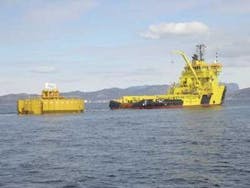
First use of the Atlantis artificial buoyant seabed (ABS) for deepwater drilling is set for a location off China later this year. In February the owner of the technology, Atlantis Deepwater Technology Holding (ADTH), was finalizing terms with China Oilfield Services Ltd. (COSL), building on a letter of intent (LOI) signed by the two parties last October.
Under the LOI the Chinese contractor is paying several million dollars to upgrade the prototype ABS unit so that it can be used for deepwater drilling off China. COSL also plans to take an equity position in ADTH, reports managing director Pål Norheim. In addition, the two parties are discussing a possible 50/50 joint venture for marketing the technology in the South Asia/Pacific region.
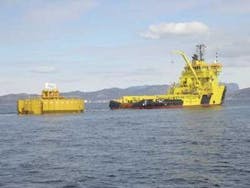
The ABS concept involves use of a submerged buoy to create an artificial seabed, in turn reducing the depth of deepwater drilling. Anchored by the 20 in. casing from the well, the buoy is installed at a water depth of 200-300 m, where it is used as a platform to install the wellhead and perform drilling operations. This opens the way to using more lower rated shallow-water rigs, thereby deriving savings of up to 50% in drilling deepwater exploration and development wells, ADTH claims.
Fjord trials
The prototype buoy, which weighs some 350 tons and has a diameter of 16 m, performed well in towing and submergence tests in Norway’s Gands Fjord in 2003. These trials formed part of a $6.4 million Demo 2000 project funded by BP, Shell, and ADTH. The current upgrading program includes the installation of more valves and piping, and the provision of a permanent control system, control umbilical, and winch for deploying it.
The ABS unit will be deployed from COSL’sNanhai 5 semisubmersible and will first be used to drill an exploration well at a defined location south of Taiwan in 650 m water depth late this summer, Norheim says. Further wells should follow in water depths of 1,500-2,000 m.