Artificial seabed extends deepwater rig capability
Nick Terdre
Contributing Editor
A trial in China of the Atlantis artificial mid-water seabed system has been completed successfully, opening the way for an application in deepwater drilling.
The technology, developed by Atlantis Deepwater Technology Holding (ADTH) over the past nine years, provides an artificial seabed which is installed at a relatively shallow depth, thus making it possible to use older rigs for deepwater operations.
The opportunity for the trial was provided by ADTH’s partner, China Oilfield Services Ltd. (COSL), which made a crucial contribution to qualifying the technology, according to Arne Johansen, president of ADTH. The two companies have a jointly owned venture established in 2005, Atlantis Deepwater Orient, to market the technology in the Far East and Australia.
Submersion tests
Initial development and construction of the first Atlantis unit took place in Norway with the backing of the Norwegian government’s Demo 2000 program. This phase included towing and submersion tests in 2003. Following the establishment of the joint venture with COSL, the unit was transported to China where further maneuvering and submersion tests were conducted last year.
The Atlantis unit is essentially a large buoy, 16 m (52.5 ft) in diameter and 7 m (23 ft) high, with a circular opening in the middle. Buoyancy elements are attached round the circumference, giving it a total diameter of 20 m (65.6 ft). Including these elements, the system weighs 360 metric tons (397 tons) in air and occupies a total volume of 1,500 cu m (52,972 cu ft). As it has positive buoyancy, it is loaded with 30 metric tons (33 tons) of chain weights to assist submersion.
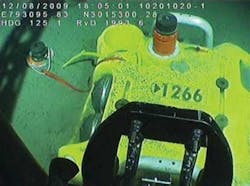
April’s trial was intended to demonstrate the deployment of the unit beneath a drilling rig, running of casing to the seabed, and the execution of drilling. This program was performed in April in the South China Sea using COSL’sNanhai V second-generation semisubmersible, which has a drilling depth capacity of 400 m (1,312 ft). Water depth at the site was around 500 m (1,640 ft).

Equipment installed on the rig consists of a 10-ft (32.8-ft) control container, an umbilical and winch, an air hose and winch, and compressors. Altogether it occupies space equivalent to about four 10-ft containers, says Johansen.
The rig first ran sections of conductor to the seabed, cemented them, and then ran surface casing into the seabed on which a wellhead was installed. The Atlantis unit then was maneuvered into position underneath the rig by two anchor-handler vessels and the wires to which it was attached were transferred to the rig.
The outer casing, or tieback string, subsequently was run down to the wellhead on the seabed and hung off a wellhead installed on the Atlantis unit. Buoyancy in the unit was increased to raise it in the water and tension the tieback string. Finally, the rig ran the drilling riser down to the Atlantis unit, and then ran the drillstring, drilling a short distance into the seabed.
The operation went smoothly and exactly to plan, says Johansen. It was important to demonstrate that the unit could be installed and drilling performed without hindrance by the strong currents at the location – about three knots on the surface and one knot in the water column at the depth where the unit was installed. Stability depends on tensioning the tieback string to generate the required overpull.
The first proper Atlantis well may come via COSL, whose majority owner, China National Offshore Oil Corp. (CNOOC), has awarded ADOL a letter of intent to study a deployment on a planned well in around 1,500 m (4,921 ft) water depth.
But the development has been followed with interest over the years by others in the offshore industry, and studies are under way for numerous companies, including one of the majors. A potential user is StatoilHydro, one of ADTH’s major shareholders, which considered a trial of the technology at one point.
The Atlantis system makes savings possible on deepwater wells. These vary from well to well, but ADTH’s calculations suggest as much as 30% is possible compared to the cost of a deepwater rig, Johansen says. The major saving comes from the difference in day rates between a shallow water rig and a deepwater unit. Depending on the state of the rig market, this could well be in the range $100,000-200,000. For a drilling operation lasting several weeks or months, that can amount to a substantial sum.
There are other advantages, for example, with respect to rig disconnection in the event of an approaching typhoon or hurricane – highly relevant in areas such as the Far East and the Gulf of Mexico. While in a conventional operation the rig needs to pull its riser all the way from the seabed, with the Atlantis there is a much shorter length of riser to pull, resulting in a much faster disconnect.
Moreover, as a certain amount of time is needed to complete the disconnection before the storm arrives, wells drilled with the use of an Atlantis unit are less likely to be interrupted by alarms that turn out to be false but which can add considerably to the cost.
ADTH is looking to press ahead with plans to build a second Atlantis unit. It likely will feature a slightly different design, with the buoyancy elements on top. The dimensions have yet to be fixed.