Renewed market optimism will be short-lived, consultant warns
Offshore staff
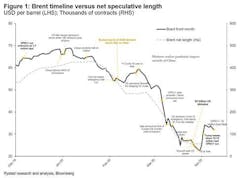
OSLO, Norway – The proposed 10 MMb/d cut by OPEC+ for May and June will keep the world from testing the limits of storage capacity and save oil prices from falling into a deep abyss, but it will still not restore the desired market balance, according to Rystad Energy.
Just hours before delegates stepped into the (again virtual) closed meeting, Brent was fluttering in the mid-$30s, seemingly oblivious to the fact that even if a 10 MMb/d cut is agreed upon, or even in the best-case scenario 15 MMb/d if the US, Canada, Norway and Brazil join forces, an excess of supply of the magnitude of 5-10 MMb/d will remain, and will need to be stored.
Rystad Energy currently estimates that the demand-supply imbalance for April 2020 is 27.4 MMb/d, an amount that is physically impossible for the oil market to absorb. So, while the unprecedented gesture by OPEC+ is, without doubt, saving the market from the worst imaginable collapse by buying producers precious needed time to adjust and by removing strain from the storage infrastructure, one should not be overly optimistic. The proposed OPEC++ cuts alone cannot reverse the deep contango curve of Brent prices in a meaningful or lasting way as storage need to remain economical to handle the standing oversupply. The consultant believes that the renewed market optimism will be short-lived.
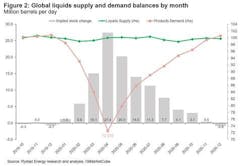
Although the proposal is nowhere close to restoring the 2Q 2020 balances, it does buy time. Rystad estimates that the difference between a “no deal” and 10-15 MMb/d cut deal gives the oil market an additional two to three months before filling crude storage capacity “right to the top.”
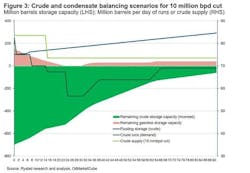
The supply cut will give demand time to improve as quarantines in parts of Europe are partially lifted, but more importantly, it gives E&P companies more time to prepare supply chains and activity plans, reduce costs and avoid an uncontrolled dismantling of parts of the industry. In this scenario, crude prices would still come under pressure, but we may bottom at $25 Brent for 2Q 2020 average, and see lower price spike risk down the road.
Global storage is already close to being filled to the brim. The world has around 7.4 Bbbl crude and products in onshore storage, including 1.3 Bbbl currently onboard tankers at sea. The consultant estimates that on average 79% of the world’s oil storage capacity is already full. Therefore, the analyst believes that the theoretical available storage capacity is limited to 1.5 Bbbl onshore for crude and products combined. The operational available capacity, unfortunately, is below the theoretical maximum as tanks cannot be filled 100% and not all market participants have equal access since most available capacity is concentrated in the US and China.
According to the Rystad bottom-up supply database, total liquids production in OPEC was 30.25 MMb/d in March 2020, and without taking into account any future cuts, is on track to grow to 31.65 MMb/d in April 2020, buoyed mostly by Saudi Arabia’s export spree. So, on the conservative side if Russia takes on an estimated 2 MMb/d of cuts, that means the share of cuts from OPEC members would translate into cutting 26% of total production. For comparison, at the last December 2019 meeting, a total 1.168 MMb/d was pledged in cuts when OPEC crude production stood at 26.314 MMb/d, so a less than 5% cut of total production.
Ever since President Trump sent oil prices soaring with one tweet about the potential OPEC+ production deal, the White House has been quite non-committal in joining along in these supply cuts, even though US shale is a clear target should oil market destruction escalate any further. US companies, such as Pioneer Resources and Parsley have spoken up about 20-30% production cuts, but majors such as Chevron insist it should be left to market forces. Canada, which has already shuttered several oil sands projects as the oil price ticks lower, is now looking at nearly 1.1 MMb/d of curtailments in 2Q 2020, and has expressed interest in joining a global oil market management program.
There are still many important questions that remain unanswered. Despite the many unknowns, one thing certain with this deal is that OPEC countries are once again coming to the rescue, Rystad said.
We will know more once the “emergency” G-20 meeting takes place today and whether other non-OPEC producers are ready to take similar unprecedented action.
04/10/2020