New Fortress Energy strikes debt restructuring deal
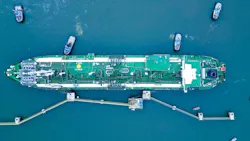
New Fortress Energy (NFE), the LNG-to-power developer founded by billionaire Wes Edens, announced a major debt restructuring on March 17, 2026, avoiding a traditional US bankruptcy filing while dramatically reshaping the company.
Under a Restructuring Support Agreement (RSA) backed by a majority of creditors, NFE will pursue a consensual UK Restructuring Plan (UK RP)—one of the largest of its kind—launching in April with court sanction expected by Q3 2026.
The process splits the firm into two entities: privately held BrazilCo, owned by creditors and encompassing NFE’s Brazilian terminals, power plants, and operations; and publicly traded “New NFE,” retaining Caribbean, Puerto Rico, Mexico, and other global LNG-to-power assets.
The deal slashes “New NFE” corporate debt from approximately $5.7 billion to $527.5 million. Creditors receive new debt, up to $2.5 billion in preferred equity (with escalating payment-in-kind coupons), and 65% of common equity.
Existing shareholders are diluted to 35% of “New NFE” common stock, with potential further dilution if preferred shares convert after three years. NFE shares, which traded near $60 in 2022, closed around $0.70–$0.80 in late March 2026 following the announcement.
Edens hailed the transaction as a “landmark milestone,” saying “New NFE” will emerge as a “capital-light, low-leverage business” generating significant free cash flow from matched long-term supply and demand, requiring little additional capital. The UK process was chosen, management said, to preserve greater value than a US Chapter 11 filing might have allowed.
The restructuring caps years of financial strain. NFE reportedly never generated positive free cash flow in its history and recently reported $1.3 billion in losses over four quarters. It carried roughly $8.9–9.3 billion in total debt amid project delays and execution challenges.
Critics, including the Institute for Energy Economics and Financial Analysis (IEEFA), point to deeper issues revealed in filings: accounting misstatements and internal control weaknesses since 2023; poor performance at its sole operating Fast LNG unit off Altamira, Mexico (high ~20% feedgas losses and elevated operating costs); abandonment or stalling of a second Altamira project; and more than $1 billion in dividends paid to shareholders and insiders from 2020–2025 despite negative cash flows.
NFE’s signature Fast LNG technology—modular offshore platforms using repurposed jackup rigs or fixed jackets plus a separate floating storage unit—delivered one operational facility in Mexico that has loaded multiple cargoes, sometimes exceeding nameplate capacity. Many other ambitious Gulf of Mexico plans, however, quietly faded.
The company is framing the outcome as a reset toward stability. Creditors appear supportive, and operations are expected to continue uninterrupted. Still, success depends on court approvals, regulatory clearances, and New NFE’s ability to deliver promised cash flows in a capital-intensive industry. Existing shareholders will be diluted to 35% of common equity in New NFE, with potential for further dilution.
About the Author

Bruce Beaubouef
Managing Editor
Bruce Beaubouef is Managing Editor for Offshore magazine. In that capacity, he plans and oversees content for the magazine; writes features on technologies and trends for the magazine; writes news updates for the website; creates and moderates topical webinars; and creates videos that focus on offshore oil and gas and renewable energies. Beaubouef has been in the oil and gas trade media for 25 years, starting out as Editor of Hart’s Pipeline Digest in 1998. From there, he went on to serve as Associate Editor for Pipe Line and Gas Industry for Gulf Publishing for four years before rejoining Hart Publications as Editor of PipeLine and Gas Technology in 2003. He joined Offshore magazine as Managing Editor in 2010, at that time owned by PennWell Corp. Beaubouef earned his Ph.D. at the University of Houston in 1997, and his dissertation was published in book form by Texas A&M University Press in September 2007 as The Strategic Petroleum Reserve: U.S. Energy Security and Oil Politics, 1975-2005.