OSRL introduces shallow-water well control capability
Oil Spill Response Ltd (OSRL) has added a new shallow water deployment capability for managing complex well-control scenarios globally.
The association introduced the development to delegates at the SpillAsia 2026 conference in Singapore.
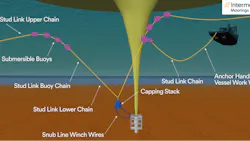
It integrates OSRL’s Split Lowering System (SLS), co-developed with InterMoor, with the new Snub Line Winch System (SLWS), developed by Oceaneering.
In combination, these technologies enable running of a capping stack when surface conditions render conventional vertical access unsafe or impracticable OSRL explained.
The SLS allows the stack to be deployed, positioned and lowered from an offset location outside the hazardous surface plume, with the SLWS providing controlled final alignment and landing on the BOP or wellhead.
Vania De Stefani, the association’s CEO, said the combination “helps support safer, controlled capping stack deployment in challenging shallow-water scenarios and reinforces the value of collaborative preparedness across the industry.”
Other benefits are said to include:
• Improved control during the final landing sequence
• Can be deployed in water depths from 75 to 600 m
• Rapid mobilisation from OSRL’s Norway base by sea or air
• Supports installation without a seabed interface of components.
Recently, OSRL also sent its Guyana capping stack to the Subsea Response facility at the Emergency Response Base, at VEHSI in Guyana.
As activity expands across the Equatorial Margin, the new base will strengthen OSRL’s regional presence and provide access to preparedness, training and response for members and other interested parties in Guyana and the wider region.
Earlier, the OSRL had relocated its Global Rapid Response System to VEHSI, along with associated subsea well intervention equipment.
The capping stack is one of six located around the world, available to support rapid deployment and response readiness to local subsea well control incidents.
About the Author
 Jeremy Beckman
Jeremy Beckman
Staff Writer / Editor, Europe
Jeremy Beckman has been Editor Europe, Offshore since 1992. Prior to joining Offshore he was a freelance journalist for eight years, working for a variety of electronics, computing and scientific journals in the UK. He regularly writes news columns on trends and events both in the NW Europe offshore region and globally. He also writes features on developments and technology in exploration and production.