Compact BOP valve opens access to broader range of intervention tasks
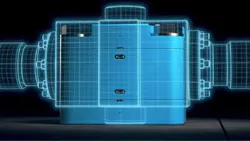
Unity Well Integrity has developed a compact preventer (BOP) valve said to measure one-third the width of established systems.
The Unity Qb (cube) valve is designed for intervention in space-constrained areas normally inaccessible to standard BOP equipment from offshore platforms, and could support wireline, slickline, coil tubing and future drilling applications.
Conventional BOPs, the company explains, are typically large and cross-shaped in design, which dictates where they can be placed on a platform. During a hydrocarbon leak, they seal or shear using rams that move in a straight line, clamping in from opposite sides of the well bore.
With the Unity Qb, the rams rotate around a central cartridge within the housing. Effectively, the company claims, this makes the technology a hybrid between a conventional BOP and a ball valve.
It is said to be capable of performing all conventional BOP functions in a much tighter space, enabling installation of a BOP where typically only a shear-seal ball valve could fit.
Its pressure rating of 10,000 psi is twice the figure for Unity's established compact shear valve (CCS), but with the same weight. This means it can be deployed on higher-pressure wells that lower-rated equipment cannot service, the company claims.
In addition, it is stackable in single, dual or triple configurations.
Unity CEO Gary Smart said: “The future of well intervention will be defined by technologies that deliver more capability from a smaller footprint…We recognised that the size and complexity of conventional BOP systems were increasingly constraining operations in space-limited environments…
“By unlocking access to constrained work environments and creating greater flexibility in system design, Unity Qb has the potential to reshape how intervention operations are executed offshore. This innovation challenges established conventions and expands what's possible for our industry.
“Our CSS Valve will remain part of our offering, ensuring our existing fleet continues to support clients who need it. The new Unity Qb is intended to extend the range of interventions we can support, in addition to what we have already been delivering successfully for the last three decades.”
About the Author
 Jeremy Beckman
Jeremy Beckman
Staff Writer / Editor, Europe
Jeremy Beckman has been Editor Europe, Offshore since 1992. Prior to joining Offshore he was a freelance journalist for eight years, working for a variety of electronics, computing and scientific journals in the UK. He regularly writes news columns on trends and events both in the NW Europe offshore region and globally. He also writes features on developments and technology in exploration and production.