Yokogawa and ANYbotics partner to advance autonomous inspection robots
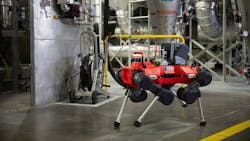
Yokogawa Electric Corp. and ANYbotics have signed a partnership agreement to integrate Yokogawa’s OpreX Robot Management Core (RMC) with the software stack powering ANYbotics’ ANYmal robotic inspection portfolio, including the ANYmal X explosion‑proof model.
The move aims to position the companies to deliver a unified, enterprise‑grade layer for managing mixed fleets of explosion‑proof and non‑EX inspection robots across the oil and gas, power, and metals industries.
While the companies have completed “multiple onshore trials” with customers, an offshore trial is in the planning stages, with schedule and scope “currently under discussion,” according to comments provided to Offshore. Results will be shared once publicly disclosable.
According to ANYbotics CEO Dr. Péter Fankhauser, the integration is designed to "improve safety, reduce downtime and drive operational excellence.”
Masaharu Maeda, Yokogawa Electric vice president and head of the Solutions Business Division, added, “By combining it with our AI‑based OpreX Plant Image Analyzer, we will contribute to promoting the digitalization of inspection work.”
What the integration does
Yokogawa’s OpreX RMC is designed to centralize the planning, execution and governance of robotic missions and to act as the management layer above heterogeneous robot fleets. When tied into plant control systems, data captured by robots can be used to trigger instructions and missions, enabling a stepwise path toward autonomous plant operations.
ANYbotics’ ANYmal platform is a ruggedized, IP67‑rated quadruped built for autonomous inspections in harsh environments. The lineup includes ANYmal D for general industrial use and ANYmal X, billed as the world’s first explosion‑proof legged inspection robot certified for ATEX/IECEx Zone 1. ANYbotics says it has conducted several deployments of a prototype ANYmal X and plans a formal launch later this year.
How it fits offshore
In detailed follow‑up responses to Offshore, Yokogawa outlined an architecture that maps cleanly to typical offshore automation environments:
- Robot Management Layer: OpreX Robot Management Core (RMC) orchestrates fleets and missions, consolidating robot‑collected data.
- Integration Hub: Yokogawa’s Collaborative Information Server (CI Server) brokers connectivity. RMC shares robot data with CI Server; conversely, CI Server can trigger robot missions in response to instrument alarms or other plant events.
- Protocol Coverage: CI Server supports OPC UA, MQTT, Modbus and ODBC, and includes control system drivers, enabling linkage into DCS/PCS and SCADA environments, and facilitating handoffs to data historians and CMMS platforms (e.g., PI/AVEVA, SAP, Maximo) via standard interfaces already present offshore.
This approach is intended to let operators treat robots as standard plant assets, ingesting inspection results into established historian and maintenance workflows while automating mission dispatch from the same alarm and event sources that drive operator rounds today.
Control of Work, SIMOPS and emergency procedures
Yokogawa also signaled a path to embed robotic inspections in permit‑to‑work and SIMOPS regimes. The company is exploring integration between OpreX RMC and the Control of Work (CoW) solution from Yokogawa RAP Ltd.
"This approach not only ensures proper governance of robot missions within existing permit workflows, but also enables advanced use cases such as robots verifying isolation/LOTO status in the field and feeding confirmation data back into the CoW system—strengthening procedural compliance and overall safety offshore," Yokogawa told Offshore in a written statement.
What’s next?
For the offshore sector, the near‑term milestones are the planned offshore trial and proof points on Zone 1 deployments at production facilities. If the integration performs as designed, operators could see a practical path to routine autonomous inspections, closed‑loop mission dispatch from alarms, and digitally verifiable CoW compliance, Yokogawa says, all while leveraging their existing control, historian and maintenance systems.
Exclusive content:
About the Author

Ariana Hurtado
Editor-in-Chief
With more than a decade of copy editing, project management and journalism experience, Ariana Hurtado is a seasoned managing editor born and raised in the energy capital of the world—Houston, Texas. She currently serves as editor-in-chief of Offshore, overseeing the editorial team, its content and the brand's growth from a digital perspective.
Utilizing her editorial expertise, she manages digital media for the Offshore team. She also helps create and oversee new special industry reports and revolutionizes existing supplements, while also contributing content to Offshore's magazine, newsletters and website as a copy editor and writer.
Prior to her current role, she served as Offshore's editor and director of special reports from April 2022 to December 2024. Before joining Offshore, she served as senior managing editor of publications with Hart Energy. Prior to her nearly nine years with Hart, she worked on the copy desk as a news editor at the Houston Chronicle.
She graduated magna cum laude with a bachelor's degree in journalism from the University of Houston.