Woodside’s VOPS software predicts rig motions in variable weather conditions
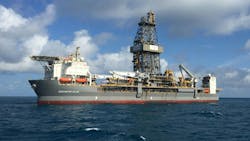
Woodside Energy is planning further developments of its Vessel Operability Planning Service (VOP).
This software has been used to support operations on five offshore drilling rigs, performing more than 20 exploration and decommissioning campaigns in recent years.
Woodside commissioned the development to address movement of its platforms and rigs in strong swells. The service is designed to provide accurate forecasts of motions in response to waves at the offshore location to strengthen safety and reduce weather-related downtime.
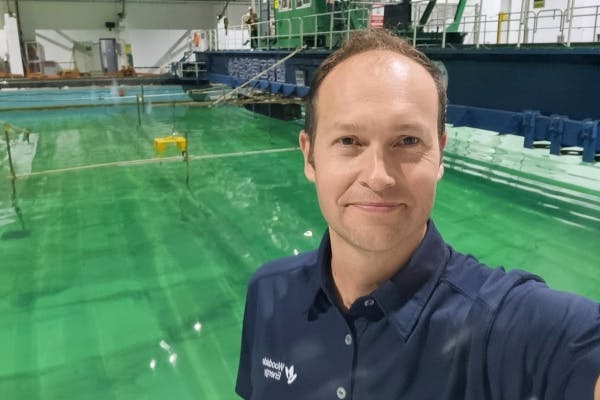
Ian Milne, Woodside senior metocean engineer, has been leading the development since joining the company in 2021. He is also senior research fellow at the University of Western Australia’s (UWA) ARC Transforming Energy Infrastructure through Digital Engineering (TIDE) hub, which is supported by Woodside’s FutureLab.
Woodside, via its academic partnership with UWA, has developed what it describes as a scalable, cloud-based solution tailored to its drilling and decommissioning needs.
“This provides bespoke predictions of rig movement using historical data and forecasts up to 10 days ahead,” Milne said.
Among the deliverables so far are earlier, more precise assessments of weather impacts on operations to minimize downtime for operational planning.
“The Minerva plug and abandonment campaign in the Bass Strait, for example, was able to progress blowout preventer preparations during mooring operations, knowing that the heave-to would be within acceptable limits,” he noted.
Another example is improved decision support, enabling quicker prediction of hazardous vessel motions that can affect sensitive equipment.
“This allows timely suspension and quicker resumption of operations, reducing non-productive time at sea,” he added.
VOPS’ predictions are designed to incorporate the full directional wave spectra and vessel response characteristics. And the measured rig motion data can be used for bias-corrected, probabilistic predictions.
To date, the software has supported more than 3,000 motion forecasts, drawing on more than 50,000 hours of field measurements.
Woodside and Transocean teams operating offshore Australia and in the US Gulf of Mexico have jointly used the service to derive real-time rig data, supporting developments including the prediction of rig offset (horizontal motions).
“This is particularly important for decommissioning in shallow waters with weak conductors, potentially reducing dependence on tethering and complex mooring systems.”
Other planned VOPS projects include investigating the use of AI to predict rig offset as well as wave basin-testing of semisubmersibles for improved operational guidance in long-period swells.